We need your help now

Support from readers like you keeps The Journal open.

You are visiting us because we have something you value. Independent, unbiased news that tells the truth. Advertising revenue goes some way to support our mission, but this year it has not been enough.

If you've seen value in our reporting, please contribute what you can, so we can continue to produce accurate and meaningful journalism. For everyone who needs it.


Alamy Stock Photo

Israel launches over 100 strikes against targets in Syria and occupies buffer zone along border

Egypt has condemned Israel’s taking control of the buffer zone, describing it as the “further occupation of Syrian lands”.

ISRAEL’S FOREIGN MINISTER Gideon Saar said today that his country had struck “chemical weapons” sites in neighbouring Syria, where rebel forces ousted president Bashar al-Assad over the weekend.

Speaking at a press conference, Saar said “we attacked strategic weapon systems like, for example, remaining chemical weapons or long-range missiles and rockets in order that they will not fall in the hands of extremists”.

Saar did not provide details about when or where the strikes took place.

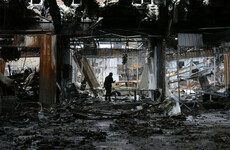
Rami Abdel Rahman who heads the Syrian Observatory for Human Rights told AFP that “Israeli warplanes launched over 100 strikes in Syria today, including on the Barzah scientific research centre”.  

An Associated Press journalist in Damascus reported airstrikes in the area of the Mezzeh military airport, south-west of the capital, on Sunday.

Israel has previously launched attacks on the airport and has carried out hundreds of airstrikes in Syria in recent years, targeting what it says are military sites related to Iran and Lebanon’s Hezbollah militant group.

Israeli officials rarely comment on individual strikes.

Syria agreed to give up its chemical weapons stockpile in 2013, after the government was accused of launching an attack near Damascus that killed hundreds of people.

But it is widely believed to have kept some of the weapons and was accused of using them again in subsequent years.

Israeli incursion

Saar has also said Israel’s military had taken over of the buffer zone along its border with Syria was a “limited and temporary step”. Israel already occupies much of the Golan Heights in Syria.

“This is a limited and temporary step we took for security reasons,” Saar said in a press conference at the foreign ministry in Jerusalem.

Israeli Prime Minister Benjamin Netanyahu announced on Sunday that he had ordered the army to “take control” of the zone after the fall of Assad.

Egypt has condemned Israel’s taking control of the buffer zone, describing it as the “further occupation of Syrian lands”. 

The incursions by Israeli forces “constitute a violation” of the 1974 disengagement agreement between Israel and Syria, a UN spokesman said.

The UN peacekeeping force deployed in the Golan Heights, known as UNDOF, “informed the Israeli counterparts that these actions would constitute a violation of the 1974 disengagement agreement,” said Stephane Dujarric, spokesman for Secretary-General Antonio Guterres.

He said that the Israeli forces that entered the zone were still present in at least three locations.

The United States, Israel’s closest ally, has said the occupation of the buffer zone must be temporary while defending the move. 

“This is a temporary action that they have taken in response to actions by the Syrian military to withdraw from that area. Now, what we want to see, ultimately, is that agreement fully upheld, and we’ll watch to see that Israel does that,” State Department spokesman Matthew Miller told reporters.

Asked if the United States was calling on its ally to pull out, Miller said the agreement reached after the 1973 Yom Kippur War “includes Israel’s withdrawing to its previous position.”

He declined to set a timetable, pointing to the fast-changing situation on the ground in Syria.

“Israel has said that these actions are temporary to defend its borders. These are not permanent actions, and so ultimately, what we want to see is lasting stability between Israel and Syria, and that means we support all sides upholding the 1974 disengagement agreement,” Miller said.

He voiced understanding for Israel’s actions, saying that the Syrian army had “abandoned its positions in the area around the negotiated Israeli Syrian buffer zone” and left a possible vacuum.

Syrian rebels reached Damascus over the weekend and overthrew Assad’s government following nearly 14 years of civil war, raising hopes for a more peaceful future but also concerns about a potential security vacuum in the country, which is still split among armed groups.

The rebels’ success brought an end to more than 50 years of rule by the Assad family. 

Israelis have welcomed the fall of Assad, who was a key ally of Iran and Lebanon’s Hezbollah militant group, while expressing concern over what comes next.

With reporting from AFP and Press Association

Readers like you are keeping these stories free for everyone...
A mix of advertising and supporting contributions helps keep paywalls away from valuable information like this article. Over 5,000 readers like you have already stepped up and support us with a monthly payment or a once-off donation.

Close
JournalTv
News in 60 seconds