We need your help now

Support from readers like you keeps The Journal open.

You are visiting us because we have something you value. Independent, unbiased news that tells the truth. Advertising revenue goes some way to support our mission, but this year it has not been enough.

If you've seen value in our reporting, please contribute what you can, so we can continue to produce accurate and meaningful journalism. For everyone who needs it.

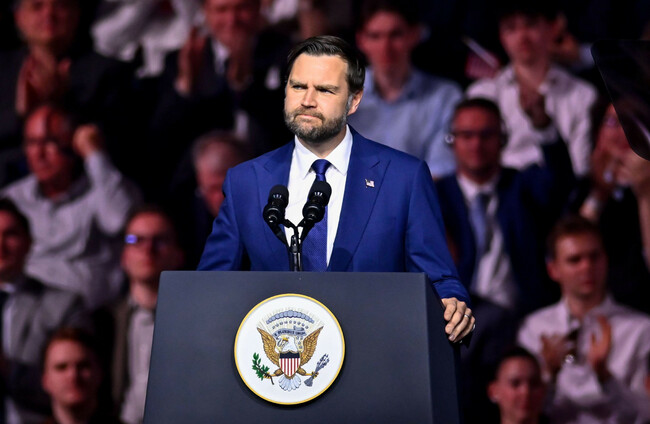
JD Vance speaks during pre-election rally in Budapest, Hungary, on 7 April, 2026. Alamy Stock Photo

US vice president JD Vance flies to Pakistan for peace talks with Iran

It comes as a tenuous, temporary ceasefire appears to be on the precipice of collapsing.

US VICE PRESIDENT JD Vance will head to Pakistan to lead mediated talks with Iran today, after Donald Trump tasked him with finding a resolution to the conflict.

Vance, the member of Trump’s inner circle who has seemed to be the most reluctant defender of the conflict, has long been sceptical of foreign military interventions and outspoken about the prospect of sending troops into open-ended war.

The vice president’s visit to the Pakistani capital of Islamabad comes as a tenuous, temporary ceasefire appears to be on the precipice of collapsing.

The chasm between Iran’s public demands and those from the US and its partner Israel seems irreconcilable.

Vance is joined by Trump’s special envoy Steve Witkoff and son-in-law Jared Kushner.

They both took part in three rounds of indirect talks with Iranian negotiators aimed at settling US concerns about Tehran’s nuclear and ballistic weapons programmes and its support for armed proxy groups in the Middle East before Trump and Israel launched the 28 February war against Iran.

The White House has provided scant detail about the format of the talks – whether they will be direct or indirect – and has not provided specific expectations for the meeting.

But the arrival of Vance for negotiations marks a rare moment of high-level US government engagement with the Iranian government.

Since the Islamic Revolution in 1979, the most direct contact had been when president Barack Obama, in September 2013, called newly elected Iranian president Hassan Rouhani to discuss Iran’s nuclear programme.

Almost immediately after the White House and Iran announced a temporary ceasefire on Tuesday evening, the sides found themselves at odds over the terms of the truce.

Iran insisted that an end to the Israeli war in Lebanon was part of the ceasefire. But Israeli prime minister Benjamin Netanyahu and Trump said the truce did not cover Lebanon and the Israeli operations there continued.

The US, meanwhile, demanded that Iran make good on reopening the Strait of Hormuz.

The Islamic Republic had closed the critical shipping waterway in response to Israel’s intensifying attacks against the Hezbollah militant group in Lebanon.

Trump last night said Iran was “doing a very poor job” of allowing oil tankers to pass through, writing on social media: “That is not the agreement we have!”

White House spokeswoman Anna Kelly said Vance, Witkoff, Kushner and Secretary of State Marco Rubio “have always been collaborating on these discussions” and said Trump was optimistic that a lasting deal could be reached during the two-week ceasefire.

“President Trump has a proven track record of achieving good deals on behalf of the United States and the American people, and he will only accept one that puts America first,” Kelly said.

On Wednesday, Vance dismissed speculation that the Iranians requested that he join the talks, telling reporters: “I don’t know that. I would be surprised if that was true. But, you know, I wanted to be involved because I thought I could make a difference.”

Close
JournalTv
News in 60 seconds