We need your help now

Support from readers like you keeps The Journal open.

You are visiting us because we have something you value. Independent, unbiased news that tells the truth. Advertising revenue goes some way to support our mission, but this year it has not been enough.

If you've seen value in our reporting, please contribute what you can, so we can continue to produce accurate and meaningful journalism. For everyone who needs it.

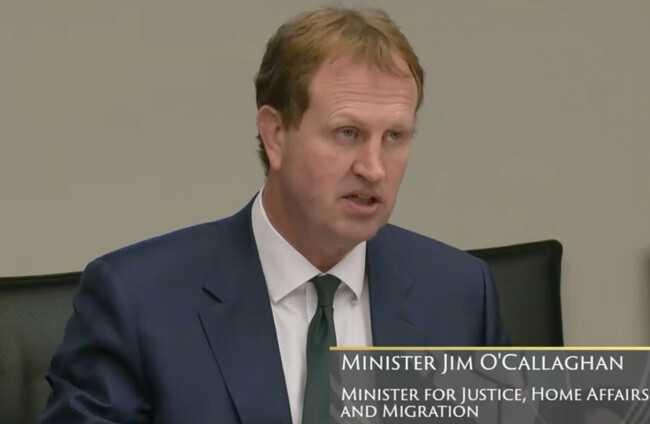
Justice Minister Jim O'Callaghan at the committee today Oireachtas

Jim O'Callaghan says families refusing transfers from Ipas centres are 'abusing' the system

The Justice Minister also told TDs about dozens of renegotiations on Ipas centre contracts this year.

JUSTICE MINISTER JIM O’Callaghan has claimed that people remaining in Ipas centres despite facing transfers to other parts of the country are “abusing” the system.

O’Callaghan said it was “intolerable” that it was taking place given that there “remains a significant cohort” of people seeking international protection who have been left without accommodation.

As reported by The Journal last week, numerous families in Ireland’s international protection system are locked in a standoff with the Department of Justice over plans to transfer them to far-flung centres across the country.

They have been unwilling to leave as they have put down roots via work and school places for their children.

The International Protection Accommodation Service (Ipas) is currently looking to free up bed space by moving more than 2,000 people out of accommodation.

Thousands of people seeking asylum in Ireland are housed in centres that are largely privately-run but are paid for by the State.

All of the families affected by the transfers have been approved for legal status as international protection claimants by the Irish government.

While it is expected that they leave Ipas accommodation after gaining the legal status, the housing crisis has meant many have been unable to find somewhere new to live.

This was a feature of the Direct Provision system before asylum numbers began to jump from 2022.

Today’s Oireachtas Justice Committee heard that there are roughly 600 people without accommodation.

Addressing TDs on the committee today, O’Callaghan said the State can face legal action if it fails to provide accommodation.

This is happening in a case where the Irish Human Rights Commission is seeking a Supreme Court challenge concerning the State’s obligation to provide asylum seekers with accommodation.

The people who are newly arriving into Ireland do not yet have a legal entitlement to work here and do not have access to standard housing benefits or standard social welfare entitlements.

This contrasts with people in who have been approved for legal status as an international protection claimant and who are allowed to work.

“It is vital for the integrity of the international protection system that the provision of accommodation is not abused in this manner and that the accommodation is available to those who have no rights to other housing supports,” O’Callaghan told the committee this afternoon.

Ipas centre contracts

O’Callaghan told TDs that the spike in arrivals post-pandemic – when a combined 159,000 people sought protection in Ireland in a three-year period -put the State in a “very weak negotiating position” right at the moment that it needed to dramatically expand the accommodation available.

He said his department was “going around the country” and accepting “almost every offer” that it received.

O’Callaghan said his department was now making savings from Ipas contracts, estimating that there have been around “100 renegotiations” of contracts this year.

These are saving approximately €46 million, O’Callaghan added.

He said the department was now focused on moving towards State-owned accommodation and away from private providers.

This can cut the costings to house people by almost two thirds, O’Callaghan said, outlining that it costs approximately €12,000 per year per person in a State-owned facility.

“As a general policy position when it comes to international protection accommodation, we need to move away from the emergency use of hotels to a more sustainable and cost efficient state accommodation model,” the Fianna Fáil TD said.

Dundrum House contract

O’Callaghan was also asked by Fine Gael Tipperary South TD Michael Murphy about the department’s contract for Dundrum House Hotel in Tipperary.

Murphy said the department entered the contract despite the company involving having “no track record” in handling such work and having only been founded a short time prior.

However, O’Callaghan rebuffed the questions and said that a company that had no prior track record “wouldn’t preclude a contract being entered into” by the department.

“There are factors that are taken into account when the department and I are entering into contracts with accommodation providers. We look at location, we now look at price, we now look at services available,” O’Callaghan said.

Dundrum House has been the subject of ongoing court cases, while Murphy has recently sought for the Public Accounts Committee to examine the State contract with the hotel.

Readers like you are keeping these stories free for everyone...
A mix of advertising and supporting contributions helps keep paywalls away from valuable information like this article. Over 5,000 readers like you have already stepped up and support us with a monthly payment or a once-off donation.

Close
JournalTv
News in 60 seconds