We need your help now

Support from readers like you keeps The Journal open.

You are visiting us because we have something you value. Independent, unbiased news that tells the truth. Advertising revenue goes some way to support our mission, but this year it has not been enough.

If you've seen value in our reporting, please contribute what you can, so we can continue to produce accurate and meaningful journalism. For everyone who needs it.

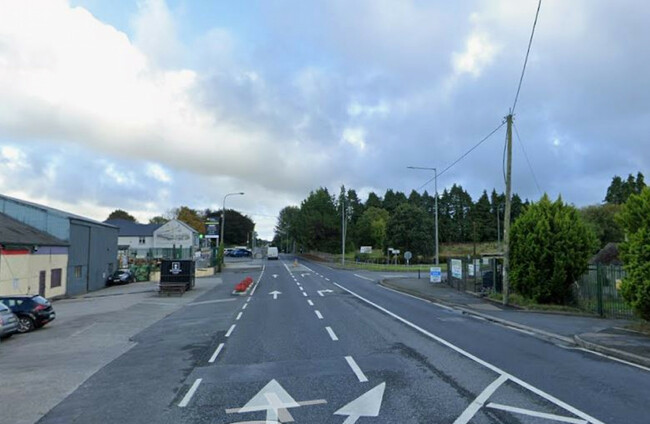
The road that runs through Kilmeaden Google Streetview

Kilmeaden will ‘no longer be a village’ if planned multi-billion-euro data centre goes ahead

More than 300 people have objected to the proposed data centre, citing traffic, aesthetic and environmental concerns.

RESIDENTS OF A small village in Waterford say they’ve been blindsided by plans to build a massive multi-billion-euro data centre on the site of a former cheese factory.

More than 300 people have already objected to the technology park in Kilmeaden, around twelve kilometres outside of Waterford city, which would drastically transform the village. 

Planning permission for the development was sought last month. The campus would span more than one square kilometre.

Environmentalists say, if it goes ahead, the increased emissions from the centre could threaten climate targets. But the company argues that data centres are a necessary step in the transition to clean energy.

The lives of locals, which include many elderly people, are going to be “completely disrupted” during the 10 years the technology park is being built, one Kilmeaden resident said.

Kilmeadan reflects a familiar clash playing out across the country right now, between those who say Ireland needs to build infrastructure faster, and those who fear that rapid progress comes at too high a cost for the people who live beside it. 

Around 300 people live in the village’s immediate surrounds, while there are approximately 3,000 people in the wider area.

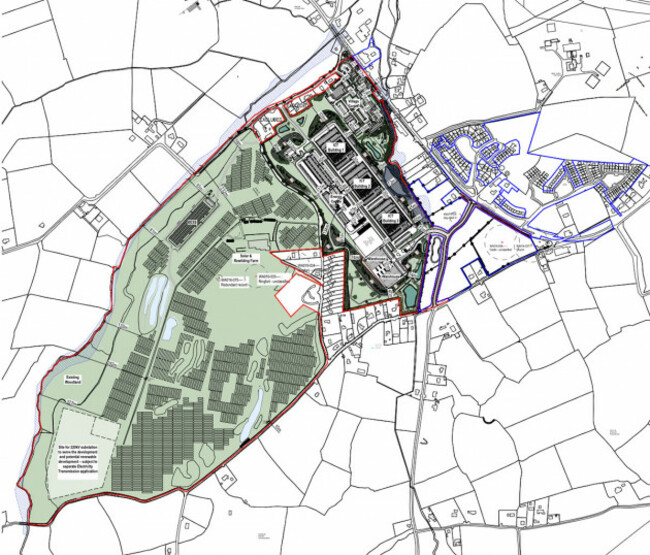
The proposed campus would house a data centre, as well as some 43,000 solar panels to help run it. 

It would also include a new village centre, with a gym, café, shop, pharmacy, and office space. A two-storey childcare facility and outdoor play area are also in the plans.

masterplan (1) Drawing of the proposal, included in the planning application

The Irish company behind the development, Echelon, has leased data centres to TikTok, among others. 

Echelon says it’s listening to concerns, but it argues that the site was already, for many years, used for industry when the Kilmeaden cheese factory was there. It ceased operations in 2013 after moving its cheesemaking to Kilkenny. The building was subsequently demolished.

Just last month, Echelon broke ground on a separate new data centre in Arklow, Co Wicklow, which Taoiseach Micheál Martin launched, praising its potential economic benefits.

However, some locals in Kilmeaden are reluctant to support the new project, which will take a decade to build. 

The Kilmeaden Against Industrialisation Action Group said that the calm and safety of rural life would “vanish” if the data centre is built. 

“People feel ignored, disrespected, and powerless,” they said.

They see this as part of a wider trend in the country, which has prompted councillors to call for national planning guidelines specifically for solar farms. Indeed, planning permission has been sought for a separate solar farm just 5km down the road from Kilmeaden.

“Our green fields are being turned into energy zones,” the Kilmeaden group said.

In the planning submission, Echelon says it will also build houses on the site through a partnership with developer Kent Homes, which built the two main housing estates in Kilmeaden.

Karen Miller, who bought a home in the smaller of these estates a decade ago, says the area was sold to her as a village setting. 

“[We're] thinking, for the next ten years this is going to be our life: noise, dust, road works,” she said.

If they go ahead with what they’re planning, this is no longer going to be a village. This is going to be an industrial site.

Echelon said that “detailed consideration” was given to the visual impact, and that the data centre will be set back from the site’s boundaries.

Miller feels the inclusion of a new town centre in the plans is “only a sweetener”, to win over locals.

“It’s just completely and utterly flabbergasting how they think the data centre is appropriate in a small village like Kilmeaden,” she said.

“You’ve got bungalows just in front of where the cheese factory is, with elderly people living in them … Their life is going to be completely disrupted by this.”

Waterford councillor John O’Leary said he’s not against development in the area, but he doesn’t want it to become an “industrial hub”.

He is among the objectors, taking issue with the extra traffic the site would produce and the damage it would do to the landscape.

Echelon has said that there will be an increase in traffic while the campus is being built, but assessments done as part of the application indicate “no significant impacts” once it’s operational.

O’Leary believes it would be “more appropriate” to build data centres in areas far from homes and villages.

In the Waterford County Development Plan for 2024-2029, the council said it wouldn’t support the establishment of data centres, saying grid restraints would make them “unfeasible”.

However, Echelon says the location is perfect due to its proximity to the national transmission grid, and its solar farm and battery storage compound would be on lands that aren’t subject to any particular zoning.

Environmental impact

David Smith, the deputy chief executive of Echelon, told Newstalk’s Breakfast Business this week that the company wants the centre to be “sustainable” and “additive to national infrastructure”.

He said the company is building the centres in “non-urban environments” – places where the electricity grid isn’t as strained.

“We can’t have a 100% renewable grid tomorrow. We need to build the transition asset,” said Smith.

Friends of the Irish Environment say the data centre threatens climate targets.

“The predicted emissions from the site would make meeting local and national carbon reduction targets extremely difficult, with calculations suggesting the development would itself generate almost as much CO2 in its first eight years of operation as Waterford City and County’s entire baseline emissions,” the NGO said in a statement.

“This could preclude the area from achieving required climate goals by 2030.”

On the development’s website, Echelon says it aligns with the Climate Action Plan (CAP), claiming data centres will help with the transition to clean energy.

“As Ireland decarbonises its national grid and more of our energy comes from wind and solar, energy centres such as this provide back-up for when the wind doesn’t blow and the sun doesn’t shine,” it says.

“In the short term, the energy centres will be powered by gas, although they will not be ‘always on’. In the medium term, we expect to be able to fuel the energy centres with biogas, or green hydrogen should it be available.”

The CAP has a specific target to deliver 2,000 MW of new gas plant capacity to meet the country’s carbon reduction target in electricity generations by 2030. 

The NGO also claims that the on-site energy infrastructure will only offset the increased electricity demand by 2%. Echelon was asked for comment on this but declined to provide one. 

Close
111 Comments
This is YOUR comments community. Stay civil, stay constructive, stay on topic. Please familiarise yourself with our comments policy here before taking part.
Leave a Comment
    Submit a report
    Please help us understand how this comment violates our community guidelines.
    Thank you for the feedback
    Your feedback has been sent to our team for review.

    Leave a commentcancel