We need your help now

Support from readers like you keeps The Journal open.

You are visiting us because we have something you value. Independent, unbiased news that tells the truth. Advertising revenue goes some way to support our mission, but this year it has not been enough.

If you've seen value in our reporting, please contribute what you can, so we can continue to produce accurate and meaningful journalism. For everyone who needs it.

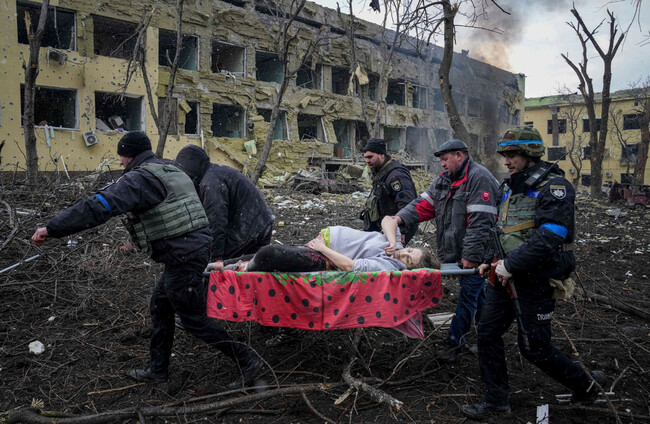
Ukrainian emergency workers and volunteers carry an injured pregnant woman from a maternity hospital damaged by an airstrike in Mariupol, Ukraine in 2022. Alamy Stock Photo

Irish humanitarian aid helping pregnant women in Ukraine as war brings rise in premature births

The Journal is in Kyiv reporting on the war in Ukraine.

LAST UPDATE | 1 hr ago

ON THE STREETS of Kyiv we occasionally come across ex-soldiers limping from war wounds but there are other injuries that are less obvious, especially to people suffering in the bitter cold this winter and the shelling in front line towns. 

One group suffering as the four year war drags on are pregnant women and their babies. Since the start of the war there has been a 20% increase in infants born prematurely, their mothers suffering in the stress of battle ravaged zones and the cold of winter.

Between 2023 and 2024 there has been a 37% increase in maternal mortality.  

That all feeds into the broader targeting of healthcare facilities in Ukraine. As of February 2026 the World Health Organisation has said there have been 2,881 attacks of hospitals and clinics, which includes damage to more than 80 maternity and neonatal centres.  

Speak to anyone in Ukraine and they will tell you of -21 degrees Celcius winter without heating as Russia launched attacks on the energy sector of the country in a strategy to wear down Ukrainian resolve. 

Some residents, like Dayna, told us that in the rural areas outside Kyiv it has been particularly difficult. She said that some are lucky to have gas supplies to light fires but most suffer without electricity to heat their homes. 

The battle wounds are obvious, the impact on Ukrainian mental health and their youngest citizens is immense.

According to the UNFPA, the United Nations Population Fund, which is the UN’s sexual and reproductive health agency, said caesarean section rates in Ukraine are exceptionally high because doctors are forced to deliver babies in the most expedient way in combat zones.

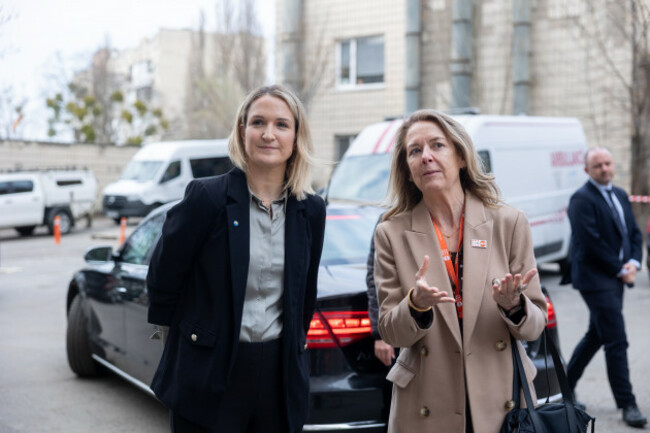
IMG_5445 Helen McEntee meeting with Jacqueline Mahon of UNPFA at the Kyiv Regional Perinatal Centre today. Kyiv Flash Kyiv Flash

Premature babies

One project looking to solve those problems is the Irish Government and UNFPA funded Kyiv Regional Perinatal Centre. 

It serves the capital city but also the wider region and specialises in helping women and their babies with high-risk pregnancies and complex deliveries. The centre’s work is essentially to provide care for women who have been displaced from areas where there is heavy fighting. 

The highrise medical facility also cares for premature babies in incubators with specialist equipment. One of the most dynamic aspects of the work is that of the ambulance, or mobile unit, which travels to the women. There are also 25 mobile teams across Ukraine, driving into the worst hit areas to bring pregnant women out.

Faye Callaghan, who is working with UNFPA said that the caesarean rate increases are signs of a struggling system. She also explained that the issue of women’s health is multifaceted and that the women, particularly in rural areas, are unable to consume enough calories during pregnancy but also cannot attend screenings to detect cervical and breast cancer. 

“Closer to the frontline, women are under a lot of stress, and also medical teams are under a lot of stress. When a woman is in labour, it’s hard to predict and plan for.

“If a woman is in labour, and suddenly shelling comes, the doctors will often make a decision to do a caesarian to speed up the birth of the baby, for the safety of the Mother, the baby and the medical teams.

“Or it’s also the case that the woman is under greater stress from being in a shelled hospital, which puts the baby at stress, so there’s an urgency to deliver the baby,” she said. 

Jaqueline Mahon, is an Irish woman based in Kyiv where she works as the UNFPA country representative. 

She said that there are other significant issues of gender based violence and domestic violence arising out of the war.

“In women and girls we are seeing, sadly, it is because families are under so much pressure and so much tension as well. So that’s something also that we’re working to support women as well and men as well, in relation to also conflict related sexual violence,” she said. 

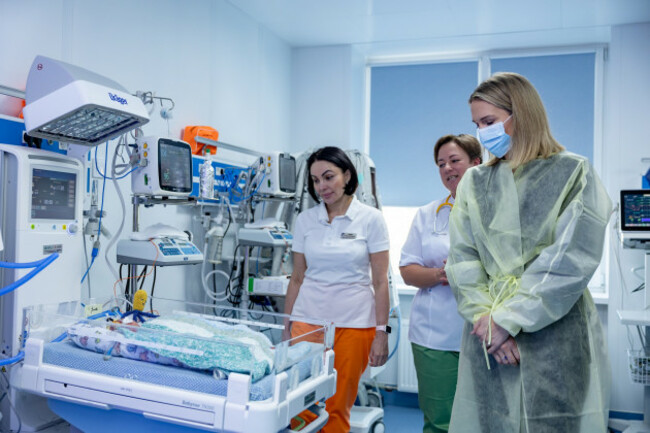
IMG_5607 Helen Mcentee visits the Kyiv Regional Perinatal Centre, which is part funded by Irish humanitarian aid.

Helen McEntee visited the centre today and viewed the work of the unit. She spoke to ambulance crews and also viewed a neonatal ward with young babies in incubators. 

The Minister announced today an extra €40m aid for Ukraine which is to be used in humanitarian and long-term development projects. Ireland has in total given €65m in financial support this year. 

On the visit Mcentee said that she thought of her own family and how it would be if the situation faced by Ukraine was in Ireland. 

“As someone who has, two children, the idea that you wouldn’t have access to any maternal support, or that you wouldn’t have access if something happened, that your baby would not have access to what everybody else should have in terms of the intensive care unit – these are the day to day things that you don’t think of when a country is at war,” she added. 

McEntee said that the fact that there was one mobile unit or ambulance to cover 1.3 million people is something she will discuss with her team about focusing funding to solve the problem.  

Irish diplomacy in Kyiv

For Irish diplomats and Minister for Foreign Affair Helen McEntee, who is visiting the city, the focus is also on the European accession campaign by Ukraine. 

They were formally declared candidates in June 2022 and then accession negotiations started in June 2024. 

Ireland has a new embassy in the city, with four diplomats based there. 

Today in Kyiv, McEntee met with the Ukrainian Foreign Minister Andrii Sybiha and Ukrainian President Volodymyr Zelenskyy in separate meetings, much of which focused on the campaign to join the EU. 

McEntee said as she departed Ukraine that she admired the “visible strength and resilience” of Ukrainians.

She said that there has been a lot of work done by the Ukrainian Government to meet their obligations towards EU membership, but that there is more needed.

“There’s more needs to be done there. And I think whether it’s the Rule of Law, whether it’s judicial appointments, whether it’s corruption these areas.

“There’s legislation that’s been progressed and there’s very clearly a willingness on the side of the President and his team to make that progress, but you know, we both need to move together.

“The EU needs to show progress on our side, and they need to keep doing what they’re doing. I think there’s an understanding on their side. They need to do more, and they need to keep that momentum up, and we need to be able to show progress.

“That’s that’s where our blockage is at the moment, and we have to figure out a way to try and unblock that,” she said. 

McEntee has rounded on the Hungarian Government, which is blocking a €90m EU loan to Ukraine. She also criticised Hungary as it emerged that Viktor Orbán’s Foreign Minister Peter Szijjarto was communicating with Russian Foreign Minister Sergei Lavrov about European Union matters. 

McEntee described the revelation as showing that Hungary “betrayed that confidence and is working against us”. 

Readers like you are keeping these stories free for everyone...
A mix of advertising and supporting contributions helps keep paywalls away from valuable information like this article. Over 5,000 readers like you have already stepped up and support us with a monthly payment or a once-off donation.

Close
JournalTv
News in 60 seconds