We need your help now

Support from readers like you keeps The Journal open.

You are visiting us because we have something you value. Independent, unbiased news that tells the truth. Advertising revenue goes some way to support our mission, but this year it has not been enough.

If you've seen value in our reporting, please contribute what you can, so we can continue to produce accurate and meaningful journalism. For everyone who needs it.

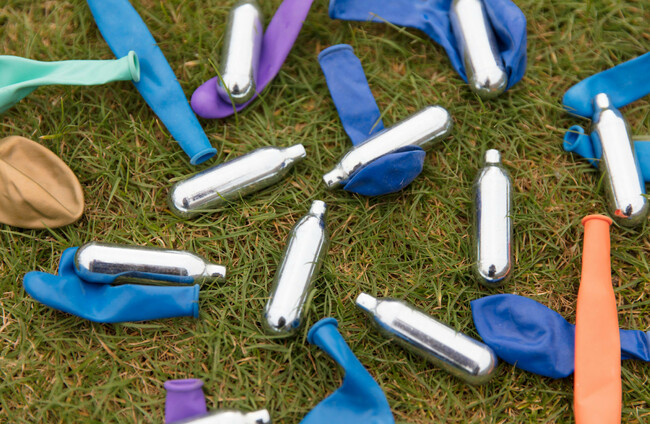
Laughing gas cannisters and balloons Alamy Stock Photo

Nitrous oxide hospital admissions increased four-fold over four-year period, new study shows

The report states that the study shows the rising trend of nitrous oxide use over a very short time.

ACUTE HOSPITAL ADMISSIONS for mainly young adult males presenting with
neurological consequences due to the misuse of Nitrous Oxide (NO) or laughing gas have increased four-fold on a quarterly basis over a four-year period.

In a new study published in the just published April edition of the Irish Medical Journal (IMJ), medics warn that “a multi-targeted harm-reduction strategy is needed to reduce preventable harm and to lessen the burden on acute care services”.

The paper entitled ‘Recreational Nitrous Oxide Use: A Growing Trend with Unintended Consequences’ by medics at the Acute Medicine Department, Mater Misericordiae University Hospital in Dublin found that “admissions to Irish hospitals with neurological consequences of inhaled NO misuse have greatly increased over the last four years, and this issue is predominantly affecting very young adults”.

The medics state that the multi-targeted harm reduction strategy should consist of highlighting the need for youth-targeted prevention, awareness campaigns, and multidisciplinary follow-up pathways.

The medics state that it is the first study to describe the increase in acute hospital admissions in Ireland and say “as clinicians, we have observed an increase in cases of neurological symptoms in young people in our clinical practice, in association with NO abuse”.

The medics found that there were 63 cases identified over four years between Q1 2020 and Q2 2024 and state that there was more than a four-fold increase in quarterly admissions when comparing Q1 2020 with Q4 2023.

The report shows that admissions reached a peak in Q2 2023 with 11 admissions.

The report states that the study shows the rising trend of nitrous oxide use over a very short time, showing a significant increase from Q3 2022, peaking in Q2 2023.

They state that “this aligns with the clinical observation we had made regarding the increased prevalence of nitrous oxide use”.

The various descriptions of the cases as a result of the inhalation of Nitrous Oxide including ‘poisoning by and exposure to unspecified gases and vapours’ and ‘accidental poisoning by and exposure to chemicals and noxious substances’.

The report found that the mean age of those admitted was 19.68 years and 71.4% were male with 28.6% female.

The average length of stay in hospital was 6.26 days, contributing to 394.5 total bed days.

The study found that most patients, at 87.3%, were from the Dublin area.

The report states that NO leads to a short-lived euphoric sensation when inhaled.

They state that typically, recreational NO users transfer the gas from highly pressurised canisters into balloons, and inhale from these.

The paper states that recreational NO abuse can cause harm to users where the NO canisters decrease to a temperature of –40 degrees Celsius when opened, and direct contact can cause freeze burns to lips, hands and throat.

The medics state that more insidiously, inhalation of NO can also trigger inactivation of vitamin B12, which is a crucial nutrient for nerve tissue health, brain function, and red blood cells.

View 52 comments
Close
52 Comments
This is YOUR comments community. Stay civil, stay constructive, stay on topic. Please familiarise yourself with our comments policy here before taking part.
Leave a Comment
    Submit a report
    Please help us understand how this comment violates our community guidelines.
    Thank you for the feedback
    Your feedback has been sent to our team for review.

    Leave a commentcancel

     
    JournalTv
    News in 60 seconds