Sign in. It’s quick, free and it’s up to you.
An account is an optional way to support the work we do. Find out more.
Sign in. It’s quick, free and it’s up to you.
An account is an optional way to support the work we do. Find out more.
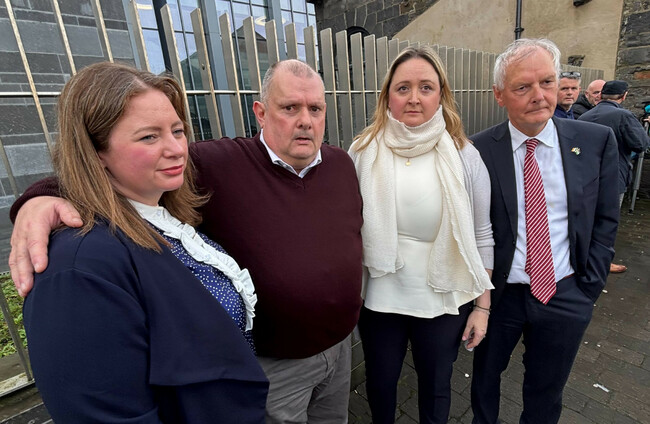
A SEVEN-YEAR investigation into four serving gardaí and one retired superintendent in Limerick came to an end in court this afternoon amid cheers and recriminations.
The probe resulted in the gardaí sitting in the dock as accused for eight weeks, their careers and reputations on the line, in a trial of the very practices that gardaí use behind the scenes every day.
The accusation was that the gardaí had perverted the course of justice in not proceeding with minor road traffic offences prosecutions.
The weight of the State surrounded the accused, with the National Bureau of Criminal Investigation (NBCI) tasked with compiling the evidence. In the end 12 jurors from Co Limerick exonerated the five accused.
The investigation began with a seperate probe, almost a decade ago, with a focus on whether gardaí were passing information to a criminal group in Limerick. One of the gardaí who was investigated in that probe was then Superintendent Eamonn O’Neill.
He was cleared of any wrongdoing in that case but gardaí had seized phones. In examining text messages on those phones, details were found that showed communications from members of the public to Eamon O’Neill asking him if he could help them with road traffic offence tickets.
It was alleged that O’Neill had contacted other colleagues, who then asked the relevant prosecuting gardaí to “square” or halt the issuing of the ticket to the driver.
The drivers involved were a politician, a number of Limerick hurlers and members of the public.
The NBCI investigated the allegations and interviewed some 130 people. Some of the details that followed cannot be discussed for legal reasons but ultimately five people were identified to be defendants in this case – four serving gardaí and one superintendent.
They were retired Garda Superintendent Eamon O’Neill, who served across the division but was the lead officer in Newcastlewest; Limerick-based Sgt Michelle Leahy; Sgt Anne-Marie Hassett, who formerly served in Limerick city; Garda Tom McGlinchey, Murroe Garda Station; and Garda Colm Geary, Clare Garda Division. All pleaded not guilty.
The five were charged with perverting the course of public justice in relation to the cancelling of fixed charge penalty notice. Leahy was accused of the offence in connection to striking out a summons while in court.
The jury heard weeks of detailed evidence. It heard from analysts who examined and downloaded the data from seized phones and also heard from investigating gardaí who interviewed their colleagues as suspects and from senior officers involved in the case and its decision-making.
There were also witnesses who discussed the concept of garda discretion. This is a Common Law power, which permits gardaí to decide against prosecuting minor offences.
What the jury had to decide ultimately came down to the legality of the use of that discretion, and whether it was an effort by the gardaí concerned to unlawfully block the process of prosecuting traffic offences or if it was part of their powers.
The prosecution, led by Senior Counsel Carl Hanahoe, alleged that the issue for the State was that motorists contacted Eamon O’Neill seeking advice, and that he forwarded the requests to McGlinchey, Hassett and Geary, who in turn contacted the various gardaí in each case.
The State alleged that Michelle Leahy was a court prosecutor in a district court in Limerick and had withdrawn two summonses having been contacted.
In the end the jury returned with a unanimous verdict which ended debate.
During the trial there was evidence given by senior ex-gardaí who outlined that discretion was a critical part of policing and a key factor in how the public interact with the force.
The argument was made that it enabled gardaí to keep in touch with local communities and to show a softer side of policing, which had the effect of showing that gardaí acted fairly.
It was also used to keep in contact with people who provided information about serious crime.
The counter-argument was that gardaí would have to become robotic in how they dealt with motorists on the side of the road if this was not the case. That discretion would end.
The investigation came after the appointment of Garda Commissioner Drew Harris. He came in with a mandate from the Government to clean up the Gardaí as an organisation.
It followed a series of scandals, most notably in how An Garda Síochána treated whistleblower Maurice McCabe. McCabe’s biggest complaint was the cancelling of penalty point offences.
In an effort to try and prove it was making an effort to change An Garda Síochána formed a new anti-corruption unit which was, at the time, led by the NBCI.
The NBCI is seen as the country’s lead investigator – a kind of Irish FBI, it was deployed as a shock troop to Limerick.
Behind the scenes, a senior source inside the probe said that Garda management at the upper reaches were paralysed in their decision-making processes.
Results mattered more than logically assessing the sense in pursuing a fatally flawed investigation. There was also pressure, with the text messages having been found, to progress the probe.
Ultimately it was a performance management issue that belonged, as former Chief Superintendent Gerry Mahon said, in the realms of discipline.
The case was a juggernaut and ended up in court, costing an estimated €3m in legal costs, because it could not be stopped.
At repeated Garda Representative Association conferences it has been raised that the Garda organisation has married punitive discipline to unachievable performance management.
At the moment there are two Limerick gardaí, who were investigated as part of the probe, still suspended despite the Director of Public Prosecutions (DPP) stating they had no case to answer.
Those two members are now joined by the four serving gardaí who have been cleared by a jury.
The GRA have declared the case a witch hunt, Labour TD Alan Kelly has called out the DPP and An Garda Síochána, and defence solicitor Dan O’Gorman said he would support calls for a public enquiry.
The Garda organisation has refused to comment.

To embed this post, copy the code below on your site

















have your say