We need your help now

Support from readers like you keeps The Journal open.

You are visiting us because we have something you value. Independent, unbiased news that tells the truth. Advertising revenue goes some way to support our mission, but this year it has not been enough.

If you've seen value in our reporting, please contribute what you can, so we can continue to produce accurate and meaningful journalism. For everyone who needs it.

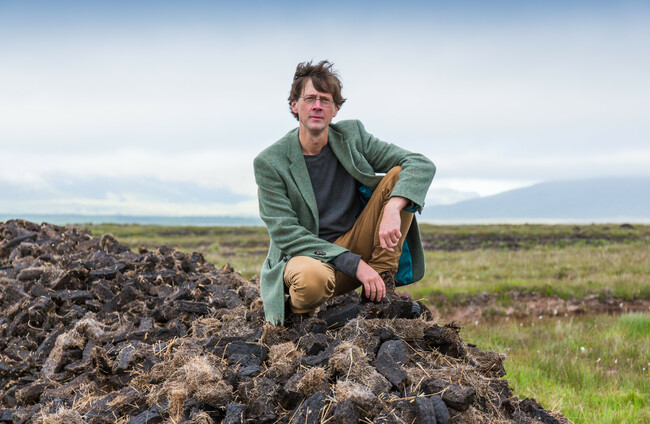
Bhí an scríbhneoir agus an déantóir clár faisnéise, Manchán Magan, atá imithe ar shlí na fírinne, an neamhspleach, d'fhas sé a ghlasraí féin agus bhí muca, cearca agus beacha aige. TG4

World wise traveller and film-maker Manchán is not gone from us, he's gone ahead of us

The writer and film-maker Manchán Magan, whose death was announced today, leaves a legacy which will ripple around the world and across generations.

(Seo alt ónár bhfoireann nua Gaeltachta.  Is féidir an bunleagan as Gaeilge a léamh anseo.)

NATIVE PEOPLES IN Australia, America, Canada and around the world will be mourning the death of Manchán Magan today. His passing will echo around the world.

So said television producer Brian Reddin of Dearg Films, who worked with Manchán on the groundbreaking series No Béarla and was set to start work on the second series next week until he received a call from Manchán two weeks ago indicating that the broadcaster’s health may be failing.

That series in 2006 was during a time when some people believed that Teilifís na Gaeilge (TnaG or TG4 as it is now) was a white elephant – or Teilifís De Lorean as one commentator dubbed it – and another commentator said that the money that was to be invested in the establishment of TnaG would be better spent on prison. Manchán was among the stars who helped TnaG break out of that incarceration.

According to Reddin, Manchán and Hector were the stars who broke the mould for Teilifís na Gaeilge/TnaG – TG4 as we know it now – and it was difficult to imagine two more different personalities.

“Hector is a wild man, extroverted,  outgoing man and the young lads loved him – but Manchán was completely different – he was approachable, intellectual and thoughtful but he brought his own thing to the work.”

According to Reddin, Manchán had a special connection with indigenous peoples around the world because of the programs he made with them.

He was working with indigenous peoples in Canada very recently – the ripples of his death will be felt around the world and I think that’s great.

Reddin also said that it was Manchán who introduced him to Patrick Duffy – and the producer has completed a direct series with the star we met in The Man from Atlantis and Dallas – and he also remembers the gifts he would bring him from his farm in the middle of the country.

“Manchán was a special man, he was very self sufficient, he grew his own vegetables, he kept pigs, chickens and bees – often when I was working at home I would hear the doorbell and I would go out, there would be no one there but there would be a bag full of sausages on the step and a note from Manchán greeting me with the sausages that came from his own pigs.”

TnaG viewers were introduced to Manchán, with his first series, Manchán ar Seachrán/Wandering Manchán, back in the Winter of 1996. A young city accent Irish speaker on a tour of India and the wider Far East,  a land of Summer, an exotic land you wouldn’t associate with the Irish language.

As you watch this programme, with Manchán as your guide, you could imagine yourself on the banks of the Ganséis or walking through the city centre of Delhi, Kolkata or Mumbai. You would get the full experience from his mouth – nothing would be forced on you, from the different types of food to the smell that comes with millions of people being in one place.

OtherVoicesLive / YouTube

He had a special talent, curiosity. He was polite and listened to those he spoke to. He would eventually offer his own insights but he realised that his role was that of a guide. In this way, the audience became fond of him. He personified TG4′s ‘other eye’ and it was through him that many came to TnaG/TG4.

He was a wanderer and a storyteller and he travelled around the world exploring for TnaG and those trips were enjoyable and informative.

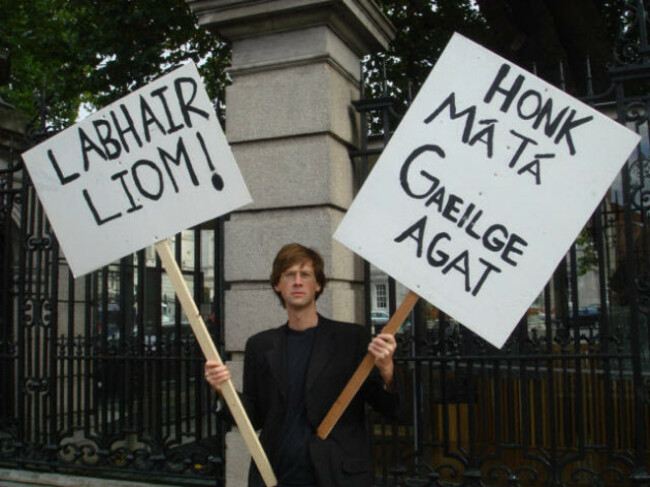
8507825966_36e326b4cb_o No Béarla, the series in which he travelled around Ireland speaking only Irish, challenged many of the sacred cows we have about the language. TG4 TG4

But it wasn’t until he focused on Ireland for the series ‘No Béarla’, a series in which he travelled around the country speaking Irish fluently, that I had the opportunity to speak to him. At the time, back in 2006, I was the editor of Lá, a daily Irish language newspaper, and we were interested in the challenge Manchán was taking on and we interviewed him at the time.

In that series in 2006 he exposed a little of the hypocrisy associated with Irish across the country – we certainly respect the language but if you try to communicate in the main language according to the Constitution, you certainly get an insight into the true respect for the language.

Reddin explained that there was a special connection between Manchán and Kneecap because of No Béarla. “Naoise and Liam grew up watching No Béarla and he was reciting poetry on Kneecap’s album,” he said.

“The second series of No Béarla was due to start next week, a commission had been received from TG4 and it would be going out next year as the broadcaster was celebrating 30 years on the air. He was going to do this programme with Naoise (Moglaí Bap).”

According to Reddin, Manchán leaves behind a legacy that will last for centuries, between his television programs, his books, his theatre performances. “He always had something interesting to say.”

One can imagine him now, on the brink of eternity embarking on a journey that, unfortunately, will not become a documentary series on TG4, Manchán in Eternity, to give us the traveller’s knowledgeable guide to that unknown land.

Condolences to his wife, Aisling, his mother Cróinle, all his family and his colleagues among the independent producers, and his collaborators in TG4 and RTÉ. May Manchán rest in peace and go n-éirí an bóthar leis.

As the old saying goes, he is not gone from us, but ahead of us.

 The Journal’s Gaeltacht initiative is supported by the Local Democracy Reporting Scheme

Readers like you are keeping these stories free for everyone...
A mix of advertising and supporting contributions helps keep paywalls away from valuable information like this article. Over 5,000 readers like you have already stepped up and support us with a monthly payment or a once-off donation.

Close
JournalTv
News in 60 seconds