We need your help now

Support from readers like you keeps The Journal open.

You are visiting us because we have something you value. Independent, unbiased news that tells the truth. Advertising revenue goes some way to support our mission, but this year it has not been enough.

If you've seen value in our reporting, please contribute what you can, so we can continue to produce accurate and meaningful journalism. For everyone who needs it.

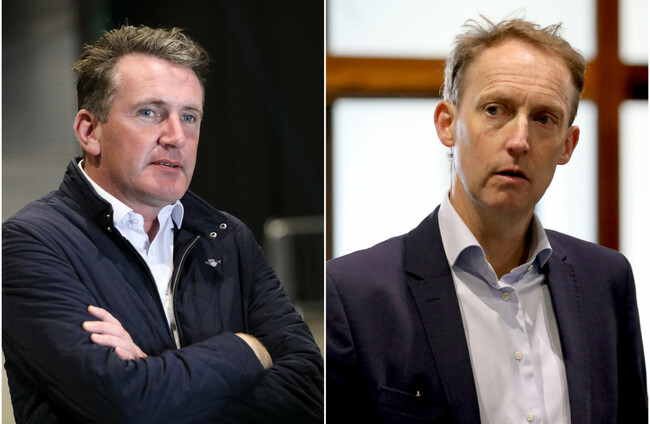
Labour MEP Aodhán Ó Ríordáin is against the deal, while Fianna Fáil MEP Barry Andrews is pro-Mercosur. Rollingnews.ie

'People assume this is just about beef': Two Irish MEPs argue the pros and cons of Mercosur

Two Irish MEPs give us their arguments for and against the Mercosur-EU trade deal.

FOLLOWING THE EUROPEAN Union’s vote in favour of the colossal Mercosur-EU deal last Friday, opinions on the trade agreement remain as polarised as ever. 

The deal still needs to be approved by the European Parliament and also faces a challenge in the European Court of Justice, but for now, it looks likely to proceed after over 25 years of negotiations. 

In Ireland, the trade agreement has divided opinion both within political parties and within the Government, with the Regional Independents and Fianna Fáil and Fine Gael backbenchers mounting a last-minute campaign for Ireland to vote against the deal (which we did). 

Beef farmers have been the most vocal group against the deal in Ireland, but leaving aside this sector’s concerns — what were the other main arguments for and against the trade deal? 

We asked two Irish MEPs on differing sides of the debate to lay it out for us. 

Pro-deal: Fianna Fáil’s Barry Andrews

The deal is beneficial to all other Irish industries

Andrews has gone against his party on this issue, telling The Journal that the Irish Government’s decision to vote against the trade agreement was “frankly…ridiculous”. 

He noted that claims by farming lobby and representative groups that the Irish beef industry will be damaged as a result of the deal are disputed, and that even if there is a negative impact on the sector, other industries in Ireland will benefit hugely from the deal. 

“I don’t buy this argument whatsoever that the beef industry is left to hang dry or politically ignored; the opposite is true. It’s the other sectors of the Irish economy that absolutely rely on open trading markets, low tariffs, low quotas, getting rid of protectionism, that are due to benefit most from this trade agreement,” the Dublin MEP said. 

Using pharmaceuticals as an example, Andrews noted that this sector will go from a tariff of 14% currently to zero.

“And our pharmaceutical exports are 50 times more valuable than our beef exports,” Andrews said. 

“We export 90% of what we produce.

“So our livelihoods are literally built on international trade and selling goods for international consumption.

“Given those facts, and the geopolitical reality of the need to diversify our markets, I think that the decision of the government to vote against the trade agreement is a massive own goal, and I just hope it gets through the [European] Parliament in due course,” the Dublin MEP added. 

Environmental safeguards go far enough

On the environmental arguments made against the deal, Andrews argued that the protections that are built in in relation to deforestation go far enough. 

Cattle ranching is the main reason for deforestation in Brazil’s rainforest, where huge swathes of trees have been cut down to let farmers produce more meat, which also causes its own emissions through land use and methane.

Environmental groups have argued that the deal will provide incentives to farm more beef, soy, and timber for paper in deforestation-prone areas, with Friends of the Earth describing the agreement as “toxic” and one that will drastically increase greenhouse gas emissions.  

Andrews disputes this and argues that the trade deal will likely reduce deforestation because the commitments built into the agreement are binding (as part of the deal, both sides commit to effectively implement the Paris Climate Agreement).

On top of this, he made the point that there are other agreements and other legislation that protect against the import into the EU of products that benefit from deforestation, although he does concede that the EU’s deforestation regulation has been delayed for another year until 2027. 

Anti-deal: Labour’s Aodhán Ó Ríordáin

Climate climate climate

On the other side of the argument is Dublin MEP Aodhán Ó Ríordáin, although he tells The Journal he “doesn’t feel passionately about rejecting it”. 

He made the point that in the context of US tariffs imposed on the EU and the current global instability more broadly, trade deals like this are actually “very important”.

However, on balance, he said he can’t look beyond the environmental concerns. 

“Europe is not taking environmental and climate change seriously,” Ó Ríordáin said, noting that the EPP [the biggest and most influential EU political grouping] in particular are trying to put environmental protections “on the chopping block”. 

“So when it comes to deforestation and the type of environmental protections that we would have in the EU, I just don’t feel that Mercosur is up to that standard.

“Now that may be making perfect the enemy of progress, but on balance, I think more guarantees should be obtained by negotiators on this matter,” he said.

Moreover, Ó Ríordáin added that he regrets that “this has become a debate about beef and nothing else.”

“I do have serious concerns about the power of the farming lobby over Irish politics. I think it’s oversized. I think it is really illustrative of whatever the IFA [Irish Farmers' Association] say, a bunch of Irish politicians just jump,” he said.

“I think that really needs to be analysed, because the average member of the public would assume that this is just about beef, and it’s not.”

Ó Ríordáin disputes Andrews’ claim that the environmental enforcement measures within the deal go far enough, arguing that they are not strong enough to withstand a government that is intent on deforestation.

“I mean, take Brazil, for example, if you have a change in the political climate and go back to the likes of Bolsonaro, then we have a very different scenario when it comes to deforestation.

“So it’s a concern. It’s not robust enough to withstand the whims of a far-right government coming back into office.”

Summing up his argument against the deal, Ó Ríordáin said:

“In a political climate where climate is not taken seriously at all… I think that it has to be at the forefront of all we talk about. And if it’s not at the forefront of this deal, well then the deal isn’t good enough.”

Readers like you are keeping these stories free for everyone...
A mix of advertising and supporting contributions helps keep paywalls away from valuable information like this article. Over 5,000 readers like you have already stepped up and support us with a monthly payment or a once-off donation.

Close
22 Comments
This is YOUR comments community. Stay civil, stay constructive, stay on topic. Please familiarise yourself with our comments policy here before taking part.
Leave a Comment
    Submit a report
    Please help us understand how this comment violates our community guidelines.
    Thank you for the feedback
    Your feedback has been sent to our team for review.

    Leave a commentcancel

     
    JournalTv
    News in 60 seconds