Sign in. It’s quick, free and it’s up to you.
An account is an optional way to support the work we do. Find out more.
Sign in. It’s quick, free and it’s up to you.
An account is an optional way to support the work we do. Find out more.
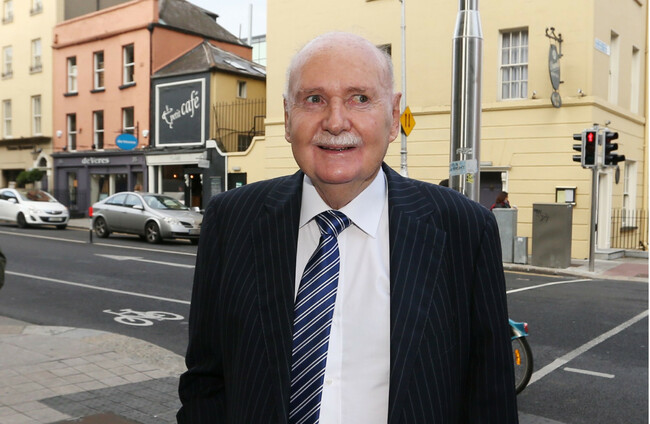
FORMER IRISH NATIONWIDE boss Michael Fingleton engaged in “cart-before-the-horse” and “solo run” lending and approved millions in loans projects before ever bringing them before the board for sanction, the High Court has heard.
The civil case against former INBS chief Michael Fingleton is in its third day before the High Court, where it has been alleged that he negligently mismanaged the building society (INBS) and engaged in property “gambles” with high net-worth individuals in an informal and speculative manner.
87-year-old Fingleton, who is in ill health after a stroke, ran the building lender from 1971 to 2009 as managing director and chief executive.
At its height in 2007, INBS had reported assets of €16 billion, but was a high-profile casualty of the financial crisis of 2008.
Liquidators for Irish Banking Resolution Corporation (IBRC) have taken the case against Fingleton, who denies the allegation of negligent mismanagement.
The losses, relating to property loans, had been estimated by the IBRC at €6 billion.
However, only €250 million in damages is now being pursued by IBRC relating to five loans made by INBS, allegedly approved by Fingleton, who the court was told was also “nodding through” top ups and extensions to certain clients.
At the High Court today, Lyndon MacCann SC, for IBRC, during his third day opening the case, said that in 2007 a Luxembourg-registered company called Laurent Properties applied for a loan with INBS to develop two adjacent sites in the south of France to build a hotel and casino.
MacCann said the borrower valued the property at €7M for the first site but then applied for a second loan to develop the second site.
MacCann said INBS issued loans authorised by Fingleton to Laurent Properties in September 2007, without the board having sight of an application.
The court heard that Fingleton approved a second loan of €2.1M for the second site, again before the board or the bank’s credit committee saw it.
The development never took place and by the time Nama purchased the bad loans for €4.5M in 2010, it represented a loss, interest included, of €5.9M – a discount of 57%.
MacCann said it was “cart-before-the-horse lending” made without security, guarantees, independent valuations or the board’s approval, which “beggars belief”.
In a separate loan to a UK company called Coast and Capital to buy up to 32 petrol stations, a loan of £1.75M had been approved for deposits on a site to be bought from oil giant BP in April 2006.
On this occasion, Fingleton told the borrower that INBS would back the entire project and the society indicated it was prepared to loan Coast and Capital £34.5M again without board approval or credit analysis, said counsel.
MacCann said that despite the deposit asked for being £1.75M, a sum of £4M was advanced. The board had not approved the advance, even though Fingleton had told the borrower it would be approved, counsel said.
The borrower’s estimation was that the value of all 32 filling stations across England and Wales would increase to £38M with planning permissions secured, said counsel.
The following December, £27.4M was advanced by INBS for the project without any authorisation from the board and was provided in addition to the £4M for the deposit, said counsel.
When the second large loan was issued, the number of sites to be purchased to be flipped had already reduced from 32 to 23, “as they fell by the wayside”, said counsel.
The debt built up on the deal was £30.5M by the time Nama bought them in May 2011 for £11.4M – a loss of 63%.
This, counsel said, represented “a complete solo run” by Fingleton.
The court heard of a third deal that incurred “massive losses”, according to counsel, when money was borrowed to purchase and develop an old hospital site outside of Cardiff.
In May 2004, £20M was loaned to a company referred to as Galliard (Sully) Ltd, and then topped up with a further £5M in May 2006, counsel said.
“There was no profit generated. Instead there was a massive loss. Huge,” said MacCann. Counsel said fatal planning issues included the safe destruction of the hospital’s incinerator.
Nama eventually bought the loans at a loss of £23.8M, representing a 78% loss, which counsel described as a “huge punt” made on “hope”.
The case continues at the High Court.
To embed this post, copy the code below on your site












have your say