We need your help now

Support from readers like you keeps The Journal open.

You are visiting us because we have something you value. Independent, unbiased news that tells the truth. Advertising revenue goes some way to support our mission, but this year it has not been enough.

If you've seen value in our reporting, please contribute what you can, so we can continue to produce accurate and meaningful journalism. For everyone who needs it.

Thousands of fines and warnings issued over abandoned and badly parked Moby bikes in Dublin

Dubliners are frustrated by Moby bikes blocking footpaths and being abandoned in estates – but the company says it’s a victim of its own success.

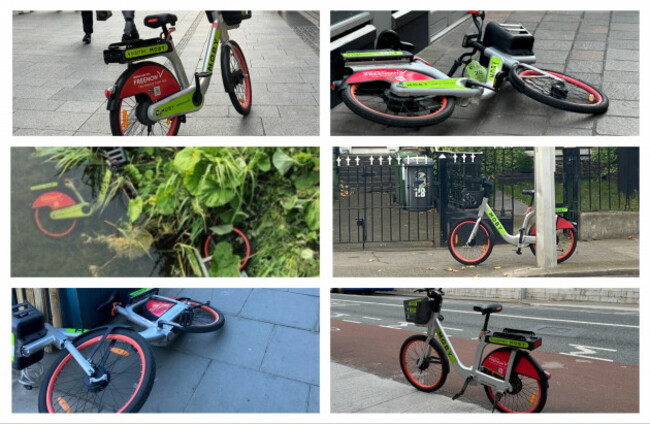
MixCollage-01-Oct-2025-04-15-PM-3389 Rogue Moby bikes in Dublin. Nicky Ryan / Valerie Flynn / Twitter Nicky Ryan / Valerie Flynn / Twitter / Valerie Flynn / Twitter

THREE THOUSAND USERS of Dublin electric bike share scheme Moby have been issued with fines this year for abandoning or badly parking bikes, with four or five times as many warnings issued, the company has said.

Moby Bikes told The Journal the proliferation of inappropriately parked or abandoned bikes is the result of a “skyrocketing” number of new users as it fully electrified its fleet over the past year. 

About half of users who are fined pay up. Seventy percent of these are subsequently refunded, as the measure is intended as a deterrent against repeated rule-breaking. About 15% of users who are fined actually end up out of pocket.

Dublin City Council, which permits the scheme to operate in its area, said it is “engaging with Moby Bikes regarding improper parking of bikes”.

“They are taking measures to address this issue,” the council said.

Correspondence released under Freedom of Information shows a council official has raised the issue of abandoned Moby bikes in various parts of the city with the company several times in the past year.

There are hundreds of Moby bikes in Dublin that can be located, hired and unlocked with an app. At the end of their journey, users are supposed to park their bike at an official bike stand, as opposed to propping it against a lamp-post or railings, or leaving it in less busy areas such as housing estates – but this does not always happen.

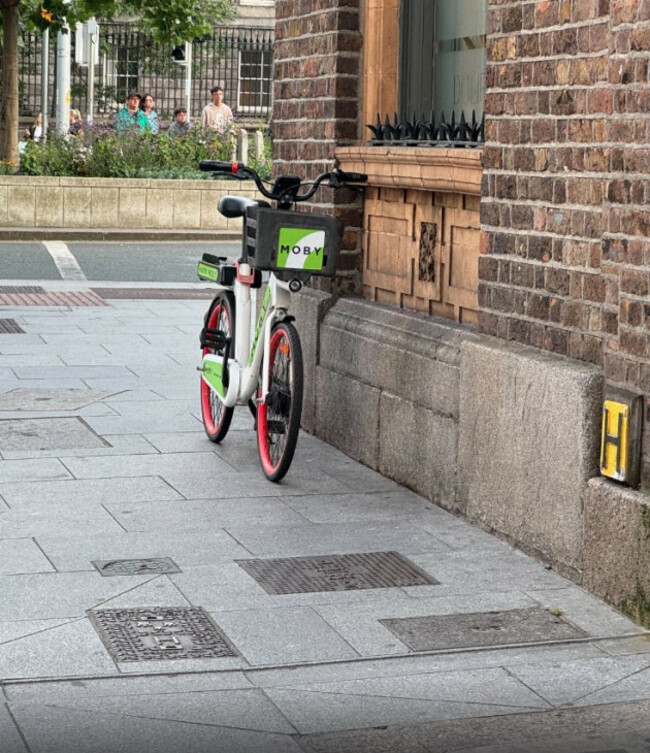
moby hawkins A lonely Moby on Hawkins Street. Nicky Ryan / The Journal Nicky Ryan / The Journal / The Journal

New users and tourists

Moby chief executive Thomas O’Connell said: “We’ve had 60,000 new users in about five months and something like 2,000 new users a week sometimes, so that’s the main issue.”

O’Connell said new users – many of whom have not used a bike share scheme before – need to be “educated”. He added that during the summer, the system was used by many tourists who were not used to it.

He noted that in some European cities, people are allowed to park shared bikes anywhere, which is not the case in Dublin.

Dublin users are required to upload a photo of the parked bike to the Moby app. It’s on this basis that the company is issuing warnings and fines.

New technology

O’Connell said that, unfortunately, some people “don’t care” or don’t pay attention to this condition of the scheme.

“It’s just the volume – if you can imagine 2,000 new people a week riding it for the first time. So I think we’re a bit of a victim of our own success maybe,” he said.

O’Connell said that when the number of new users plateaus, and as people become more acquainted with the rules, the issue is likely to be resolved.

In addition, Moby is testing a new technology that would use artificial intelligence to detect, from the uploaded photo, whether the bike is locked to a bike stand. O’Connell said this could “hopefully stop the problem happening in real time”.

Green Party councillor Feljin Jose, who raised the issue of inappropriately parked Moby bikes with the council’s environment and transport department during the summer, said he was satisfied the council was aware of the problem and seeking for it to be addressed.  

“We don’t want to head towards a situation you have in some European cities with e-scooters strewn around the place,” Jose said.

That’s the situation Dublin City Council has succeeded in avoiding all these years by requiring the use of bike stands.

“If and when we get shared e-scooters, it will have to be the exact same system,” he said.

Correspondence released to The Journal shows that in May, the council had to ask Moby to remove a bike from the Dodder river on foot of repeated complaints from a local. The local resident said the bike had been in the river since March, and noted that its battery could be leaking into the river.

Also in May, the council had to ask Moby to remove bikes incorrectly left by some users at Dublin Bike stations. Moby responded that it had experienced a temporary “tech issue”, whereby users did not have to upload a photo of where they had parked their bike at the end of their journey.

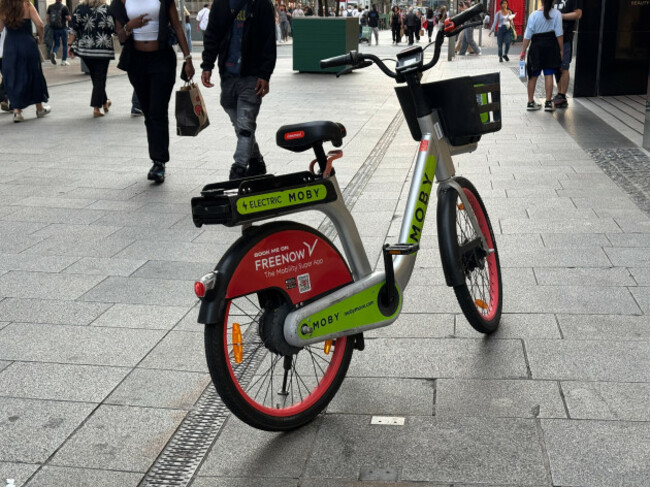
IMG_3873_Original (1) A Moby bike abandoned on Henry Street. Nicky Ryan / The Journal Nicky Ryan / The Journal / The Journal

Bike stands

Dubliners have taken to social media in the past year to draw attention to inappropriately parked or abandoned Moby bikes, including in housing estates and in Dublin’s canals.

Some have also expressed frustration at finding public bike racks full-up with shared bikes.

However, Dublin City Council told The Journal: “Sheffield stands are provided for use by all cyclists, whether using a bike service or personal bikes.”

O’Connell said that this seems to be an issue where the bike share companies “can’t win”.

“If the bike is abandoned it’s a problem, and then if it’s parked properly it’s a problem. The answer there would be more Sheffield stands,” he said.

There is also another licensed stationless bike share scheme in the Dublin area, Bleeper, which offers both pedal and electric bikes. It does not seem to have experienced the same problems as Moby with inappropriate parking over the past year.

A spokesman for Bleeper said he understood the frustration experienced by people who can’t lock their own bike at the stand they want to when they’re full, but said: “Shared bikes are being used by members of the public as well.”

The government has stated in its Climate Action Plans that shared mobility schemes have the potential to reduce car dependency and emissions. The Department of Transport produced a national policy on shared mobility earlier this year aimed at further developing these systems.

Readers like you are keeping these stories free for everyone...
A mix of advertising and supporting contributions helps keep paywalls away from valuable information like this article. Over 5,000 readers like you have already stepped up and support us with a monthly payment or a once-off donation.

Close
68 Comments
This is YOUR comments community. Stay civil, stay constructive, stay on topic. Please familiarise yourself with our comments policy here before taking part.
Leave a Comment
    Submit a report
    Please help us understand how this comment violates our community guidelines.
    Thank you for the feedback
    Your feedback has been sent to our team for review.

    Leave a commentcancel

     
    JournalTv
    News in 60 seconds