Take part in our latest brand partnership survey

We need your help now

Support from readers like you keeps The Journal open.

You are visiting us because we have something you value. Independent, unbiased news that tells the truth. Advertising revenue goes some way to support our mission, but this year it has not been enough.

If you've seen value in our reporting, please contribute what you can, so we can continue to produce accurate and meaningful journalism. For everyone who needs it.

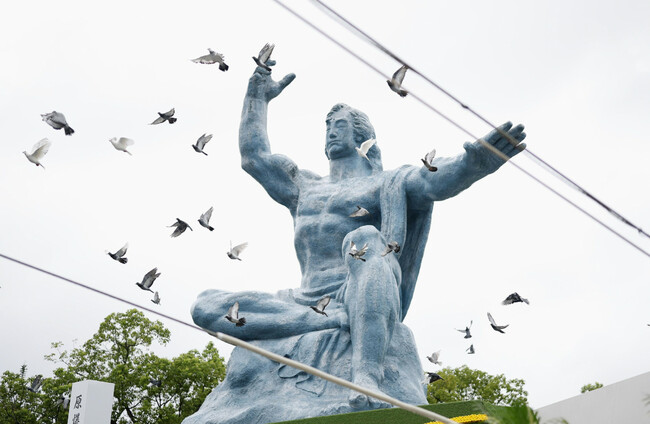
Doves are released during a memorial ceremony at Peace Park in Nagasaki Alamy

Nagasaki marks 80 years since devastating atomic bomb

About 74,000 people were killed by the A-bomb in Nagasaki, on top of the 140,000 killed in Hiroshima days earlier.

TWIN CATHEDRAL BELLS have rung in unison in Japan’s Nagasaki for the first time since the atomic bombing of the city 80 years ago, commemorating the moment of horror.

On 9 August, 1945, at 11:02am, three days after a nuclear attack on Hiroshima, the United States dropped an atomic bomb on Nagasaki.

After heavy downpours this morning, the rain stopped shortly before a moment of silence and ceremony in which Nagasaki mayor Shiro Suzuki urged the world to “stop armed conflicts immediately”.

“Eighty years have passed, and who could have imagined that the world would become like this?

“A crisis that could threaten the survival of humanity, such as a nuclear war, is looming over each and every one of us living on this planet.”

About 74,000 people were killed in the southwestern port city, on top of the 140,000 killed in Hiroshima.

Days later, on 15 August, 1945, Japan surrendered, marking the end of World War II.

Historians have debated whether the bombings ultimately saved lives by bringing an end to the conflict and averting a ground invasion.

‘Invisible terror’

But those calculations meant little to survivors, many of whom battled decades of physical and psychological trauma, as well as the stigma that often came with being a hibakusha.

Ninety-three-year-old survivor Hiroshi Nishioka, who was just three kilometres from the spot where the bomb exploded, told ceremony attendees of the horror he witnessed as a young teenager.

“Even the lucky ones (who were not severely injured) gradually began to bleed from their gums and lose their hair, and one after another they died,” he recalled.

“Even though the war was over, the atomic bomb brought invisible terror.”

Nagasaki resident Atsuko Higuchi told AFP it “made her happy” that everyone would remember the city’s victims.

“Instead of thinking that these events belong to the past, we must remember that these are real events that took place,” the 50-year-old said.

Today, 200-300 people attending mass at Nagasaki’s Immaculate Conception Cathedral heard the two bells ring together for the first time since 1945.

One of them, 61-year-old Akio Watanabe, said he had been waiting since he was a young man to hear the bells chime together.

The restoration is a “symbol of reconciliation”, he said, tears streaming down his face.

The imposing red-brick cathedral, with its twin bell towers atop a hill, was rebuilt in 1959 after it was almost completely destroyed in the monstrous explosion just a few hundred meters away.

Only one of its two bells was recovered from the rubble, leaving the northern tower silent.

With funds from US churchgoers, a new bell was constructed and restored to the tower, and chimed Saturday at the exact moment the bomb was dropped.

‘Working together for peace’

The cathedral’s chief priest, Kenichi Yamamura, told AFP “it’s not about forgetting the wounds of the past but recognising them and taking action to repair and rebuild, and in doing so, working together for peace”.

He also sees the chimes as a message to the world, shaken by multiple conflicts and caught in a frantic new arms race.

Nearly 100 countries were set to participate in this year’s commemorations, including Russia, which has not been invited since its 2022 invasion of Ukraine.

Israel, whose ambassador was not invited last year over the war in Gaza, was in attendance.

An American university professor, whose grandfather participated in the Manhattan Project, which developed the first nuclear weapons, spearheaded the bell project.

During his research in Nagasaki, a Japanese Christian told him he would like to hear the two bells of the cathedral ring together in his lifetime.

Inspired by the idea, James Nolan, a sociology professor at Williams College in Massachusetts, embarked on a year-long series of lectures about the atomic bomb across the United States, primarily in churches.

He managed to raise $125,000 from American Catholics to fund the new bell.

Author
View 123 comments
Close
123 Comments
This is YOUR comments community. Stay civil, stay constructive, stay on topic. Please familiarise yourself with our comments policy here before taking part.
Leave a Comment
    Submit a report
    Please help us understand how this comment violates our community guidelines.
    Thank you for the feedback
    Your feedback has been sent to our team for review.

    Leave a commentcancel

     
    JournalTv
    News in 60 seconds