We need your help now

Support from readers like you keeps The Journal open.

You are visiting us because we have something you value. Independent, unbiased news that tells the truth. Advertising revenue goes some way to support our mission, but this year it has not been enough.

If you've seen value in our reporting, please contribute what you can, so we can continue to produce accurate and meaningful journalism. For everyone who needs it.

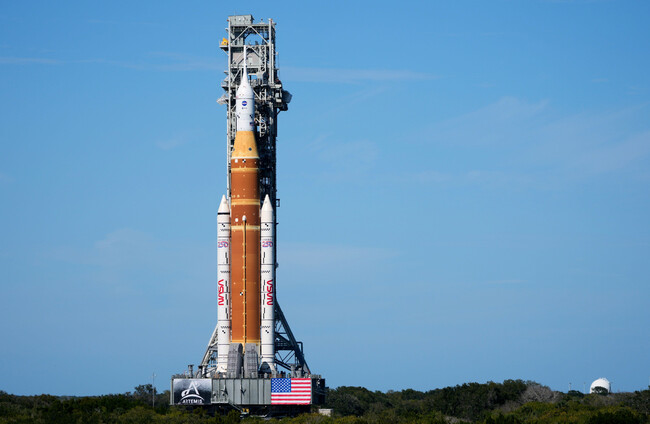
NASA's new moon rocket, Artemis II, slowly makes its way to pad 39B at the Kennedy Space Center. Alamy Stock Photo

Rocket for Nasa's first crewed mission to the moon since the 1970s arrives at launch pad

The Artemis II mission could blast off as early as 6 February.

NASA HAS ROLLED out its towering new rocket as preparations begin for its first crewed mission to the moon in more than 50 years.

After nearly 12 hours, the immense orange and white Space Launch System rocket and the Orion vessel were slowly wheeled out of the Vehicle Assembly Building at the Kennedy Space Center in Florida, and painstakingly moved 6.5 kilometers to Launch Pad 39B.

The US space agency will now begin a string of tests for the Artemis II mission.

If the tests are all satisfactory, three Americans and one Canadian will head to the moon sometime between 6 February and the end of April.

However, they will not actually land on the moon, but fly around it instead. 

The 10-day manned mission will be the first to travel around the moon and back again since Apollo 17 in 1972, with Nasa’s subsequent Artemis III mission planned to return humans to the lunar surface.

Nasa said Artemis “will send astronauts to explore the Moon for scientific discovery, economic benefits, and to build the foundation for the first crewed missions to Mars”.

“We’re making history,” Artemis 2 mission management team chair John Honeycutt told a press conference on Friday.

‘Pretty pumped’

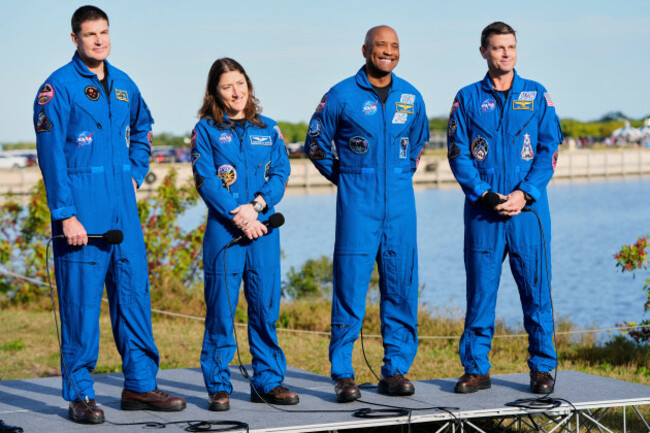
US astronauts Reid Wiseman, Victor Glover and Christina Koch, along with Canada’s Jeremy Hansen, were on site yesterday for the rocket’s rollout.

“I’m actually pretty pumped to see that,” Hansen told reporters. “In just a few weeks, you’re going to see four humans fly around the moon, and if we’re doing that now, imagine what we can do next.”

the-crew-of-the-new-nasa-moon-rocket-artemis-ii-take-part-in-a-news-conference-from-left-canadian-space-agency-astronaut-jeremy-hansen-mission-specialist-christina-koch-pilot-victor-glover-and Canadian Space Agency astronaut Jeremy Hansen, mission specialist Christina Koch, pilot Victor Glover and commander Reid Wiseman at the Kennedy Space Center. Alamy Stock Photo Alamy Stock Photo

Glover added: “We’re swinging for the fence, trying to make the impossible possible.”

Nasa Administrator Jared Isaacman said the mission would fulfil “a promise to the American people that we will return to the moon”.

The billionaire entrepreneur said the moon would be a “perfect proving ground” for autonomous capabilities within spacecraft.

“We talk about building a moon base. Now, day one of the moon base is not going to look like this glass-enclosed dome city that we might imagine some day,” he said. 

That’s certainly what the ideal end state would be. But it’s probably a lot of rovers that are moving around, a lot of autonomous rovers that are experimenting with mining, or some mineral extraction capabilities to start.”

He continued: “Naturally, in terms of what we want to achieve in space, you’re going to incorporate more autonomy in our robotic missions. We’re looking at a mission to Venus right now that could have some onboard AI capabilities in it.

“So this is the way we’re going to go. But I tell you, if humans are on a spacecraft, they’ll always have a vote, they always have a say in it.”

Before the mission can take off, engineers must ensure the SLS rocket is safe and viable. After a battery of tests, a pre-launch simulation will be carried out.

The uncrewed Artemis I mission took place in November 2022 after multiple postponements and two failed launch attempts.

Nasa hopes to put humans back on the moon as China forges ahead with a rival effort that is targeting 2030 at the latest for its first crewed mission.

The space agency is hoping that the Moon could be used to help prepare future missions to Mars. But the programme has been plagued by delays.

The US space agency surprised many late last year when it said Artemis II could happen as soon as February – an acceleration explained by the Trump administration’s wish to beat China to the punch.

Artemis III, currently scheduled for 2027, is expected to be pushed back, as industry experts say Elon Musk’s SpaceX is behind on delivering the Starship megarocket needed for the mission.

With reporting from © AFP 2026

Readers like you are keeping these stories free for everyone...
A mix of advertising and supporting contributions helps keep paywalls away from valuable information like this article. Over 5,000 readers like you have already stepped up and support us with a monthly payment or a once-off donation.

Close
24 Comments
This is YOUR comments community. Stay civil, stay constructive, stay on topic. Please familiarise yourself with our comments policy here before taking part.
Leave a Comment
    Submit a report
    Please help us understand how this comment violates our community guidelines.
    Thank you for the feedback
    Your feedback has been sent to our team for review.

    Leave a commentcancel

     
    JournalTv
    News in 60 seconds