Sign in. It’s quick, free and it’s up to you.
An account is an optional way to support the work we do. Find out more.
Sign in. It’s quick, free and it’s up to you.
An account is an optional way to support the work we do. Find out more.
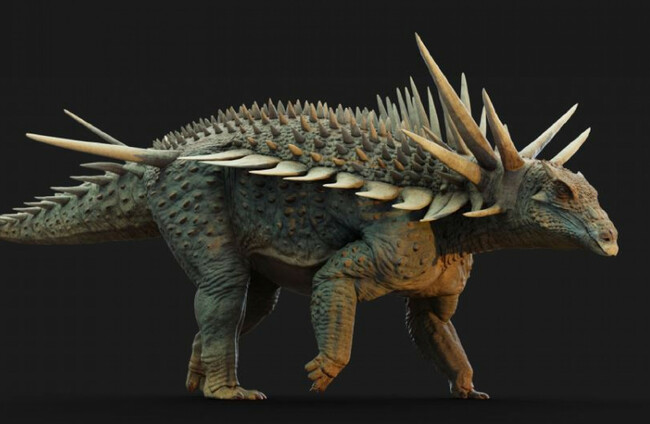
A DINOSAUR DUBBED one of the “strangest” ever boasted an elaborate armoury of long bony spikes and a tail weapon, according to findings published in the science journal Nature.
Spicomellus, which roamed the earth 165 million years ago, is the world’s oldest ankylosaur, a herbivorous group of dinosaurs known for their tank-like bodies.
Palaeontologists’ image of Spicomellus was based on a single rib bone found in Morocco in 2019.
But newly discovered remains have helped scientists form a clearer picture of the unusual dinosaur.
The fossils showed it had bony spikes fused onto all of its ribs – something never seen before in any other vertebrate species living or extinct, according to the research published Wednesday.
Richard Butler, a professor at the University of Birmingham and the project co-lead, called the fossils an “incredibly significant discovery”.
“Spicomellus is one of the strangest dinosaurs that we’ve ever discovered,” he said.
Professor Susannah Maidment of London’s Natural History Museum said the armour evolved initially for defence purposes but was probably used later to attract mates and show off to rivals.
“Spicomellus had a diversity of plates and spikes extending from all over its body, including metre-long neck spikes, huge upwards-projecting spikes over the hips, and a whole range of long, blade-like spikes, pieces of armour made up of two long spikes, and plates down the shoulder,” she said.
“We’ve never seen anything like this in any animal before.”

To embed this post, copy the code below on your site














have your say