We need your help now

Support from readers like you keeps The Journal open.

You are visiting us because we have something you value. Independent, unbiased news that tells the truth. Advertising revenue goes some way to support our mission, but this year it has not been enough.

If you've seen value in our reporting, please contribute what you can, so we can continue to produce accurate and meaningful journalism. For everyone who needs it.

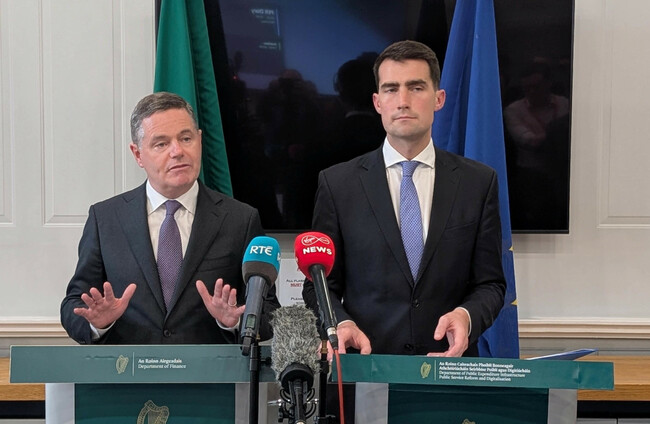
Ministers Paschal Donohoe and Jack Chambers at the Department of Finance this evening. PA

No changes to personal taxes in Budget, Donohoe says

The finance minister said the budget is focusing on Budget is to put in place the measures keeping jobs in the country.

THERE WILL BE no changes to personal taxes in the Budget, the Finance Minister Paschal Donohoe has said.

The Summer Economic Statement set out a planned package of €9.4 billion for Budget 2026, including €7.9 billion in additional public spending and €1.5 billion in the tax package.

Speaking to reporters on Friday, Donohoe said that tax package was focused on “jobs and investment”.

He said: “The most important thing we can do in preparing a Budget is to put in place the measures that will help keep jobs within our country, keep what we have and get more jobs in the future.

“And the main priority, and how we will do that from a taxation perspective, will be regard to measures that can enhance the competitiveness of our country and support further investment within our economy as well.”

He added:

The consequence of that is there will not be changes from a personal taxation within the Budget, because I’m going to be prioritising decisions instead with regard to jobs and investment in the future of our company.

Pressed on whether that meant there would be no changes to tax bands, Donohoe said: “I’m indicating that we’ve a tax package overall of €1.5 billion.

“That is the biggest tax package that I believe is safe to implement within our economy.

“If we would go beyond €1.5 billion, that runs the risk over time of narrowing our tax base and undermining safety in our public finances and the ability to pay for our public services in the future.

He said many of the different budgets he has done in the past have brought forward indexation, and the cost of doing that is at around €1.2 to €1.3 billion.

“If I was to move ahead with all of the different measures that I’ve been asked to do, it could give rise to a total tax package overall that I believe would be too big and would pose risk within our economy.

“And the decision that we are working on at the moment is how we can prioritise further investment within our economy and getting and keeping jobs,” said the minister. 

Meanwhile, Public Expenditure Minister Jack Chambers said no decision on Christmas welfare bonuses will be announced before Tuesday’s Budget but noted it had been a feature of several Budgets.

He said the emphasis of the social protection approach will be on “targeted measures”.

Exchequer returns

Speaking about the Exchequer returns, Donohoe said there would have been an underlying €1.9 billion Exchequer deficit at the end of September if Apple tax receipts were not included.

An Exchequer surplus of €1.4 billion euro was recorded to the end of September, down significantly from the €5 billion recorded at the same point last year – and follows major transfers to long-term investment funds.

Ireland has recovered more than €13 billion – plus interest – in corporation tax from Apple after the European Commission successfully argued the US tech giant had been given undue tax benefits that were illegal under EU state aid rules.

When receipts arising from the Court of Justice of the European Union (CJEU) ruling on Apple taxes are excluded, an underlying Exchequer deficit of €1.9 billion was recorded – a deterioration of €6.9 billion on the same period last year.

The underlying deficit largely reflects the transfers to the Future Ireland Fund and the Infrastructure, Climate and Nature Fund.

The latest Exchequer returns came ahead of Tuesday’s Budget.

The data also shows that tax revenue to the end of September was €73 billion euro – €4.8 billion or 7.1% ahead of of the same period last year.

However, this was improved by one-off tax revenues arising from the CJEU ruling which, when excluded, left underlying tax receipts of €71.3 billion.

Gross revenue to the end of September was €91.2 billion, an increase of €8.1 billion  compared with the same month last year.

Non-tax revenue and capital resources for the year were €4.8 billion, up by €2.5 billion on last year, primarily driven by transfers to the Exchequer arising from the CJEU ruling.

Appropriations-in-aid of €13.4 billion brought total other revenue to €18.2 billion.

September, a key month for corporation tax, saw receipts up €300 million on the same period in 2024.

On a cumulative basis, and excluding receipts arising from the CJEU ruling, corporation tax receipts of €18.2 billion were €400 million euro ahead of the same period last year.

Total expenditure to the end of September was €89.8 billion.

Of this, gross voted expenditure was €77.5 billion, which was €5.4 billion (7.6%) ahead of the same period last year.

Non-voted expenditure accounted for 12.3 billion euro, up by €6.3 billion euro on the same period in 2024.

This reflects the transfer of €6.1 billion euro to the Future Ireland Fund and the Infrastructure, Climate and Nature Fund this year.

Donohoe said broadly steady tax revenue growth is a positive sign of the “underlying strength of our economy” ahead of Budget 2026.

“Budget 2026, which Chambers and I will present to the Oireachtas on Tuesday, will set out a budgetary package that will help keep our economy and public finances on the right track, protecting the jobs we have, and adding to that, and meeting the needs of our people in a way that is affordable and sustainable.”

Chambers said increased spending has supported the country “through a series of economic challenges and shocks”.

He said the focus for the Budget “remains on value for money and ensuring that public spending delivers real impact for our people”.

The Summer Economic Statement set out a planned package of €9.4 billion euro for Budget 2026 – including €7.9 billion in additional public spending and €1.5 billion in the tax package.

Additional spending is broken down to €5.9 billion euro for current expenditure and €2 billion euro for capital expenditure.

The Central Bank, Irish Fiscal Advisory Council (IFAC) and Economic and Social Research Institute (ESRI) have raised concerns about the risk of the planned Budget package overheating the economy.

Close
59 Comments
This is YOUR comments community. Stay civil, stay constructive, stay on topic. Please familiarise yourself with our comments policy here before taking part.
Leave a Comment
    Submit a report
    Please help us understand how this comment violates our community guidelines.
    Thank you for the feedback
    Your feedback has been sent to our team for review.

    Leave a commentcancel

     
    JournalTv
    News in 60 seconds