We need your help now

Support from readers like you keeps The Journal open.

You are visiting us because we have something you value. Independent, unbiased news that tells the truth. Advertising revenue goes some way to support our mission, but this year it has not been enough.

If you've seen value in our reporting, please contribute what you can, so we can continue to produce accurate and meaningful journalism. For everyone who needs it.

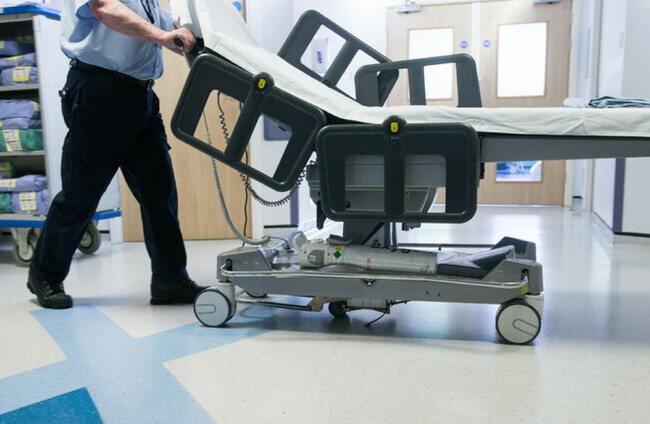
There were 463 waiting on trolleys, compared to a figure of 617 over the same period in 2025. Alamy Stock Photo

Number of patients on trolleys over St Brigid’s bank holiday weekend down 25%

The Irish Patients’ Association meanwhile warned that ‘long-wait cohorts continue to grow’ and that the Department ‘risks misreading its own data’.

THERE WERE 25% fewer patients waiting on trolleys after St Brigid’s bank holiday weekend when compared to the same period in 2025.

The Minister for Health, Jennifer Carroll MacNeill, has said this points to “significant progress in national health service performance during the early weeks of the year”.

On Tuesday 3 February, there were 463 waiting on trolleys, compared to a figure of 617 over the same period in 2025.

A Department spokesperson said this is “particularly notable” as it came in the face of an 8% national increase in demand for urgent care services over the holiday period.

There was also an 8% rise in attendances by those aged 75 and over.

Carroll MacNeill praised the “continuous hard work of all health care staff”.

While she acknowledged that “challenges remain in our health service,” Carroll MacNeill added that “these results highlight what can be achieved when staff are supported to deliver a whole-service approach that increases productivity, improves patient flow and eases congestion”.

She pointed to improved uptake of the flu vaccine among children aged 2 to 17 who are eligible for a free nasal spray vaccine, as well as the RSV immunisation programme for infants, as some measures that helped more people avoid ED attendances and hospital admissions.

A Department spokesperson also pointed to the availability of more senior decision makers on sites during evenings and weekends, the expansion of virtual care initiatives, and additional primary care services as measures supporting hospital avoidance.

As of late 2025, two-thirds of the workforce has signed up to the Public Only Consultant Contract (POCC), which the Department said facilitates enhanced senior decision-making during evenings and weekends.

The number of hospitals utilising acute virtual wards has also expanded from two to seven, while an additional 40,000 GP hours were provided this season, facilitating an estimated 138,000 extra consultations to support hospital avoidance

However, while the national trend is described as “positive,” with 17 of 29 hospitals improving their average trolley counts in 2025, Carroll MacNeill acknowledged that “performance remains variable”.

The West North-West Region continues to give “significant cause for concern” and faces “persistent pressures on patient flow and waiting times”.

A Department spokesperson said it “remains focused on these challenges” and Carroll MacNeill has requested “focused and sustained action to stabilise services in the region and mitigate risks to patient safety”.

Meanwhile, the Irish Patients’ Association remarked that “frontline staff continue to work under sustained pressure and deserve recognition”.

It added that the “pressure is not disappearing but is moving through the system”.

It said that the combined trolley figures for the full working week after the St Brigid’s bank holiday were 5% higher than in 2025.

“Emergency Department congestion and long waiting lists are not separate problems,” said the association.

“They are interconnected indicators of constrained capacity, delayed discharges, and insufficient elective throughput.”

Last month, outpatient waiting lists increased to around 632,000, up from around 569,000 the year before.

There was also an increase in the number of inpatient and day case waiting lists, which reached around 112,000 last month, up from around 94,500 in January 2025.

The Irish Patients’ Association remarked that “a system that reports isolated improvements while long-wait cohorts continue to grow risks misreading its own data”.

“Patients do not experience ‘performance snapshots’. They experience time – and for over 124,000 people now waiting more than 12 months across outpatient and inpatient care, those numbers are increasing.”

Readers like you are keeping these stories free for everyone...
A mix of advertising and supporting contributions helps keep paywalls away from valuable information like this article. Over 5,000 readers like you have already stepped up and support us with a monthly payment or a once-off donation.

Close
13 Comments
This is YOUR comments community. Stay civil, stay constructive, stay on topic. Please familiarise yourself with our comments policy here before taking part.
Leave a Comment
    Submit a report
    Please help us understand how this comment violates our community guidelines.
    Thank you for the feedback
    Your feedback has been sent to our team for review.

    Leave a commentcancel

     
    JournalTv
    News in 60 seconds