Sign in. It’s quick, free and it’s up to you.
An account is an optional way to support the work we do. Find out more.
Sign in. It’s quick, free and it’s up to you.
An account is an optional way to support the work we do. Find out more.
LAST UPDATE | 20 Apr
MORE THAN $71bn (€60.4bn) will be needed over the next decade for recovery and reconstruction in Gaza, according to a joint assessment by the United Nations and the European Union.
Much of the Palestinian territory, including schools, hospitals and other civic infrastructure, has been reduced to rubble by Israeli military strikes in the last two-and-a-half years following the Hamas attack on 7 October 2023.
The UN and the EU’s final Gaza Rapid Damage and Needs Assessment (RDNA) was published today. It was developed in coordination with the World Bank.
It said the escalation of the conflict since October 2023 “has led to an unprecedented loss of life and a catastrophic humanitarian crisis”.
“Over two years of conflict has resulted in more than 71,000 Palestinian fatalities and over 171,000 injured, and many are missing under the rubble.”
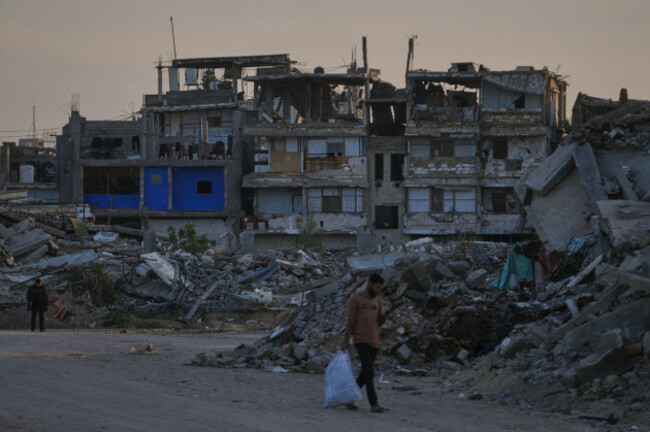
According to the RDNA, some 371,888 housing units have been destroyed or damaged, more than 50% of hospitals in the territory are non-functional and nearly all schools have been destroyed or damaged.
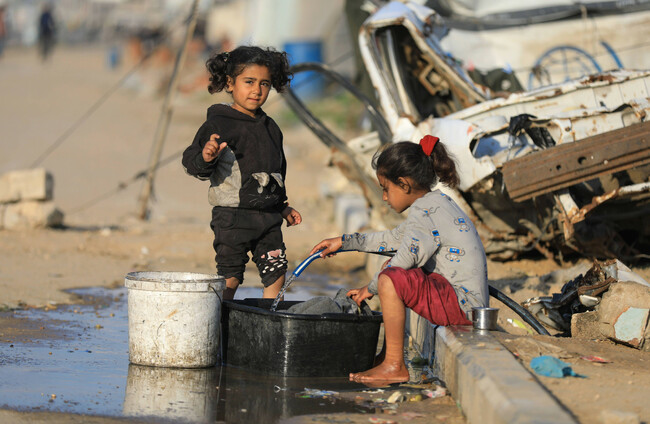
At the same time, 1.9 million people – nearly Gaza’s entire population – have been displaced, often multiple times, and more than 60% of the population had lost their homes.
“The scale and extent of deprivation across living conditions, livelihoods/income, food security, gender equality, and social inclusion, have pushed back human development in the Gaza Strip by 77 years,” the assessment states.
It determined that $26.3bn (€22.4bn) would be required in the first 18 months to restore essential services, rebuild critical infrastructure and support economic recovery.
“Recovery and reconstruction needs are estimated at around $71.4bn (€60.7bn),” it states.
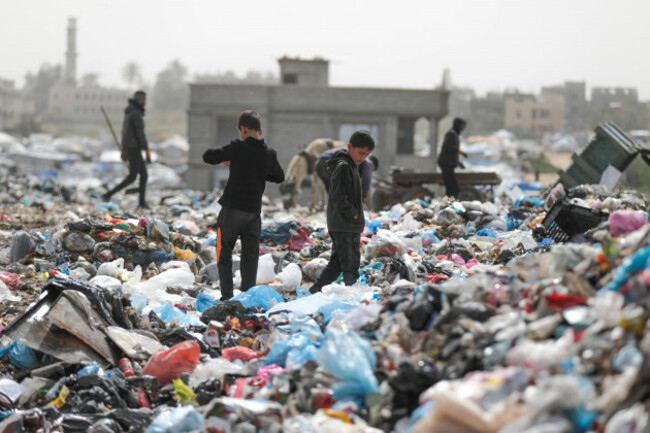
“Physical infrastructure damages are estimated at $35.2bn (€29.9bn), with economic and social losses amounting to $22.7bn (€19.3bn).”
Gaza’s economy has contracted by 84%, while nearly three-quarters of Gaza’s pre-conflict employed population lost their jobs, resulting in an employment-to-population ratio of 9.3% in the Strip.
“Over 80 percent of employees in Gaza were unable to work due to extensive workplace destruction, roadblocks, and transportation disruptions, as well as on-site challenges such as power outages or supply shortages,” the assessment states.
Gaza has been under a fragile US-brokered ceasefire since last October. However, violence has continued since it came into effect.
Over 750 Palestinians have been killed since it came into effect, according to the Palestinian health ministry. The Israeli military says five of its soldiers were also killed in Gaza during the same period.
Israel’s military campaign in the Strip has killed more than 72,000 people in total.
Separately today, a group of UN experts said the EU must immediately suspend its trade agreement with Israel as a “minimum” requirement under international law.
The group was made up of special rapporteurs, working groups and independent experts, including Francesca Albanese, Farida Shaheed and George Katrougalos.
The experts said the EU-Israel Association Agreement, the legal basis for the EU’s trade relations with Israel, has granted the country preferential access to the European market since 2000 “despite well-documented human rights violations that have escalated into atrocity crimes, including genocide”.
Recalling that under Article 2 of the Agreement respect for human rights and democratic principles are an “essential element,” the experts said that serious and persistent breaches of international human rights law and international humanitarian law by Israel should have triggered the legal grounds for suspension of the agreement long ago.
“The EU cannot credibly claim to uphold human rights while sustaining preferential trade with a State whose conduct has been found by multiple international bodies as amounting to genocide, crimes against humanity, and war crimes,” they said.
EU foreign ministers are due to meet in Luxembourg tomorrow. The UN experts said they must “consider the suspension, in full or in part,” adding: “This meeting is taking place amid growing public demand within Europe for accountability.”
“In light of the gravity and scale of the human rights violations documented, full suspension is not a matter of political discretion but a legal imperative incumbent on the European Union, and represents the minimum measure required to align its actions with its obligations under international law.”
A petition to suspend the agreement last week reached one million signatures.
With reporting from © AFP 2026

To embed this post, copy the code below on your site















have your say