Take part in our latest brand partnership survey

We need your help now

Support from readers like you keeps The Journal open.

You are visiting us because we have something you value. Independent, unbiased news that tells the truth. Advertising revenue goes some way to support our mission, but this year it has not been enough.

If you've seen value in our reporting, please contribute what you can, so we can continue to produce accurate and meaningful journalism. For everyone who needs it.

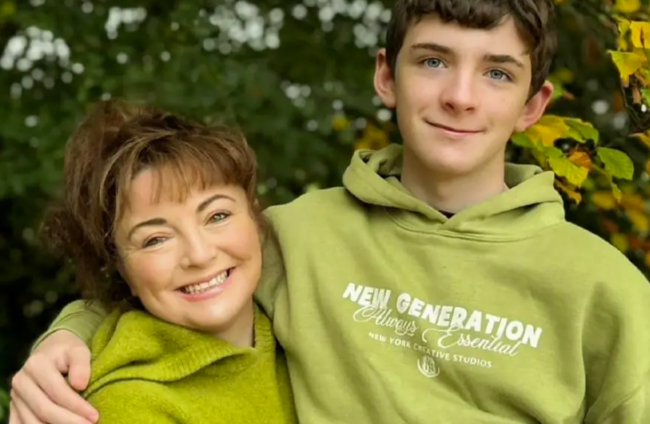
Amanda Nugent with her son Ruaidhri at home in Wexford. Elle Nugent Traynor/Mediaconsult/PA

People with incurable skin disease Butterfly Skin lack support, report finds

The rare condition is caused by an absence of proteins between the skin layers, causing it to tear and blister at the slightest touch.

SERIOUS GAPS EXIST in the care of people with an incurable and painful skin disease, an independent report has found.

An examination of supports for the 300 people in Ireland living with epidermolysis bullosa (EB) revealed that home nursing services are affected by staff shortages, high turnover and limited training.

The rare condition, also known as Butterfly Skin, is caused by an absence of proteins between the skin layers, causing it to tear and blister at the slightest touch.

It requires painful bandaging to prevent infection, which in severe cases must be changed daily.

Patients living with the condition, and others caring for family members with EB, will outline their concerns about the shortfalls in care to TDs and Senators in Leinster House on Wednesday. 

The EB Butterfly Review, commissioned by national charity Debra, found “serious systemic gaps” are limiting patients’ quality of life, and that access to essential wound care materials and medication is inconsistent.

Ireland lacks a national bandage scheme, which means those with less severe forms of EB often bear the financial burden.

‘Severely lacking’

Psychological and dental support are described as “severely lacking”, with financial and welfare supports “complex and exhausting”.

The Ernst & Young report recommends delivery of high-quality home nursing services, making it easier to apply for financial support and improving access to, and affordability of, medications and wound care.

Debra CEO Jimmy Fearon said there have been some positive developments in recent years and the charity has been working with the Government and HSE to secure ring-fenced, annual funding which would make “a world of difference” to the EB community.

“This could be used to build integrated and sustainable nursing care to alleviate some of the heavy burden of the lifelong condition and provide additional psychological support at St James’s Hospital to safeguard the mental health of EB patients,” he said.

One mother living with EB says the lack of co-ordinated care makes her feel invisible to the State.

“You’re punished in every single way,” said mother-of-one Amanda Nugent, 47, from Newbawn in Co Wexford.

“Because of my type of EB, I can’t access medical cards. I’m not entitled to long-term illness, to disability, yet I have one of the rarest conditions in the world.”

She is forced to borrow plasters and bandages from her 12-year-old son Ruaidhri, who also lives with EB simplex, along with over 20 relatives in her extended family.

Ms Nugent, who was diagnosed at age 37, says she grew up experiencing excruciating blisters, one the size of a duck egg, on her feet.

She was “absolutely devastated” when her son was also born with the condition.

“It is devastating too for my mental health because there is a feeling that I gave that to him,” she said.

Dubliner Liz Collins, whose daughter Claudia Scanlon lives with one of the most severe types of EB, said that every chapter of life brings new challenges, and dressings have to be carried out 365 days a year.

“It’s a horrible place to be, like being stuck in a hole you can’t get out of,” she said.

“Carers often feel like prisoners because the current level of care is fragmented, fragile, and not properly co-ordinated. A community care co-ordinator would go a long way to resolving that.”

Readers like you are keeping these stories free for everyone...
A mix of advertising and supporting contributions helps keep paywalls away from valuable information like this article. Over 5,000 readers like you have already stepped up and support us with a monthly payment or a once-off donation.

Author
View comments
Close
Comments
This is YOUR comments community. Stay civil, stay constructive, stay on topic. Please familiarise yourself with our comments policy here before taking part.
Leave a Comment
    Submit a report
    Please help us understand how this comment violates our community guidelines.
    Thank you for the feedback
    Your feedback has been sent to our team for review.

    Leave a commentcancel

     
    JournalTv
    News in 60 seconds