Take part in our latest brand partnership survey

We need your help now

Support from readers like you keeps The Journal open.

You are visiting us because we have something you value. Independent, unbiased news that tells the truth. Advertising revenue goes some way to support our mission, but this year it has not been enough.

If you've seen value in our reporting, please contribute what you can, so we can continue to produce accurate and meaningful journalism. For everyone who needs it.

File phot: Hospital ward Alamy Stock Photo

Hospitals under the 'spotlight' with new performance dashboard showcasing best and worst in class

The data shows there has been a rise in the number of full-time consultants but a fall-off in consultant appointments.

A NEW ONLINE dashboard which puts the “spotlight” on the productivity performance of hospitals around the country has gone live this afternoon.  

Launched by the Department of Health, the new dashboard collates pre-existing statistics into fresh formats that provide perspectives on what has been dubbed a “productivity conundrum” by senior officials.

The new platform, which will be open to the public to access, comes just days after Health Minister Jennifer Carroll MacNeill announced that the majority of health staff will have to work weekends under a new rostering deal.

The online tool allows for the comparisons of waiting lists and other performance indicators, such as weekend discharges, but it will also allow hospital management to benchmark their performance against their peers.

The department said the dashboard is a “learning tool” and “not a stick to beat anyone with”.

Quietly it is the expected it will increase accountability for hospital management teams whose productivity metrics are going in the wrong direction. 

Increase in consultants but fall-off in appointments

One of the key data set looks at the rise in the number of full-time consultants working in the health system. Despite the increase, the data shows a fall-off in consultant appointments.

Consultants could have held 1.5 million more appointments last year if they were operating on the same level of productivity as 10 years ago, according to the new metrics calculated by the Department of Health.

This is something department officials have said there needs to be an “important debate” around, stating that hospital management need to “get to grips with that question”. 

Department officials said the dynamics behind that discrepancy have yet to be explained, adding that Ireland would have a “vastly more effective service” and “massive reductions in waiting times” if 2016 productivity levels had been maintained.

Acknowledging that consultants may find the blunt comparison unfair given the impact of Covid-19 on the intervening years, officials still said the health service seems to be “a bit stuck” on the roughly 1,200-appointments-per-consultant figure.

Described as a “productivity puzzle”, officials outlined the fall in outpatient appointments per consultant.

There were 1,812 consultants in 2016, rising to 3,061 in 2024.

However, the number of appointments per consultant has fallen from 1,686 in 2016 to 1,209 in 2020 – where it appears to have roughly plateaued into the present day.

Using the correlating 3.1 million outpatient appointments in 2016, the department said this meant the same efficiency could have resulted in 5.2 million outpatient appointments last year.

However, this is 1.5 million above the actual figure of appointments which stood at just 3.7 million in 2024.

“We’re open to hearing from consultants who are the experts in it,” a department official said, adding that it “definitely warrants a major effort” to push back towards previous productivity levels – even if 2016 rates are no longer realistic.

What hospital is doing the best at weekend discharges? 

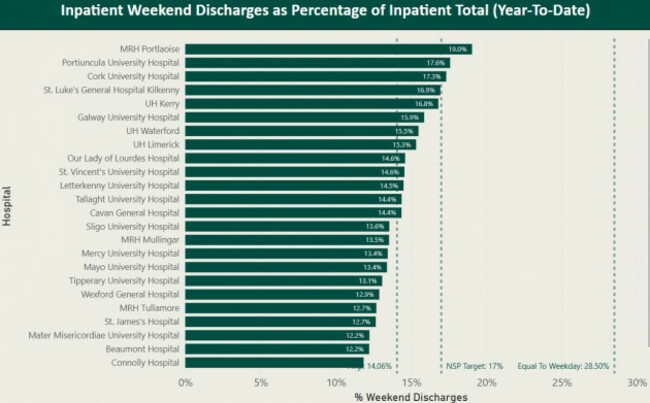
The dashboard also looks at weekend discharges, something the health minister has been focusing on since taking office. The data shows that only three hospitals are meeting the target of 17%. 

Untitled

It shows that Portlaoise Hospital, Portiuncula University Hospital and Cork University Hospital have reached the target, but the majority fall far short. 

Officials believe that moves to a fuller seven-day working week will improve productivity.

Will money follow productivity? 

The new dashboard attempts to distil years-long increases in productivity across different types of care into a single figure so as to compare where there has been expenditure increases, and to review if productivity has followed. 

Officials said it showed that some hospitals are “notably better” at converting increased funding into activity, adding that they wish to determine the reasons for that.

The department said that when major public investment decisions are being made in healthcare, there is a need to have assurances that investment will be converted into improved services.

This platform will now add transparency around that very question. 

The health minister said today that there has not been enough focus on how hospitals are locally managing increased investment and whether it is being done in the most efficient way for better patient outcomes.

Carroll McNeill said: “For too long hospitals have had the opportunity to regard themselves as independent republics.

“They are very much part of a State system that is funded by the State, and it’s a reasonable and appropriate process to shine this light in relation to their activity.”

She said it could not be the case that increased investment in health did not result in increased efficiency.

Carroll McNeill added: “That means more outpatient appointments, that means better use of surgical capacity, that means better use of diagnostic capacity.

“And I think the productivity dashboard here is a way of making sure that we are holding hospitals and individual specialisms to account to manage themselves better.”

Consultants reaction

The Irish Hospital Consultants Association(IHCA) said in a statement that it welcomed  the Department of Health’s focus on transparency and performance but cautioned that such productivity data must be presented in proper context.

The association said the OECD does not regard the number of doctor consultations per person as a valid measure of productivity, as consultations differ in complexity, duration and impact, and the metric fails to reflect the significant volume of care provided to hospital inpatients, as well as time spent on diagnostics, research, clinical governance and administration.

Any productivity analysis must seek to reflect the value and outcomes associated with care, not merely the volume, said the IHCA.

The group argued that consultants have repeatedly called for targeted investment in critical enablers to improve productivity and outcomes, such as increased access to diagnostic staff, modernised outpatient scheduling, faster turnaround for test results, and the expansion of multidisciplinary support teams.

“This is fundamentally a capacity crisis, not a productivity issue involving any one group of staff. Framing it otherwise risks creating false expectations and undermining collaborative efforts,” it said. 

“The sooner we collectively acknowledge this reality, the sooner we can make real progress in improving patient access and outcomes. We are absolutely committed to doing more — but we cannot do it alone,” the IHCA said.

With reporting by Press Association

Readers like you are keeping these stories free for everyone...
A mix of advertising and supporting contributions helps keep paywalls away from valuable information like this article. Over 5,000 readers like you have already stepped up and support us with a monthly payment or a once-off donation.

Close
13 Comments
This is YOUR comments community. Stay civil, stay constructive, stay on topic. Please familiarise yourself with our comments policy here before taking part.
Leave a Comment
    Submit a report
    Please help us understand how this comment violates our community guidelines.
    Thank you for the feedback
    Your feedback has been sent to our team for review.

    Leave a commentcancel

     
    JournalTv
    News in 60 seconds