Sign in. It’s quick, free and it’s up to you.
An account is an optional way to support the work we do. Find out more.
Sign in. It’s quick, free and it’s up to you.
An account is an optional way to support the work we do. Find out more.
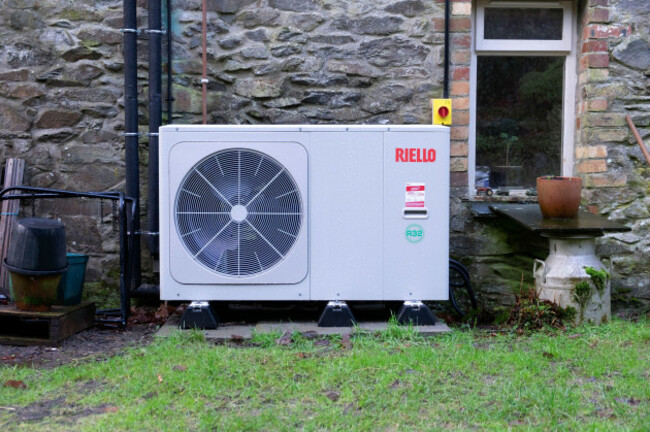
IT WILL BE 2042 by the time Ireland achieves its target of fitting 400,000 existing homes with heat pumps based on current trends, a new study has warned.
That’s 12 years too late, as the target set out in the 2024 Climate Action Plan is supposed to be met in 2030.
This is despite rapid advances in heat pump technology which mean the systems are technically suitable for as many as three quarters of Irish homes.
Researchers from the Irish Building Stock Observatory (IBSO) at TU Dublin identified a number of problems slowing uptake of heat pumps, which use electricity to take energy from outside to heat homes and provide hot water.
One of the most important is what’s called the “comfort barrier”. Over a third of Irish homes are a ‘C’ on the building energy rating (BER) scale, which means they are likely to have manageable heating costs and be reasonably comfortable when the heating is turned on.
Elihu Essien-Thompson, a research assistant at the IBSO and lead author of the paper published in the journal Energy Policy, said there are many studies showing that when a home is “comfortable enough”, homeowners are happy to continue on as they are.
This is likely to be the case for Ireland’s C-rated homes. For many of these homeowners, retrofitting provides diminishing returns on investment. People living in C-rated homes simply may not be motivated to go for an extensive upgrade to their house – but these upgrades are very much needed to meet national targets, the researchers warned.
Ciara Ahern, principle investigator at the IBSO and a co-author of the study, said cheaper electricity tariffs for people running heat pumps could help to move the dial when it comes to encouraging homeowners to switch from a boiler – particularly when a heat pump in a C-rated house could be more expensive to run than one in a B-rated house.
The study also warned of low uptake of retrofits for older apartments. Without targeted policies to address this problem, these older flats risk becoming stranded assets - prematurely devalued and left behind by the pace of change across the wider housing sector.
There is another important barrier to heat pump uptake: the criteria by which houses can qualify for state grants. To qualify for a heat pump grant, buildings must meet a specific heat loss indicator (HLI), a measure of a building’s efficiency.
This requirement is quite stringent and hasn’t kept pace with rapidly improving heat pump technology, which means the systems are actually suitable for far more homes than can qualify for the grants. The researchers concluded that the HLI criteria need to be reformed, adding that tailored measures for C-rated homes are needed.
“The [heat pump] technology is getting better, more efficient, more powerful. Plus the grid is decarbonising, the cost of producing electricity is going down. So it is possible to put heat pumps in more homes,” Essien-Thompson said.
The researchers predicted that the target of retrofitting 500,000 homes to B2 standard by 2030 will be missed, although only by two years.
Case studies of C-rated homes exposed a “critical” gap in the Ireland’s buildings rules, whereby homes can achieve B2 building energy ratings (BER) without a substantial reduction in their heat demand. That’s because homeowners can get from C to B2 standard by installing solar panels.
Solar photovoltaic (PV) panels, which convert sunlight into electricity to power homes, enjoy “strong marketability”, the researchers noted, not least because they have a payback period of just five to 10 years.
One case study the researchers looked at, an extended 1980s three-bed semi-d, was able to do just that. Even at B2, this house would not be considered “heat-pump ready”.
From the point of view of meeting Ireland’s emisisons reduction targets, this use of solar panels rather than energy efficiency upgrades to achieve a better BER is bad news.
Heating homes causes about 12% of Ireland’s greenhouse gas emissions. Three quarters of Irish homes are heated with oil and gas.
“Decarbonising heat is the critical part,” Ahern said.
“If you look at what drives our peak national demand load, it’s cold weather. During cold snaps, even in your B2 or indeed A-rated home, you will still be turning on your heat. Heat pump technology is so rapidly advancing that we have to reassess our traditional, albeit well intended, approaches.”
Last year, 4,360 Irish homes drew down heat pump grants from the Sustainable Energy Authority of Ireland (SEAI), the agency told The Journal. By contrast, over 30,000 homeowners received grants for solar PV, a new record.
We asked the SEAI, which administers Ireland’s grant system for heat pumps and retrofits, for its reaction to the research.
It said an overhaul of the grant system this year has made an extra €4,000 available for renewable heating, which could reduce the costs of a whole home heating system upgrade and accelerate the uptake of heat pumps. In addition, a further €2,000 for heating upgrades by homeowners doing a step-by-step retrofit is also available.
“The upfront cost of heat pumps, and the additional cost of potentially having to replace the entire heating system, may be a barrier to some homeowners seeking to adopt heat pumps,” the SEAI said.
The SEAI said Ireland has made “real progress” towards its CO2 reduction target for the residential sector for 2030.
As for the toss-up between PV, insulation and heat pumps, it said “there’s no single solution that works for every home”.
It said its message to homeowners is that “whatever improvements you can make, big or small, all of it helps to cut your energy bills and reduce emissions”.
The SEAI has begun a pilot investigating the use of heat pumps in houses without large insulation upgrades.

To embed this post, copy the code below on your site












have your say