Sign in. It’s quick, free and it’s up to you.
An account is an optional way to support the work we do. Find out more.
Sign in. It’s quick, free and it’s up to you.
An account is an optional way to support the work we do. Find out more.
THE GROTESQUE EXTENT of human waste littering the world’s oceans has been brought into stark relief by a team of researchers from University College Cork who found plastic rubbish in a two-kilometre deep submarine canyon, 320 kilometres from land.
UCC’s Marine Geology Research group has been investigating cold-water coral habitats in the Porcupine Bank Canyon, some 320 km due west of Dingle.
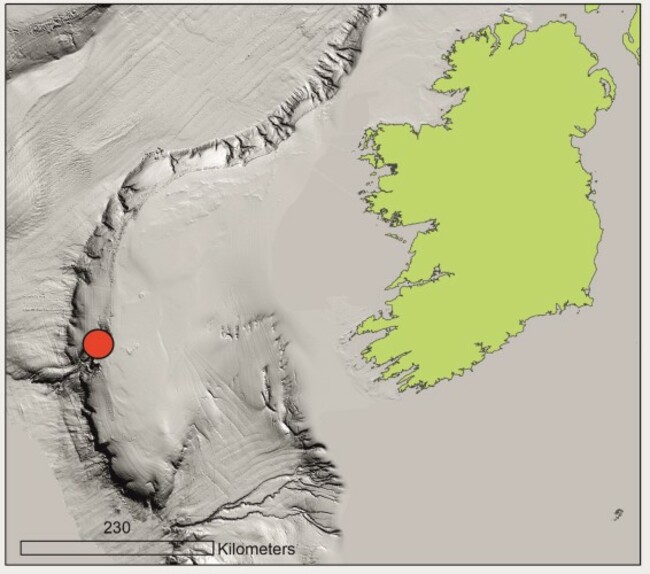
The team placed eight monitoring stations called ‘landers’ on the seabed, spaced out between 700m water depth and 2,500m water depth, to understand conditions in the vast underwater canyon and how the corals are coping with changing oceans.
They used a remotely opereated vehicle equipped with cameras to rove around the seafloor and position the landers.
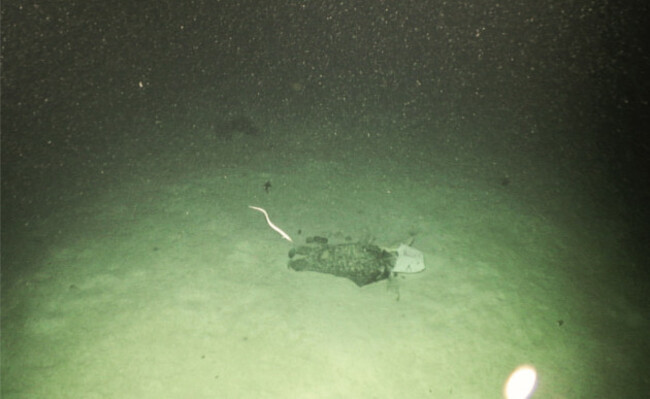
While operating the rover the team encountered a range of rubbish including black plastic bags, a large, heavy plastic bag, fishing gear and water bottles.
The rubbish was found at a depth of 2,125 metres. More than twice as deep as Carrauntoohil is high.
“Unfortunately we’ve now encountered it a couple of times so it’s no longer too surprising, but it really is shocking to find plastic waste so far off-shore and so deep in the ocean,” UCC’s Professor Andrew Wheeler told TheJournal.ie.
This area is incredibly remote. It’s not seen very often and humans can’t really go there. But then we’re down there and you see that humans have actually already been there, in a sense, in the form of their rubbish.
Micro plastics
The problem of plastic waste in the ocean isn’t exclusively larger items such as bags or bottles.
Microplastics are plastic fragments smaller than 5mm. They can be purposefully made that size or can be bits of plastic that break down from larger pieces.
They are extrememly problematic because fish or other aquatic organisms eat them and die or have other health problems.
It’s believed that they may be harming the health of coral in the enormous canyon in two different ways. As well as raining down on the seafloor and choking the coral they may also prevent food from reaching the reefs.
A primary source of food for coral is plankton that sinks to the ocean floor when it dies. Professor Wheeler explained that one fear is that the buoyancy of plankton may be affected by ingesting microplastics, meaning it never reaches the seabed, diminishing a vital source of food for the coral.
The landers collected samples every two days so the researchers would be able to see exactly what is circulating on the seabed.
Freshly docked back in Cork, the UCC team will now analyse their samples to see what food, sediment and microplastics are present to deepen our understanding of the environment on the ocean floor.

To embed this post, copy the code below on your site














have your say