Sign in. It’s quick, free and it’s up to you.
An account is an optional way to support the work we do. Find out more.
Sign in. It’s quick, free and it’s up to you.
An account is an optional way to support the work we do. Find out more.
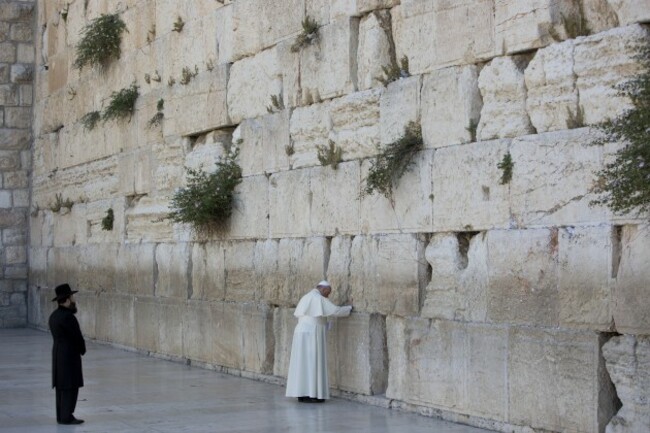
POPE FRANCIS HAS prayed at Jerusalem’s Western Wall, the holiest place where Jews can pray, in an unexpected stop in Israel this morning.
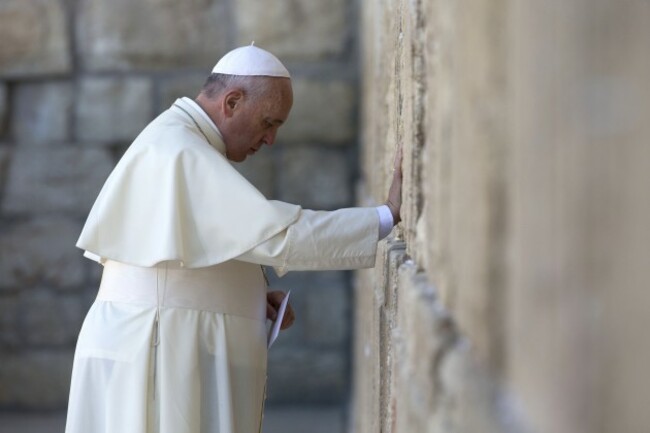
The Pope bowed his head as he touched the wall in the same gesture used a day earlier to pray at the Israeli barrier surrounding the biblical West Bank town of Bethlehem.
Pope Francis spent a few minutes this morning at the only remains of the biblical Second Temple and left a note inside an envelope in one of the cracks between the stones.
He also shared an emotional embrace with two close Jewish and Muslim friends travelling with him.
When St. John Paul II visited in 2000, he left a note asking forgiveness for the suffering inflicted on Jews by Christians over history. Pope Benedict XVI’s note prayed for peace for Christians, Muslims and Jews alike.
The Vatican hasn’t said if the contents of Francis’ prayer would be released.
Pope Francis’s message to Muslims
Earlier, the Pope urged his “brother” Muslims to never abuse God’s name through violence as he opened the third and final day of his Middle East pilgrimage with a visit to the Dome of the Rock, the iconic shrine located at the third-holiest spot in Islam.
Pope Francis took off his shoes to step into the gold-topped dome, which enshrines the rock where Muslims believe the Prophet Mohammad ascended to heaven.
Speaking to the grand mufti of Jerusalem and other Muslim authorities, Pope Francis deviated from his prepared remarks to refer not just to his “dear friends” but “dear brothers.”
“May we respect and love one another as brothers and sisters,” he said, and added,
May we learn to understand the suffering of others. May no one abuse the name of God through violence.
The mosque complex, known to Muslims as the Noble Sanctuary and to Jews as the Temple Mount, is at the heart of the territorial and religious disputes between Israel and its Arab neighbours.

To embed this post, copy the code below on your site














have your say