We need your help now

Support from readers like you keeps The Journal open.

You are visiting us because we have something you value. Independent, unbiased news that tells the truth. Advertising revenue goes some way to support our mission, but this year it has not been enough.

If you've seen value in our reporting, please contribute what you can, so we can continue to produce accurate and meaningful journalism. For everyone who needs it.


Pope Leo XIV addresses the crowd for the Angelus prayer in the Vatican on 10 August Alamy Stock Photo

Pope’s general audience moved indoors due to heatwave as child dies of heatstroke in Italy

Rome is enduring a heat wave this week and temperatures are expected to reach 38 degrees on Wednesday.

LAST UPDATE | 11 Aug

THE VATICAN HAS announced that Pope Leo XIV’s general audience will be moved indoors this coming Wednesday due to high temperatures.

Most Wednesday mornings, the Pope gives a general audience to pilgrims at the Vatican in Rome.

It’s not a Mass, but is instead a reflection on a piece of religious scripture.

The audience begins with a short reading, a homily based on the reading, and then the Pope will offer a blessing to all who are present or following online.

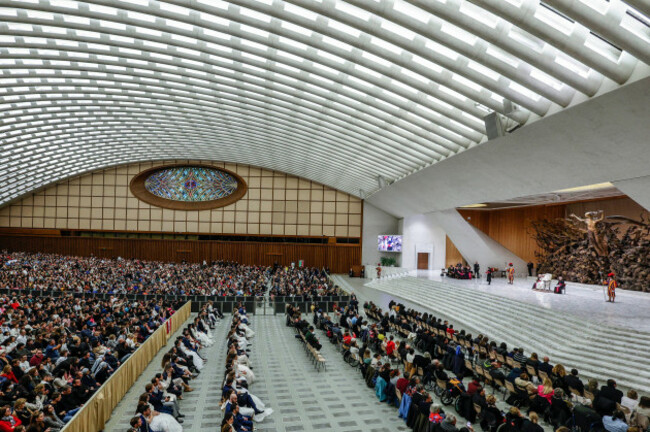
This coming Wednesday, it will be moved to the Paul VI Audience Hall, which is located next to St Peter’s Square.

It can hold around 6,300 people, though the general audience will still be broadcast on the big screens set up in St Peter’s Square.

vatican-city-vatican-city-03rd-jan-2024-pope-francis-attends-his-weekly-general-audience-in-the-paul-vi-hall-at-the-vatican-january-3-2024-credit-riccardo-de-luca-update-imagesalamy-live-ne The late Pope Francis attends a general audience in the Paul VI Hall on 3 January 2024, when it was moved indoors due to cold weather Alamy Stock Photo Alamy Stock Photo

Afterwards, Pope Leo go into St Peter’s Basilica to greet those who could not find a place in the Hall and followed the audience on the screens in the Square.

Rome is enduring a heat wave this week and temperatures in the city are expected to reach 38 degrees on Wednesday.

Elsewhere in Italy, a four-year-old Romanian boy died of heatstroke days after being found unconscious in the family’s car in Sardinia.

The boy was airlifted to a Rome hospital but died of irreversible brain damage.

The news came as Italy’s health ministry issued a red alert warning for seven major cities, including Bologna and Florence.

Some 11 Italian cities are on red alert for Tuesday, and 16 cities on Wednesday, while around 190 firefighters and the army continue to tackle a wildfire on Mount Vesuvius that caused the closure of the national park to tourists.

France

Meanwhile, records were broken at four weather stations in southern France today.

Large parts of France baked in a new summer heatwave today and the government called for vigilance.

In the southwestern city of Bordeaux, the mercury reached 41.6 degrees at around 4:00 pm, compared with a previous record of 41.2C on 23 July, 2019.

All-time records were also broken at meteorological stations in Bergerac, Cognac and Saint Girons, according to the national weather service, Meteo France.

“The maximum temperatures could rise further,” Patrick Galois, a forecaster at Meteo France, told reporters.

A temperature of 41C was also recorded in the cities of Toulouse and Carcassonne.

The heatwave, the country’s second this summer, began on Friday and was forecast to last at least until the weekend, though it could extend into next week.

Today, 12 French departments were placed on red alert, the country’s highest heat warning, and the national weather service said it was placing four more departments on red alert from midday tomorrow.

Forty-one other departments were under lower-level orange alerts, as was the neighbouring microstate of Andorra, between France and Spain.

The French public health agency called for vigilance, urging people to stay hydrated and avoid alcohol and coffee.

Spain

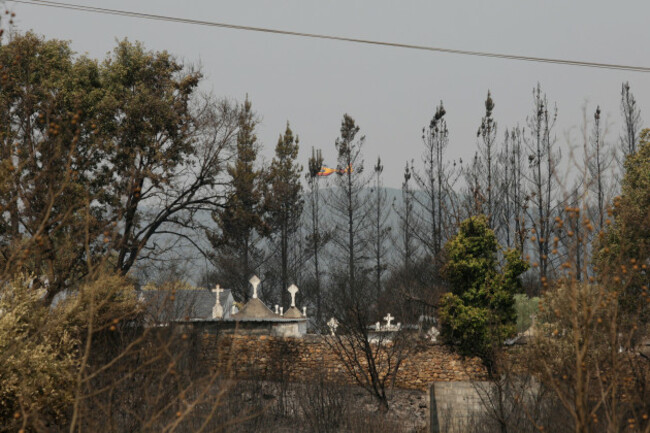
Elsewhere, firefighters in northwestern Spain struggled on today to contain a wildfire that damaged a Roman-era mining site and forced hundreds of residents to evacuate.

The firefighting effort faced “many difficulties” due to high temperatures and winds of up to 40 kilometres per hour.

Around 700 people remained displaced and four people, including two firefighters, suffered minor injuries.

The blaze broke out on yesterday near the UNESCO World Heritage Site of Las Medulas, a Roman gold-mining area famed for its striking red landscape in northwestern Spain.

UNESCO describes the site as “unquestionably the best preserved and most representative of all the mining areas of the Greco-Roman world in classical times.”

burned-field-in-the-area-of-las-medulas-on-august-11-2025-in-el-bierzo-leon-castilla-y-leon-spain-forest-fires-continue-in-the-province-of-leon-with-one-of-the-most-complex-contexts-in-the-fi Burned field in the area of Las Medulas, considered a World Heritage Site. Alamy Stock Photo Alamy Stock Photo

Spain has been in the grip of a heatwave for the past week, with temperatures nearing 40 degrees in many areas and fuelling wildfires.

The northwestern Castile and Leon region alone has seen 13 fires in the past three days, some were believed to have been deliberately started.

In neighbouring Portugal, firefighters were battling three large wildfires in the centre and north of the country.

The largest, near the town of Trancoso, has been burning since Saturday and is being battled by more than 650 firefighters backed by six aircraft.

Record highs across Hungary

Elsewhere, Bosnia’s southern city of Mostar reached 43C, while Croatia’s Dubrovnik hit 34C in the morning.

In Serbia, farmers on the Suva Planina mountain renewed appeals for emergency water supplies for livestock after streams and ponds dried up.

In Bulgaria, temperatures were expected to exceed 40C Monday on Monday, with maximum fire danger alerts in place.

Nearly 200 fires have been reported; most have been brought under control, localised and extinguished, but the situation remains “very challenging”, said Alexander Dzhartov, head of the national fire safety unit.

In Turkey, a wildfire fuelled by high temperatures and strong winds forced authorities to evacuate holiday homes and a university campus and to suspend maritime traffic in the country’s north west.

Sunday brought a new national high of 39.9C on Sunday in the south east of Hungary, breaking a record set in 1948.

Budapest also recorded a city record at 38.7C.

Authorities imposed a nationwide fire ban amid extreme heat and drought.

-With additional reporting from © AFP 2025 and Press Association

Readers like you are keeping these stories free for everyone...
A mix of advertising and supporting contributions helps keep paywalls away from valuable information like this article. Over 5,000 readers like you have already stepped up and support us with a monthly payment or a once-off donation.

Close
14 Comments
This is YOUR comments community. Stay civil, stay constructive, stay on topic. Please familiarise yourself with our comments policy here before taking part.
Leave a Comment
    Submit a report
    Please help us understand how this comment violates our community guidelines.
    Thank you for the feedback
    Your feedback has been sent to our team for review.

    Leave a commentcancel

     
    JournalTv
    News in 60 seconds