Sign in. It’s quick, free and it’s up to you.
An account is an optional way to support the work we do. Find out more.
Sign in. It’s quick, free and it’s up to you.
An account is an optional way to support the work we do. Find out more.


The Housing Essay is a new weekly deepdive from a rotating variety of voices into issues impacting the property crisis in Ireland. Are there potential solutions that may be currently overlooked or traditionally ignored by policymakers?
EUROPEAN NATIONS ARE the finest builders of cities in the world. No other place comes close. European cities combine efficiency and liveability with atmosphere and beauty. It has some of the most beautiful neighbourhoods and some of the best transport systems in the world.
Europeans continually augment and improve their cities. Modern industries and infrastructure have been integrated into medieval old towns and handsome twentieth century suburbs. The history of European cities is a history of constant change and renewal. After 1945, European cities rebuilt themselves.
The Europe of today can learn from the Europe of the past. As industries arose in the 19th century, opportunities were created for workers. The cities of Europe nimbly responded by building at an unprecedented pace. People could move to the cities, accessing opportunities. The resulting productivity increases benefitted all of Europe. Between 1800 and 1914, Berlin’s population grew twenty times and Manchester’s grew twenty-five times.
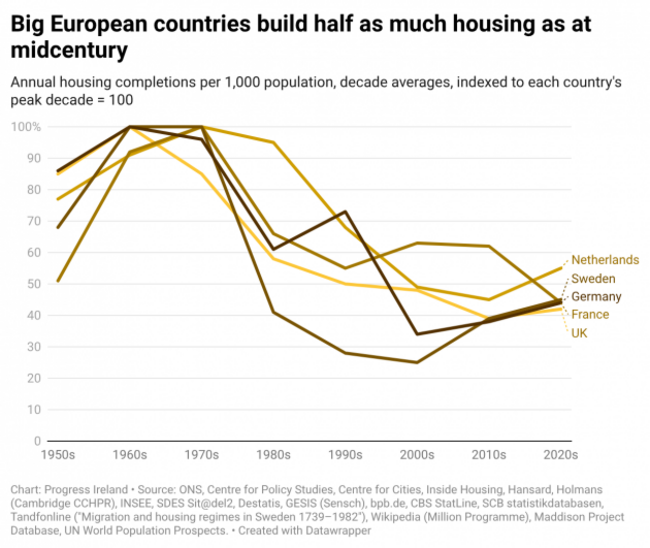
But Europe’s cities have stagnated. This isn’t because people stopped wanting to access Europe’s cities nor is it because cities lacked opportunity. It is because Europe stopped building. Europe’s ability to build has become bogged down, unable to respond to high demand in the way it once did.
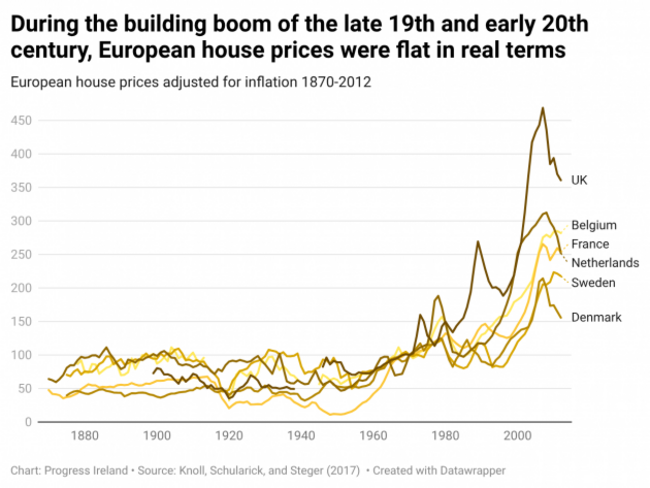
The consequence of this trend is high house and rent price growth and a Europe that is struggling to compete.
It’s important that Europe relearns how to build. Building where economic opportunity arises is key to accessing productivity growth and higher living standards in the future. If Europe falls behind, the future will be made in China and the United States. And Europe’s values will be weaker as a result.
Why has Europe stopped building? The first thing to say is that Europe’s problems are not unique. Major US cities have also undergone a “great downzoning”. But Europe has made it more difficult than it has to be. While there is no single rule or change that alone caused the problem, undoing it will mean unpicking lots of small rules which make building harder than it needs to be.
One set of these rules are environmental. The EU has one of the most robust environmental protection systems in the world. But the system of environmental protection has had some unwelcome side effects. Like with any set of laws or regulations, they should be judged by their effects and not their intentions.
One side-effect is an assessment process that makes building anything unnecessarily slow, expensive, and risky. Take the example of light rail or trams. Light rail allows people to get around cities without cars. They have been primarily an electrified mode of transport for over a century. But despite their environmental benefits, getting light rail built has become harder, not easier in the intervening century. The 2005 environmental impact statement for the Dublin City Centre light railway extension was 176 pages. Twenty years later, the report for the extension to Finglas is over 7,000 pages: the non-technical summary alone was 121 pages.
To that end, Progress Ireland published a report earlier last month addressing this problem: getting Europe building without costing the earth.
Our report touches on several broad themes in environmental protection. The first is making environmental protection more strategic.
Directives like Habitats, Birds, and the assessment regimes (SEA and EIA) were built to ask sensible questions: what will this do to the natural environment? And how might we prevent any environmental damage? But too often, the question is posed in the wrong place, assigned to the wrong part of the system, or simply impossible to adequately answer.
Instead of addressing strategic environmental questions at the level of the regional or national plan, they are left to be litigated at the level of every individual project. The result is that a developer trying to build a few hundred homes inherits questions that no developer is equipped to answer: the cumulative effect of all development in a region, the fate of a migratory species across its whole range, the impact of “other plans and projects” independent of the applicant’s proposal.
Uncertainty becomes the default, delay becomes rational, and litigation becomes the norm. This creates a chilling effect across the whole system: projects are never started, sites are never bought, and risk priced into everything.
To see how this works in practice, take the case of the Light-bellied Brent Geese. They use a network of feeding grounds in the wider Dublin area from October to April each year. However, no statutory plan appeared to resolve this issue. This means the question of the geese is then raised at the level of individual projects. No one can say for sure what might happen to the geese, so projects are rejected. This has led to some 1,200 homes being denied permission overall.
Member states could take steps on their own to implement better, as mentioned in a 2016 Commission Fitness Check. Denmark, for example, maps its biodiversity at a national level as part of a plan-led approach to conservation. However, the drafting of the Habitats Directive currently requires some positive conservation measures but doesn’t compel member states to make the extensive plans needed to resolve this problem. As such, there is a “pass the parcel” dynamic whereby member states end up with systems that work out these questions when it comes to individual planning decisions, not the strategic level plans.
To address this, relevant directives should be updated to improve strategic level plans and explicitly remove onus on project level assessments. Instead of each individual project having to address these big, thorny questions, they can be settled in advance by the plans. Uncertainty about how nature will be protected is replaced by clarity. This also fits neatly into the EU’s simplification agenda: regulatory burdens are reduced without compromising on environment protections.
Second, we show how we’ve lost our sense of proportionality. The original purpose of the directives was to protect the environment, but today they are often associated with decisions that most observers would consider disproportionate.
Take Environment Impact Assessments (EIAs). They have spiralled away from their original purpose, and now serve to slow development unnecessarily. One particular issue is scope creep, where ‘indirect’ effects and other matters which are not a first order impact of the development have to be part of the impact assessment. Even nature restoration projects, which by definition will help nature, are subject to these requirements.
This creates unnecessary bureaucracy, both for the party seeking to develop, who must carry out additional surveys at additional expense, and the planning authorities, who must review the hundreds or even thousands of pages of material that is submitted.
Another problem is materiality. If there is a flaw in an EIA, no matter how small, it can be used by the courts to quash planning permission for the entire project. Permission for 221 homes in Dublin was quashed because there existed two versions of report about the potential for impact on bats, one of which was available to the public online (which committed the developer to seeking a separate licence relating to bats) and another only available in hard copy at the offices of the decision-maker (which did not); the court quashed the permission to preserve an opportunity for the public to make submissions on whether the planning permission should include a condition obliging the developer to seek that separate licence.
Given the need to renew our built environment, disproportionality is causing undue delays and uncertainty. We can restore proportionality to our environmental directives by targeted changes to the original directives. Scope creep should be narrowed. Materiality should be considered by the courts before planning permissions can be quashed. Again, this is in keeping with the wider simplification agenda.
Thirdly, environmental directives create an unreasonably high bar for development.
Under the Habitats Directive, once an appropriate assessment of a proposed project is completed, authorities must subject the proposal to a three-step test before consenting to adverse effects. First, it must be established that there are no alternative places where the development can take place. Second, it must be established that the development is for “imperative reasons of overriding public interest” (IROPI). Third, if those two conditions are met – which rarely happens – adequate compensatory measures must be taken.
At the first step, it’s not clear what counts as an “alternative” site for development. Does the alternative land have to be owned by the developer? How long might this alternative take? And, crucially, at what cost? No matter who the developer is, money is a constraint, as is time. If there is no practical feasibility component to this ‘alternative’ test, then it will be difficult for projects to clear it.
At the second step, the question is what counts as an imperative reason of overriding public interest. The original directive is quite broad, explicitly mentioning reasons “of a social or economic nature”. It’s difficult to argue that housing in high-demand areas, or infrastructure enabling such housing, does not pass this test. In regions where there is a demonstrable housing shortage, the development of new housing is clearly in the overriding public interest and the directive should make this clear. (One option for assessing shortages would be an income to house price ratio.)
An update to Habitats Directive Article 6(4) would address these two issues, clarifying the importance of housing and supporting infrastructure in distressed areas and enabling construction where it is most needed. Like for renewable energy development, the EU can deem these classes of infrastructure to automatically satisfy the test.
There is more detail and specific recommendations in our report, which you can read in full here. We’ve included specific recommendations for how particular directives should be changed to achieve the goals of a renewed built environment.
The EU has a big opportunity to tackle these problems. A housing simplification omnibus is expected in 2027, and there is real momentum around the simplification agenda across Brussels. Get this right and we can take a step towards a Europe that works for its citizens and its environment.
Fergus McCullough is a co-founder of Progress Ireland, a think tank researching policies and implementation of actions to support improved housing, infrastructure and innovation in Ireland. You can read more work like this on their Substack here.
To embed this post, copy the code below on your site















have your say