We need your help now

Support from readers like you keeps The Journal open.

You are visiting us because we have something you value. Independent, unbiased news that tells the truth. Advertising revenue goes some way to support our mission, but this year it has not been enough.

If you've seen value in our reporting, please contribute what you can, so we can continue to produce accurate and meaningful journalism. For everyone who needs it.

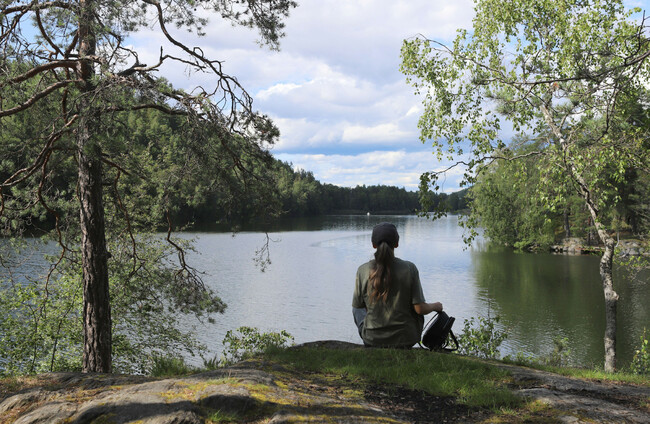
A lakeside hiking trail near Oslo, Norway Alamy Stock Photo

Opinion We should aim to be the first generation to experience more nature, not less

Our relationship with nature is broken but fixing it could be the key to happier, healthier lives, writes Dr Ola Løkken Nordrum.

WE ARE IN the midst of an unprecedented environmental crisis – yet so often, many of us feel nothing about it.

Europe, on our doorstep, experienced yet another heatwave this summer. Hundreds of people died from heat-related illnesses, and wildfires wreaked havoc. But this is just the beginning; worse is yet to come due to unchecked climate change. And still, we read the articles, watch the news, and move on, often feeling nothing at all.

This response, this collective inability to feel strongly enough about the crisis to act on it, is, I believe, linked to our disconnect from the natural world. Our relationship with nature is broken.

A recent study has reported that people’s connection with nature has dropped by 60% since 1800. We are caught in a vicious circle where environmental degradation, fuelled by accelerated urbanisation, has eroded our connection to the natural world.

This is a symptom of a broken system, one in which nature is only seen as valuable when it directly benefits the economy. As a result, only a small fraction of Ireland consists of healthy natural ecosystems.

Most of us live in urban areas and spend the majority of our lives indoors. Consequently, many of us are suffering, often unknowingly, from a collective “nature deficit disorder”. It is no wonder why many struggle to care, or to act.

But this disconnection is not beyond repair. I believe that by rebuilding our relationship with the natural world, we can not only experience the immense health benefits of spending time in nature, but also become more inclined to protect and preserve our shared environment.

Powerful benefits

The benefits of spending time in nature are nearly endless. From the obvious physical advantages to improvements in mental health, reducing stress, boosting mood, and enhancing sleep, to more mysterious effects such as trees potentially boosting the activity of natural killer (NK) cells, which play a key role in fighting cancer and other diseases.

While not yet fully understood, these effects only reinforce the idea that nature truly is a miracle drug. There are social benefits too as nature has an extraordinary ability to bring people together, foster social interactions and help build stronger communities.

The more people experience and appreciate nature, the more likely they are to protect it. Yet in Ireland, nature is too often inaccessible and locked away, often requiring a car for access.

By making nature more available and integrated into daily life, we can rekindle the deep intrinsic connection between humans and the natural world, inspiring a renewed sense of care and responsibility.

Looking for inspiration

In Māori culture, health is viewed through the holistic lens of hauora, which comprises four interrelated dimensions: taha tinana (physical wellbeing), taha wairua (spiritual wellbeing), taha hinengaro (mental and emotional wellbeing), and taha whānau (social and family wellbeing). All dimensions are essential for balance and stability.

A vital part of spiritual health is the connection to the land, which nourishes not only the body but also the spirit. If the land suffers, so too does the person, both in a practical sense such as loss of food sources, but also in terms of a deeper acknowledgment of one’s place within a larger ecosystem.

Through the lens of hauora, true wellbeing cannot be achieved unless all dimensions are respected and cared for. Thus, no nature, no health.

In Ireland, the concept of sláinte carries deep cultural roots that resonate with this holistic view of wellbeing. While it may not be as formally structured as hauora, sláinte reflects an intrinsic valuing of health as something communal, interconnected, and grounded in both the body and spirit.

In traditional Irish culture, health wasn’t seen as an isolated personal state, but something deeply influenced by community, spiritual forces and crucially, our shared environment.

So what could this look like in practice? In countries such as Norway, spending time in nature is deeply embedded in the culture. In Oslo, a city roughly the size of Dublin, you can easily hop on a bus, train, or the metro after work and, within minutes, find yourself on hiking trails or cross-country ski tracks.

A network of cozy cabins scattered throughout the forests surrounding Oslo offers simple, warm meals, pastries, and a place to rest, making it easy for people to escape the demands of modern, often nature-deprived life. If you prefer to sleep in a tent, there are almost endless campsites dotted around the forests.

Across the country, the Norwegian Trekking Association (Den Norske Turistforening, or DNT) maintains an extensive network of marked trails and more than 550 cabins. These range from simple self-service cabins with bunk beds and basic kitchen facilities to staffed lodges serving homemade three-course meals. Accessing this network is affordable: all it takes is a DNT membership and a modest fee for each night spent in a cabin.

Ireland could benefit hugely from a network of trails and bothies or cabins, similar to Norway’s DNT model. Maintained by a nonprofit, this system would allow people to hike from cabin to cabin through Ireland’s bogs, forests, hills, and uplands, making nature more accessible and affordable for everyone.

A vision for Ireland

We should aim to be the first generation in Ireland to experience more nature, not less. For too long, each generation has been increasingly disconnected from the natural world. It’s time to change that by creating pockets of freely accessible connected, protected nature across Ireland where people can freely explore and appreciate the natural world.

We need to bring nature closer to where people live. Simple, accessible green areas such as community forests or parks could offer people a welcomed, easily accessible break from the rush of daily life. We already have lots of these in Ireland, but we need more.

These spaces don’t have to be grand or remote. Instead, we need them to be everywhere and open to all. For instance, the ‘3–30–300 rule’, suggests that people should be able to see at least three trees from home, school, or work, live in a neighbourhood with 30% tree cover, and be within 300 metres of a park or green space. This ‘rule’ should be widely adopted across Ireland.

Another opportunity lies in expanding Ireland’s National Parks. Our current park network holds great potential but remains underdeveloped. The recent extension of Connemara National Park is a welcome step, but we need more, larger and wilder national parks. Nature protection, restoration, and natural wonder must come before tourism and profit.

Coillte, Ireland’s state forestry company, should shift its priorities from commercial forestry to ecological restoration. Profit from timber should be secondary to restoring natural habitats, protecting biodiversity, and regenerating native forests. The goal should be living, resilient landscapes, not just timber yield.

We should also Introduce a Right to Roam. Public access to land is essential if we want people to develop a real connection with nature. A legal Right to Roam would empower everyone living in Ireland to explore and enjoy nature, helping to build a culture of care, respect, and curiosity for the natural world.

As a medic, I believe nature should be part of our healthcare toolkit through “green and blue prescriptions”. Enabling and encouraging people to spend time in forests, parks, or by the sea can significantly improve mental and physical wellbeing.

David Attenborough has warned that much of nature has vanished within his lifetime. In Ireland, we have a choice: to allow that loss to continue, or to ensure that future generations witness a resurgence of the natural world.

By making nature more accessible, we can foster a society that values, engages with, and protects our shared environment, and in doing so, help Ireland become the truly green isle it is meant to be. We cannot afford to numb ourselves into silence while the world that sustains us withers away on our watch.

We need to rediscover our bond with the living world. Our relationship with nature is symbiotic – nature heals and sustains us, and we in turn must protect the natural world. Our health, wellbeing and our very lives depend on it.

Dr Ola Løkken Nordrum is the operations officer of Irish Doctors for the Environment.

Readers like you are keeping these stories free for everyone...
A mix of advertising and supporting contributions helps keep paywalls away from valuable information like this article. Over 5,000 readers like you have already stepped up and support us with a monthly payment or a once-off donation.

Close
Comments
This is YOUR comments community. Stay civil, stay constructive, stay on topic. Please familiarise yourself with our comments policy here before taking part.
Leave a Comment
    Submit a report
    Please help us understand how this comment violates our community guidelines.
    Thank you for the feedback
    Your feedback has been sent to our team for review.

    Leave a commentcancel

     
    JournalTv
    News in 60 seconds