We need your help now

Support from readers like you keeps The Journal open.

You are visiting us because we have something you value. Independent, unbiased news that tells the truth. Advertising revenue goes some way to support our mission, but this year it has not been enough.

If you've seen value in our reporting, please contribute what you can, so we can continue to produce accurate and meaningful journalism. For everyone who needs it.

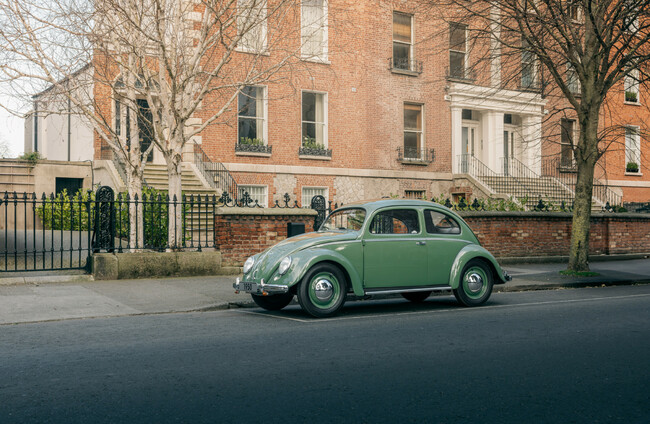
The first Volkswagen Beetle, finished in Irish Green, made in Dublin. Paddy McGrath

The DeLorean, the Shamrock and the 'Donegal Beetle' The cars once built in Ireland

Ireland has a long and interesting history of car manufacturing.

IRELAND ISN’T A country people associate with car manufacturing. We’re better known for exporting writers, musicians and tech workers than new cars. But for a few decades, Ireland really did build cars. Some were assembled from kits, some were designed from scratch, and some were so ill-fated they’ve since become collectors’ items for all the wrong reasons.

It was never a large industry, and it certainly wasn’t stable, but it was far more interesting than most people realise.

The DeLorean: Belfast’s stainless-steel gamble

The best-known Irish-built car is the DeLorean DMC-12, produced in Dunmurry, outside Belfast, in the early 1980s. Backed by major UK government incentives, John DeLorean set out to create a futuristic stainless-steel sports car with gull-wing doors and global impact. If you haven’t watched the Netflix documentary Myth & Mogul: John DeLorean, do.

The looks were spectacular. The reality was less so. The PRV V6 engine wasn’t quick, the price was high, and early build-quality issues didn’t help. Production lasted a little over a year, from early 1981 to early 1982, before the company collapsed. Around 8,500 were built. I remember driving one as a young journalist about 22 years ago and being bitterly disappointed.

Ironically, it only became a global icon after the factory closed, thanks to Back to the Future. Dunmurry’s short-lived experiment is now one of the most recognisable cars on earth.

The Shamrock: Monaghan’s fibreglass folly

If the DeLorean was Northern Ireland’s moonshot, the Shamrock was Monaghan’s cautionary tale.

As documented by Damian Corless in From Clery’s Clock To Wanderly Wagon (Collins Press), the Shamrock was the creation of two American businessmen, William K. Curtis and James Conway, who believed Ireland could build a luxury cruiser for the US market.

The designer they hired, Alvin “Spike” Rhiando, had a racing career — and an autobiography — that read like a Boy’s Own annual. Corless notes that Rhiando variously claimed to be Italian, American, Canadian and occasionally just a Londoner with a flair for showmanship. His tales included wing-walking, Hollywood stunt work, and multiple rescues in the Sahara by the French Foreign Legion.

Whatever about his adventures, Rhiando could drive a car — but designing one was another matter. The Shamrock’s proportions were wildly wrong. Corless quotes one reviewer who said it looked “more like a parade float than a car.” The massive fibreglass overhangs made routine maintenance comically difficult, and underneath sat a tiny Austin A55 engine with no hope of moving such a bulky body with any conviction. One US critic, again cited by Corless, said it resembled “a small English car wearing a big American car costume.”

The car was supposed to be built in Tralee, but early problems shifted the operation to Castleblayney. Ambitions were enormous — 3,000 cars in year one — but the reality was somewhere between eight and ten finished vehicles before the project collapsed. Local legend, also recorded by Corless, says unused fibreglass shells were dumped into Lough Muckno. As a child, one of my friends’ Dads had one in Drogheda and drove it in the St Patrick’s Parade every year. I guess the parade float comment made sense after all.

The TMC Costin: Wexford’s lightweight racer

Ireland’s most credible sports car came from Wexford. The TMC Costin, built by the Thompson Motor Company in Castlebridge, was a lightweight, minimalist machine designed by famed engineer Frank Costin, whose fingerprints were on everything from Marcos to early Lotus cars.

It came with either a Ford Kent engine or a more powerful CVH unit, and delivered strong performance thanks to its low weight. Enthusiasts loved it, but like many Irish automotive ventures, the finances didn’t add up. Fewer than 40 were made before the company folded in 1987. The design survived, however — the rights were sold to Daniel Panoz in the US, where it formed the basis of the first Panoz Roadster.

The Chico: Donegal’s brief off-road dream

In the early 1980s, a German-backed company called Auto-Montan-Werke set up in Buncrana to build an all-terrain vehicle called the Chico — sometimes nicknamed the “Buncrana Beetle”. Expectations were big: up to 1,000 jobs and 15,000 vehicles a year.

The real output was closer to 130–150 before the company folded in 1984. Like many ventures of the era, it was long on vision and short on market demand, but a few Chico survivors still pop up at shows in Donegal.

Ireland’s assembly era: when we built everyone else’s cars

While Ireland produced only a handful of original cars, we spent decades assembling them. According to Bob Montgomery, in Motor Assembly in Ireland (Dreoilín Books), more than 50 different marques were assembled here between the 1930s and the mid-1980s.

Ford’s Cork plant is the best-known example, assembling cars from 1934 to 1984, including the Escort, Cortina and Prefect. Motor Distributors Ltd assembled Volkswagens on Shelbourne Road in Dublin — including the first Beetle ever built outside Germany in 1950, a fact Montgomery highlights. Most of these cars came almost like a big Lego set – known as CKD (completely knocked down) – this method is often used to reduce import costs, such as taxes and tariffs, and to benefit from local assembly incentives that can lead to lower prices for consumers and contribute to the local economy by creating jobs.

Renault 4s were assembled in both Wexford and Dublin. Fiat operated a CKD plant in Meath. Heinkel microcars were built under licence in Dundalk. Newtownards handled everything from the York Noble bubble car to later Clan-related projects.

Montgomery notes that this work relied on local content rules — Irish glass, Irish tyres, Irish springs — which allowed assembled cars to bypass heavy import taxes. When those tariffs changed in the 1980s, the economics no longer made sense. By the mid-80s, Ireland’s assembly era was effectively over.

From building cars to building what goes inside them

Ireland no longer builds whole cars, but we’re deeply embedded in what modern cars do. Valeo’s operations in Galway and Tuam produce cameras, sensors and autonomous-driving systems for BMW, JLR, Volvo, Ford and the wider VW Group. Autolaunch in Carlow makes precision components — including Bentley bumpers. Mergon in Westmeath supplies key parts for EV battery-cooling and airflow systems used by major global brands.

There may never be a mainstream Irish car, but Irish engineering is inside some of the most advanced vehicles on the road.

Readers like you are keeping these stories free for everyone...
A mix of advertising and supporting contributions helps keep paywalls away from valuable information like this article. Over 5,000 readers like you have already stepped up and support us with a monthly payment or a once-off donation.

Close
JournalTv
News in 60 seconds