We need your help now

Support from readers like you keeps The Journal open.

You are visiting us because we have something you value. Independent, unbiased news that tells the truth. Advertising revenue goes some way to support our mission, but this year it has not been enough.

If you've seen value in our reporting, please contribute what you can, so we can continue to produce accurate and meaningful journalism. For everyone who needs it.


Ireland's data centre energy drain How Big Tech added €1.4bn to household electricity bills

New research by Friends of the Earth has found that soaring demand for data centres in Ireland has driven up energy prices, with Irish households paying the hidden cost.

WHAT DO DATA centres have to do with your electricity bill? About €1.4 billion worth, according to new research, which reveals how data centres have been driving up the wholesale price of electricity in Ireland through rising and constant demand on our grid.

The research — written by Dr Seán Fearon and commissioned by Friends of the Earth and Beyond Fossil Fuels — lays bare the impact of Ireland’s open-door policy on data centres in recent decades. Between 2015 and 2023, the data centre price effect meant households in Ireland paid an estimated €715 million extra for their electricity, or an average of €263 per household.

The Russian invasion of Ukraine in 2022 marked the worst of these years. The new research, “The Cost of Data Centres: Modelling the Household Electricity Costs of Ireland’s Data Centre Sector”, shows that during this period, data centres inflated the cost of already rocketing wholesale electricity prices, increasing households’ bills by 8.5% in 2022 alone.

data-centre-control-room Alamy Stock Photo Alamy Stock Photo

Between 2021 and 2023, data centres’ energy use exploded by a third, growing from a 14% share of the island’s electricity system in 2021 to 21% in 2023.

The impact was hardest for households on lower incomes. Anyone who was on social welfare during these years paid an extra €209 between 2021 and 2023, the equivalent of a week’s income, to service this data centre price effect.

This, in effect, wrote off the social welfare increase that people received in 2022, a vital household income that should have gone towards food, bus fares, clothes and school supplies, but was instead drained from the Irish economy.

A blank cheque for data

For many, this was money that people simply didn’t have. In 2022, 236,140 households fell into arrears on their electricity bills, 11% of all customers. This number increased again in 2023, with the number of people who were in debt on their electricity bills by 90 days or more rising.

close-up-shot-of-router-cables-in-a-data-centre-cabinet Alamy Stock Photo Alamy Stock Photo

Had the Irish state reigned in the spiralling growth of the data centre industry during those years of intense price shocks, households’ bills would have been lower. The recent US-Israeli war against Iran has shown that such shocks and supply constraints are becoming a pattern.

According to the research, if the world faces another energy price shock over the next few years, and we keep allowing data centres to expand, households in Ireland will face an additional cost of €1.6 billion. This represents the loss of hundreds of millions of euros from household incomes across Ireland due to policies which prioritise one industry above all others.

These additional costs are a direct result of state policies that have facilitated data centres to swamp the Irish grid, forcing us onto expensive and volatile fossil gas imports to meet the energy demand of the country.

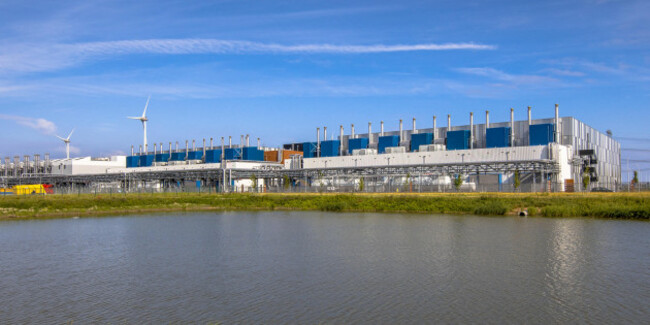
5-july-2016-eemshaven-netherlands-google-datacenter-near-delfzijl-in-the-province-of-groningen-under-blue-sky Google Datacenter near Delfzijl in the province of Groningen under blue sky. Alamy Stock Photo Alamy Stock Photo

Because data centres use so much electricity, the total demand in the Irish electricity market exceeds the availability of lower-cost renewables more often. According to the report, this means that gas sets prices more often, driving up prices.

Greenwashing tech

But what about renewables? Big Tech and the government often position data centres and renewable energy as a “twin transition” needed to increase clean energy. This assumption was core to the State’s Large Energy Action Plan, which puts continued data centre expansion front and centre of its energy policy.

However, the State’s plan doesn’t add up for the rest of us. If we meet our most ambitious renewables targets, and we limit data centre demand, then our research shows that the data centre price effect on our bills goes down. But it doesn’t disappear.

Even in this most optimistic scenario, households still end up paying over €200 extra on their electricity bills across the next eight years through the hidden costs of data centres.

The more plausible scenario is the one we are in right now, where — as the Climate Change Advisory Council has noted — we are “far below” our annual renewables targets, with data centre demand ticking upwards, adding nearly €500 euro extra to each household’s energy bill across the next eight years.

This is enough to wipe out any temporary payments given to households, the likes of which we saw in 2022.

Building renewables is not enough. For a more affordable and sustainable energy system, we have to bring down the demand for data centres.

data-servers-at-the-enterprise-data-center-3d-illustration Alamy Stock Photo Alamy Stock Photo

Data centre demand has grown much faster than home-grown renewables can catch up and, as the Climate Change Advisory Council put it a few weeks ago, are now at risk of “cannibalising” renewables on the Irish system.

But development continues at a fast pace. Recent reports would suggest that Amazon is in discussion with multiple agencies, including Bord na Móna, to build hyperscale data centres as large as 500MW in the Midlands. In Naas, Friends of the Earth is currently appealing the decision of Kildare County Council to let Herbata build a data centre that, if built, we estimate would triple the electricity consumption of the entire county. 50% of electricity produced in Meath and Dublin is soaked up by data centres.

Figures from the Energy Regulator, Commission for Regulation of Utilities (CRU), show that there could be an additional 5.8GW of data centre demand in the pipeline, nearly double the current energy demand of the whole island.

The government has made much of the supposed job benefits that the industry can bring, but by the IDA’s own figures, fewer than 1% of the entire workforce is employed in a data centre.

Is this a good trade-off for an industry that is currently sucking over 22% of our electricity, slowing down the electrification of other sectors, and set to drain over a billion euros from our wages through electricity prices alone?

Our leaders have been quick to defend Big Tech, going as far as to accuse anyone who questions it of “demonising” data centres. In a few months, temperatures will start to drop as winter sets in, days will get shorter, and bills will start to come through the door that many people will simply not be able to pay.

The government can no longer claim ignorance. Ireland’s current approach to data centres is not just an energy issue or a climate issue; it is increasingly a cost-of-living issue.

And ordinary households are paying the price.

Rosi Leonard is Data Centre Campaign Lead at Friends of the Earth Ireland.

Readers like you are keeping these stories free for everyone...
A mix of advertising and supporting contributions helps keep paywalls away from valuable information like this article. Over 5,000 readers like you have already stepped up and support us with a monthly payment or a once-off donation.

View 17 comments
Close
17 Comments
This is YOUR comments community. Stay civil, stay constructive, stay on topic. Please familiarise yourself with our comments policy here before taking part.
Leave a Comment
    Submit a report
    Please help us understand how this comment violates our community guidelines.
    Thank you for the feedback
    Your feedback has been sent to our team for review.

    Leave a commentcancel

     
    JournalTv
    News in 60 seconds