We need your help now

Support from readers like you keeps The Journal open.

You are visiting us because we have something you value. Independent, unbiased news that tells the truth. Advertising revenue goes some way to support our mission, but this year it has not been enough.

If you've seen value in our reporting, please contribute what you can, so we can continue to produce accurate and meaningful journalism. For everyone who needs it.

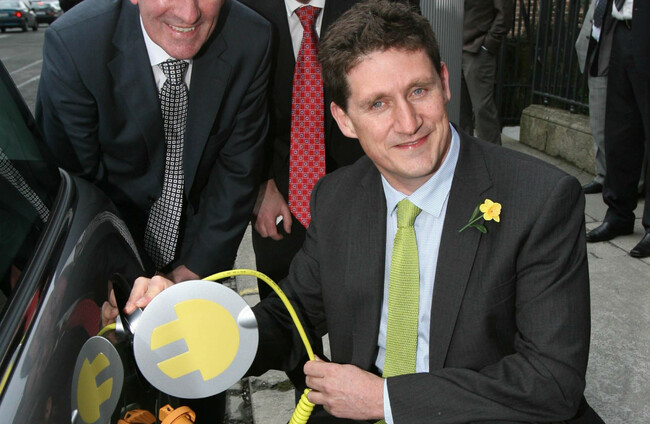
The first electric vehicle charge points in Ireland were launched in March 2010 (yes, that's a younger Eamon Ryan, then minister for communications, energy and natural resources). Alamy Stock Photo

Motoring The list of top-selling EV cars tells us two things about Irish shoppers

What we’re seeing now is the EV market growing up, writes Paddy Comyn.

IF YOU WANT a useful snapshot of where electric vehicles actually are in Ireland right now, forget the targets for a moment. Look instead at behaviour.

EV registrations are up again this year – roughly 36% (36.51) on the same period in 2024 according to figures from The Society of the Irish Motor Industry (SIMI) – after what was a very real wobble last year. That alone matters. It tells us the market didn’t collapse. It paused, recalibrated and then started moving again once prices, supply and expectations settled down.

That’s the state of the nation for EVs in 2025. Not a surge. Not a stall. A reset.

What’s changed is the tone. Buyers are quieter, more pragmatic and much less interested in being sold a future they’re not sure they’re ready for. They’re asking basic questions again: range, resale value, charging costs and whether this all still makes sense financially. That’s healthy.

You can see it clearly in the used market. Data from DoneDeal Cars shows used EV prices have stabilised and resale times are now broadly in line with petrol and diesel. Even more telling is which cars are selling fastest. Models like the MG4, MG ZS and BYD Seal are moving quickly once they hit forecourts.

That tells you two things. First, Irish buyers are more open than ever to Chinese-built EVs if the price and spec stack up. Second, trust is returning – not because of ideology, but because the sums now look predictable again.

That same realism is showing up at manufacturer level. Ford’s latest European strategy announcement was striking not for what it promised, but for what it quietly admitted. The company is leaning into partnerships (they will get Renault to make them two small EVs in the same platform as the wonderful Renault 5), affordability and “multi-energy” vehicles, with new models not arriving until 2028. Ford is also openly asking policymakers to align CO₂ targets with market reality. That’s not backsliding. It’s an acknowledgement that consumers move in stages, not leaps.

The global data backs this up. According to a recent EY Mobility Lens forecast, hybrids and plug-in hybrids will hold roughly 30% of the market well into the 2030s. Europe is still on track to cross 50% EV sales in the early 2030s, but not on the original timeline. China, by contrast, is already approaching 50% new-energy vehicle share this year, helped by stable policy and brutally competitive pricing. The US has slipped again, with mass EV adoption now forecast closer to 2039.

Ireland sits somewhere in the middle. The rebound in EV registrations in 2025 is real, and government supports – from grants to toll incentives – have helped steady things. Charging infrastructure is improving, albeit unevenly. But for many households, hybrids remain the stepping stone that makes sense today, not an ideological failure.
There’s another conversation beginning to bubble up beneath all of this, and it’s one policymakers here will be watching closely: tax.

In the UK, the government has announced plans to introduce a pay-per-mile road charge for EVs and plug-in hybrids from 2028. The logic is simple. Fuel duty is declining as electrification increases, and that revenue has to be replaced somehow. EV drivers would pay a few pence per mile, still less than the average petrol driver pays in fuel duty, but no longer zero.

This isn’t about punishing EVs. It’s about the slow death of a tax model built around petrol and diesel. And once one country moves, others will study it carefully. Ireland hasn’t gone there yet, but the question isn’t whether fuel-duty replacement will be discussed here – it’s when.

That matters, because it brings the EV debate back to something grounded: fairness, cost and transparency. People will accept change if it feels proportionate and predictable. They resist it when it feels ideological or rushed.

The mistake would be to frame this moment as hesitation or failure. It’s neither. What we’re seeing now is the EV market growing up. Prices have adjusted. Choice has widened. Buyers are no longer early adopters or sceptics – they’re normal car owners doing normal sums.

That’s why this phase is more important than the hype years. If EVs are going to become the default, it won’t be because of targets alone. It will be because people quietly decide, at the point of purchase, that this is the sensible option.

Ireland isn’t behind. It’s doing what markets usually do when the noise fades and that is finding its level. 

Paddy Comyn is the Head of Automotive Content and Communications with DoneDeal Cars. He has been involved in the Irish Motor Industry for more than 25 years. 

Note: Journal Media Ltd has shareholders in common with Done Deal Ltd

Readers like you are keeping these stories free for everyone...
A mix of advertising and supporting contributions helps keep paywalls away from valuable information like this article. Over 5,000 readers like you have already stepped up and support us with a monthly payment or a once-off donation.

View 62 comments
Close
62 Comments
This is YOUR comments community. Stay civil, stay constructive, stay on topic. Please familiarise yourself with our comments policy here before taking part.
Leave a Comment
    Submit a report
    Please help us understand how this comment violates our community guidelines.
    Thank you for the feedback
    Your feedback has been sent to our team for review.

    Leave a commentcancel

     
    JournalTv
    News in 60 seconds