We need your help now

Support from readers like you keeps The Journal open.

You are visiting us because we have something you value. Independent, unbiased news that tells the truth. Advertising revenue goes some way to support our mission, but this year it has not been enough.

If you've seen value in our reporting, please contribute what you can, so we can continue to produce accurate and meaningful journalism. For everyone who needs it.

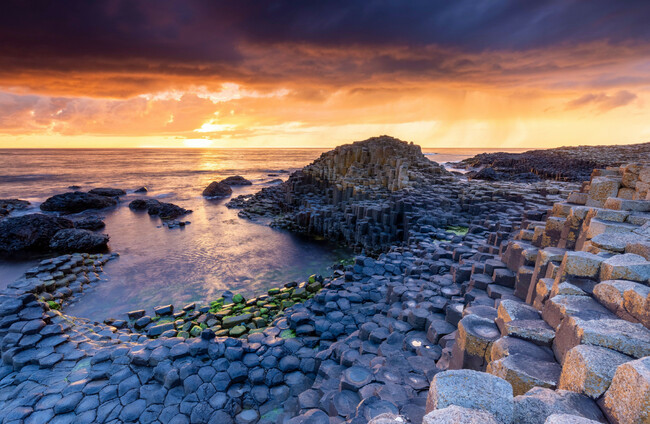
The Giant's Causeway, emblematic of Northern Ireland but also of a rich Irish folklore. Alamy Stock Photo

Fintan O'Toole and Sam McBride Facts, not tribalism, should help decide on a united Ireland

The journalists and columnists say we owe it to each other – and to those who have suffered in the past – to have a debate that is considerate and thoughful.

Journalists Fintan O’Toole and Sam McBride have co-authored For and Against A United Ireland, in which they present the strongest arguments for and against Irish unification. In this extract from the book, they explain how, most importantly, the very tone of the debate will shape the decades after a border poll.

MANY PEOPLE STATE with unbending assurance that a referendum on Irish unity will be held within a short number of years. Others hold with equal confidence that a border poll will not be held for some decades. (We use the terms ‘referendum’ and ‘border poll’ interchangeably – the first tends to be used more often in the South, the second in the North. It is important to note, however, that in reality there would be two votes, one on each side of the border.) Neither side is sure of what it claims to know. But the possibility of a referendum is ever-present. It is not just on the horizon – it affects the way people think about a wide range of political, social and cultural issues in the here and now.

Yet it is shot through with uncertainty. The secretary of state for Northern Ireland retains the power to call a referendum at any point and for any reason. Much debate focuses on the Good Friday Agreement’s compulsion on that minister to consult voters if it seems to her or him that the public would vote for a united Ireland. But in an increasingly unpredictable world, we should be aware of the possibility that a mad or bad or impulsive secretary of state could decide at any moment to bring this debate to a head.

Anyone who cares for the future of this island ought to wish that such a campaign will be conducted so as to encourage honest debate and to enable both sides to believe they were able fairly and honestly to make the best case they could. Whatever happens, ‘loser’s consent’ – the willingness of those disappointed by the outcome to live with it because they accept that it is the freely expressed desire of the majority – will be vital to the future peace and prosperity of everyone on the island.

There are ideologues on both sides who don’t share this view. They want to win at all costs. In some cases, they have been – or remain – willing to kill their neighbours to advance their political goal. In a referendum campaign, they will shout loudest, and their voice will be heard. That is right, because this decision will involve all of society. But if only the most tribally partisan arguments were considered, that campaign would be a failure, regardless of who won.

This book is for everyone who has a stake in this momentous decision. But it is especially for the undecideds – the broad and growing body of citizens on both sides of the border who are open to the best rational arguments, rather than being already irreversibly committed to backing one side or the other regardless of whether that is to their material, social or cultural benefit.

In this book, each of us separately sets out what to him seem like the strongest arguments in favour of a united Ireland and the best arguments in favour of continuing with partition.

We are not pushing you to change your mind, but we are urging you to open it.

Unlike an election, the consequences of which will rest on our heads alone, this plebiscite will decide the future for generations yet unborn. It deserves to be treated with the respectful knowledge that our offspring and our neighbours will live or die, prosper or be impoverished, flourish or be repressed based not just on what is decided, but on how the decision is taken.

The tone of the debate will shape the decades after a border poll. A triumphal or sectarian approach is stupid not just from the perspective of the two sides involved. It would deposit a residue of instability and resentment that could result not in the desired settlement of historically vexed questions, but in a continuing sense of unsettlement that would leave profound problems for future generations to grapple with.

For any society to advance, it needs honestly to confront reality. Irrespective of how difficult that reality might be, the alternative is make-believe. Comforting as ignorance may be in the short term, it ultimately can’t supplant facts.

As authors, we share a belief in rational enquiry, in honest debate, and above all in deciding this island’s future by peaceful, democratic means. What we have written will have errors and omissions, as is inherent to all human endeavour. Both of us are white, male and born on the island – and therefore conditioned by experiences and assumptions that a majority of the population does not share. But please believe that whatever we have missed, misunderstood or misinterpreted is because of our own inadequacies, not because we are seeking to steer you towards one or other outcome.

In all likelihood, some of the questions we are seeking to answer will in time seem to be the wrong ones.

In 1987, an academic surveying the future of Northern Ireland pronounced the discovery of coal as a crucial breakthrough because it was an indigenous source of energy. Now coal is irrelevant to energy security as we realise the harm its burning does to the environment.

Even as we write, the tectonic plates of geopolitics are shifting and long-established relationships between Europe, America and the rest of the world are being thrown into doubt and confusion.

The vote on a united Ireland, whenever it comes, will take place in an international environment that is currently unknowable and in all probability very different from one envisaged in 1998, when the Belfast Agreement set the stage for a future border poll. Even with what we now know, it is likely that if a referendum is held in the middle of this century the dominant social and political issue will be coping with the effects of dramatic climatic shifts. In a context where parts of the world we now view as idyllic will probably be uninhabitable, triggering mass population movements, our successors might see this question in a context that makes much of the present debate seem like a quaint dispute.

Hundreds of years of historical hope and pain will weigh on a border poll campaign, and manifest themselves in the joy and the anguish, the thrill and the fear that will follow its result. We owe it to each other, and to all those who have suffered because of the tensions and passions aroused by these issues, to consider them thoughtfully and respectfully. Not everyone who went before us had this chance.

  • This book draws on very detailed work by many experts, especially those involved with the nonpartisan ARINS (Analysing and Researching Ireland North and South) project established in 2020 as a partnership between the Royal Irish Academy and the University of Notre Dame’s Keough-Naughton Institute for Irish Studies. All of that work is available free of charge to the public and we recommend that those who want to go deeper into these questions should explore it.
  • For and Against A United Ireland by Fintan O’Toole and Sam McBride is nominated for Best Irish-Published Book, a category sponsored by The Journal in the An Post Irish Book Awards 2025.

Readers like you are keeping these stories free for everyone...
A mix of advertising and supporting contributions helps keep paywalls away from valuable information like this article. Over 5,000 readers like you have already stepped up and support us with a monthly payment or a once-off donation.

Close
35 Comments
This is YOUR comments community. Stay civil, stay constructive, stay on topic. Please familiarise yourself with our comments policy here before taking part.
Leave a Comment
    Submit a report
    Please help us understand how this comment violates our community guidelines.
    Thank you for the feedback
    Your feedback has been sent to our team for review.

    Leave a commentcancel

     
    JournalTv
    News in 60 seconds