We need your help now

Support from readers like you keeps The Journal open.

You are visiting us because we have something you value. Independent, unbiased news that tells the truth. Advertising revenue goes some way to support our mission, but this year it has not been enough.

If you've seen value in our reporting, please contribute what you can, so we can continue to produce accurate and meaningful journalism. For everyone who needs it.

Leon Farrell via RollingNews.ie

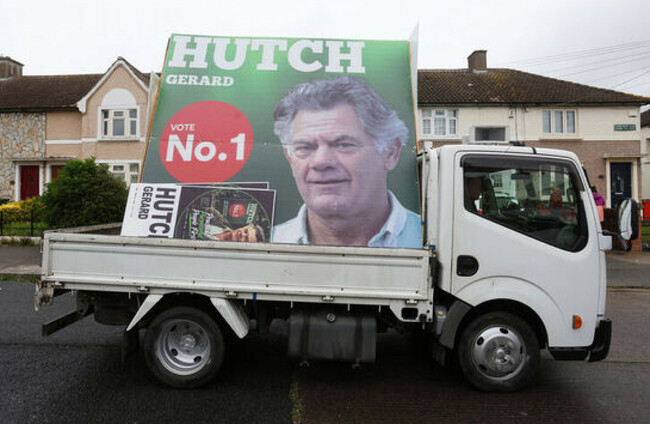
Gavan Reilly Gerry Hutch and his 30% vote in Dublin Central's best-heeled area

Our new columnist Gavan Reilly crunches the data on the most recent hotly-contested by-election – with surprising results.

Politics by Numbers is a brand-new series for The Journal where broadcaster, author and spreadsheet stan Gavan Reilly takes a data deep dive into a political point of the week.

THE FIGURE IN the headline on this piece is striking and unintuitive, so much so that when the calculations threw it up, I had to go back and double-check the sums.

One criticism among other candidates in the RDS over the weekend was that the media had become so fixated on Hutch – all clamouring to join him on the canvass in his working-class heartlands – that the rest were deprived of the oxygen they crave.

It’s a fair critique, and I don’t intend to spend too long here discussing him, his past or his platform. But suffice to say, I suspect even Hutch himself would be surprised to see how well he did in what is (statistically) Dublin Central’s best-heeled area.

Anyone who follows politics and who knows Dublin would probably make an educated guess about what amounts to the ‘better off’ corner of the constituency. They might well suggest the ‘hipster belt’: your Stoneybatters, your Phibsboroughs, your Oxmanstown Roads – the areas where you’d regularly see someone in the Bohemians’ Fontaines DC jersey that looks like a disposable vape.

But it turns out, if you crunch the numbers, that those aren’t actually the best-off areas of the constituency. In fact, surprisingly, they’re nowhere near it. If you look up the CSO’s figures for median household income – in other words, how much cash the middle-of-the-road house brings in – then those areas (the ‘Arran Quay’ electoral districts) represent the national average.

The district with the highest median income is wonkishly called ‘Drumcondra South A’. To put this plainly, it’s everywhere to the left of the route if you took a bus northbound from O’Connell Street through an area enveloped by two teacher training colleges; the DCU St Pat’s campus to your left as you pass through Drumcondra, before turning right and on towards where the Marino Institute faces the grand homes of Griffith Avenue. (Word to the wise: Griffith Avenue in the autumn is an amazing walk.) The southern border is Richmond Road, home of the constituency’s other League of Ireland club, Shelbourne.

The median household income there is €85,000 – meaning half of households there earn more than one-and-a-half times the national average. And this, very surprisingly, is Gerry Hutch heartland. 

 The breakdown of the Dublin Central tally is clear: when you map the votes of Hutch (and of Malachy Steenson, running on a more overt platform against immigration policy), the houses with more money are the ones offering their votes.

I think this is significant because it should prompt us to reconsider exactly which voters are exercised by that subject.

Orthodox thinking would be that immigration is a bigger concern for working classes, especially in the midst of a cost-of-living crisis: those who need the State’s help to get by, will see immigrants as competing for the same resources. That wouldn’t be a concern for middle class voters who can largely fend for themselves.

But the tallies don’t lie. The rightmost dots on the chart above are Drumcondra South A; the other ones just to the left, where Hutch and Steenson’s dots are even higher, is North Dock B. That’s the area including East Wall, where proposals for asylum accommodation led Malachy Steenson to greater prominence. 

It may be that the figures are skewed by a vast disparity in earning power: maybe North Dock B has loads of affluent luxury apartment dwellers – ironically, including immigrants working in Silicon Docks and who don’t have votes in Dáil election – and loads of stereotypically working class voters who are voting for Hutch and Steenson. But the trend speaks volumes, and is worth dwelling on.

Who are the voters behind the Purple Reign?

A deep dive into the tallies also explains the impressive performance that led Daniel Ennis to such an emphatic win last Friday – and the double act that the Social Democrats are pulling off.

Here’s the comparison of the votes earned by Ennis, and by his nearest rival Janice Boylan of Sinn Féin: 

 The highest green dot here is the part of Cabra that includes O’Devaney Gardens, effectively Boylan’s home box. But that’s an outlier: the trend shows that the Social Democrats scored consistently well in the areas where cash is harder to come by.

Now let’s look at the same comparison, of Ennis’s votes versus those of the two government parties:

 Seeing a spread like this is striking for a couple of reasons – firstly, it only serves to emphasise just how weak the Fianna Fáil vote was. Granted, Fianna Fáil has struggled in this constituency for a generation, without an electoral win since Bertie Ahern in 2007, but just look at the Stephens vote. His best performing area (at just 7%) is the same Arran Quay area we mentioned earlier, including Stoneybatter.

But more pertinently; it shows how the Social Democrats cleaned up in middle-class areas too. In urban areas, Fine Gael and Fianna Fáil – increasingly to their own mutual detriment – are fishing in the same pool. Fianna Fáil’s old working class base has been ceded to the parties of the left, and now its voters are in the professional classes, the same ones that Fine Gael had cornered for years. But now, the Social Democrats are winning those areas too. 

Suffice to say, a party that can beat Sinn Féin among the working classes, and comfortably outpoll the centrist/centre-right parties in the better off areas, is one building a huge movement for itself. 

Going into the count, the consensus was that Daniel Ennis would be significantly more transfer friendly than Janice Boylan, and the Sinn Féin candidate would need a healthy lead on first preferences in order to withstand the charge that the Social Democrat would make as others on the centre-left were eliminated. Once it became obvious that Ennis would top the poll in his own right, it was safe to call the race (I did so after two hours, once the Cabra boxes had been reviewed).

But given how many lower preferences Ennis won too, merely leading on first preferences would never be enough. As it turns out, Boylan would have needed a 15-point lead over Ennis to withstand the purple tsunami coming her way. 

In Dublin Central, at least, the SocDems have built an incredible vote-winning machine. Replicating this across the country would leave the party in tremendous shape when seats are being filled in the next Dáil. The challenge for them now is to maintain the support of both income groups, when their status as would-be governors attracts tougher scrutiny. 

For the party of the former League of Ireland footballer, the senior hurling starts now.

Gavan Reilly is the Political Correspondent for Virgin Media News and the host of Monday with Gavan Reilly, which airs every Monday at 10pm on Virgin Media Play and Virgin Media One.

Readers like you are keeping these stories free for everyone...
A mix of advertising and supporting contributions helps keep paywalls away from valuable information like this article. Over 5,000 readers like you have already stepped up and support us with a monthly payment or a once-off donation.

View 19 comments
Close
19 Comments
This is YOUR comments community. Stay civil, stay constructive, stay on topic. Please familiarise yourself with our comments policy here before taking part.
Leave a Comment
    Submit a report
    Please help us understand how this comment violates our community guidelines.
    Thank you for the feedback
    Your feedback has been sent to our team for review.

    Leave a commentcancel

     
    JournalTv
    News in 60 seconds