We need your help now

Support from readers like you keeps The Journal open.

You are visiting us because we have something you value. Independent, unbiased news that tells the truth. Advertising revenue goes some way to support our mission, but this year it has not been enough.

If you've seen value in our reporting, please contribute what you can, so we can continue to produce accurate and meaningful journalism. For everyone who needs it.

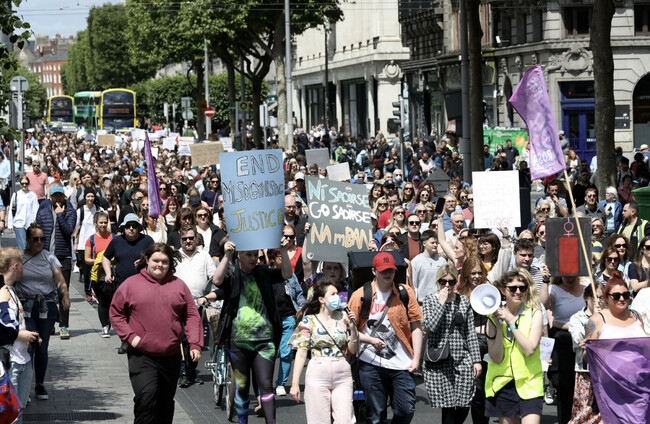
File photo of protest march in June 2024 for solidarity with Natasha O'Brien, who was attacked by soldier Cathal Crotty. Sasko Lazarov/© RollingNews.ie

Holly Cairns Ireland still isn't doing enough to tackle violence against women

There only seems to be a political focus on this issue when high profile cases are highlighted in the media, writes Social Democrats leader Holly Cairns.

TODAY MARKS INTERNATIONAL Day for the Elimination of Violence against Women. It is a fitting time for the government to face some uncomfortable truths about one of society’s most prevalent and pervasive human rights violations.

Frustratingly, there only seems to be a political focus on this issue when high profile cases of violence against women – ranging from sexual assaults and coercive control to
psychological abuse and murder – are highlighted in the media.

The bravery of survivors such as Natasha O’Brien and Bláthnaid Raleigh, who went public with their own harrowing experiences, have helped shine a light on what is unquestionably an epidemic of violence against women in this country.

We owe these women, and many others like them, a debt of gratitude for their fearless campaigning and advocacy.

Violence against women

For all this government’s talk about taking a ‘zero-tolerance’ approach to violence against women, the grim statistics lay bare the sheer scale of the problem.

In Ireland, 35% of women – more than one in three – have experienced psychological, physical and/or sexual abuse from an intimate partner. Last year, gardaí responded to over 65,000 domestic abuse incidents – an average of 1,250 every week.

In 2024, Women’s Aid national and regional frontline services were contacted 32,144 times, an increase of 12% on 2023.

These were the highest contact rates in the organisation’s 50-year history. 

Its teams heard a total of 46,765 disclosures or incidents of domestic violence and abuse – 41,432 against women and 5,333 against children. This was a 17% increase on the previous year.

There were increased reports of all forms of abuse against women: physical (up 22%), sexual (up 30%), emotional (up 15%) and economic (up 5%).

These alarming figures don’t even tell the full story, with fewer than 40% of women who experience violence seeking help of any sort. This suggests that the majority of those impacted are suffering in silence, often forced to remain in dangerous environments for a variety of reasons.

These can range from the prospect of being plunged into poverty or homelessness to an outright fear of trying to escape a violent abuser. This is often the time when a woman is most at risk of serious injury or death.

Housing crisis

The housing crisis has added a further layer of complexity for women trying to flee their abusers, particularly when there are children involved.

Despite Ireland signing the Istanbul Convention in 2015 – aimed at combatting domestic violence against women – there remains a chronic shortage of refuge spaces. It is particularly damning that, one decade on, there are still nine counties in Ireland without a domestic violence refuge.

Those able to secure refuge places can find it increasingly difficult to move on to alternative accommodation due to a lack of affordable rental properties. This situation forces some women to consider the terrifying option of returning to the home they once shared with their abuser.

Women in Ireland continue to be at severe risk of sexual violence. In 2024, the Dublin Rape Crisis Centre’s national helpline received 22,700 calls. Of those contacting the service, 85% were women. In 21% of cases, the reported abuse was by an intimate partner.

That same year, the District Court received 25,270 new applications for protections under domestic violence legislation – a 23% increase in the space of six years.

Political will


Regrettably, our justice system often works against survivors of gender-based violence. The Social Democrats want to see new powers given to gardaí to remove abusers from the home and we fully support legislative change so that survivors’ counselling notes are not routinely used as evidence in sex offence trials. 

We were also proud to introduce landmark legislation earlier this year – known as ‘Valerie’s Law’ – to ensure that a parent convicted of the murder or manslaughter of the other parent does not retain guardianship of a surviving child or children.

In addition, we have previously called for the appointment of a DSGBV Commissioner, with appropriate resources and powers to monitor the implementation of the Third National Strategy on Domestic, Sexual and Gender-Based Violence. We also believe the government should allocate sufficient capital funding to double available refuge units over its term, and move towards meeting Ireland’s commitments under the Istanbul Convention.

There are other practical measures the government could be taking. My party colleague Senator Patricia Stephenson recently introduced a Bill to establish a safe passage travel scheme for survivors of domestic violence.

This would take the form of a free travel pass, to include dependent children, which would be valid for three months.

The Government put forward a 12-month timed amendment on this Bill, which is disappointing given the urgent need for domestic violence supports. Minister Dara Calleary has made a verbal commitment to implement the initiative so it is hoped it may not take as long as a year. This is an inexpensive intervention. It’s not about the money being there – it is simply down to political will.

It is appropriate that this year’s International Day for the Elimination of Violence Against Women will focus on the digital realm. This will kick-start 16 days of activism to highlight how gender-based violence is rampant across online platforms, with toxic, abusive content aimed at demeaning, threatening, humiliating and silencing women.

This is only going to get worse thanks to weak regulation in the technology space and the relentless march of AI.

But today’s international event must be more than just symbolic. So much more needs to be invested in prevention, protection, legislative reform, and policy co-ordination to truly transform Ireland into a country where there is zero tolerance of domestic, sexual and gender-based violence. 

We know that women are most at risk and that anyone can experience it. The Government owes it to all women to tackle the issue decisively and effectively.

Holly Cairns is leader of the Social Democrats and a TD for Cork South-West

Readers like you are keeping these stories free for everyone...
A mix of advertising and supporting contributions helps keep paywalls away from valuable information like this article. Over 5,000 readers like you have already stepped up and support us with a monthly payment or a once-off donation.

View 107 comments
Close
107 Comments
This is YOUR comments community. Stay civil, stay constructive, stay on topic. Please familiarise yourself with our comments policy here before taking part.
Leave a Comment
    Submit a report
    Please help us understand how this comment violates our community guidelines.
    Thank you for the feedback
    Your feedback has been sent to our team for review.

    Leave a commentcancel

     
    JournalTv
    News in 60 seconds