We need your help now

Support from readers like you keeps The Journal open.

You are visiting us because we have something you value. Independent, unbiased news that tells the truth. Advertising revenue goes some way to support our mission, but this year it has not been enough.

If you've seen value in our reporting, please contribute what you can, so we can continue to produce accurate and meaningful journalism. For everyone who needs it.

Alamy Stock Photo

Emma DeSouza Should we follow the UK's lead and lower the voting age to 16?

Emma DeSouza looks at the planned changes in the UK, where 16-year-olds will soon be able to vote, and wonders if we need to do the same here ahead of any border poll.

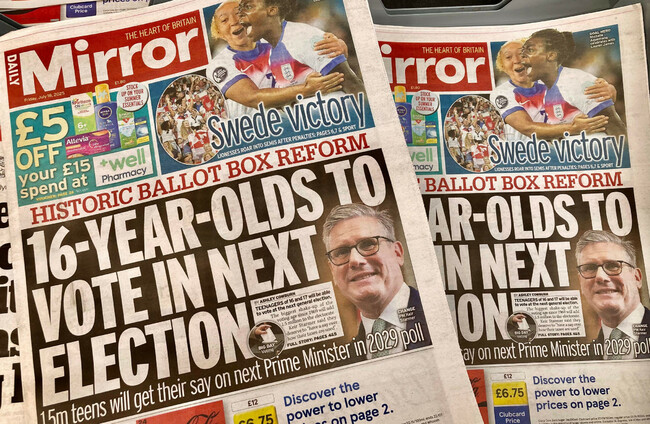
THE UK GOVERNMENT has announced that the voting age will be lowered to 16 years old ahead of the next UK General election in 2029.

Welcomed by youth groups who have long campaigned to expand voting rights, this change not only broadens the electorate for general elections but in the event of a future border poll as well. If effectively mobilised, this new franchise could prove pivotal in determining the outcome of such a vote.

The move represents the most consequential overhaul of the UK’s electoral system in generations and follows in the wake of other recent and notable efforts to modernise the voting system, including changes which saw the removal of restrictions on voting from abroad, enabling UK voters to now retain the right to vote in UK parliamentary elections for life.

By contrast, Ireland employs an outdated, exclusionary and regressive electoral system and is the only EU member state to deny European voting rights to its citizens outside the state. Ireland also remains a global outlier in denying citizens abroad the right to vote in presidential elections and restricts the right to cast a postal vote.

The implementation of broader voting rights as brought forward by the UK may, however, force change in Ireland; If a 16-year-old in Derry can vote in a border poll, then, in the interests of equality, equity and fairness, that same right must be extended to a 16-year-old in Dublin. And why shouldn’t they? It is, after all, their future too.

Level voting field

Critics of extending the franchise claim that 16-year-olds lack the experience or education necessary to make an informed political decision — the same could be said for a great many adults, and last I checked, a political acumen test was not required before casting a ballot. Rather, many of the arguments opposed to empowering young people with a stronger political voice appear, in truth, betray a fear of progress itself.

Young people are more inclined to focus on education, human rights and environmental justice. Generational divides over political priorities have defined the global sociopolitical landscape for decades, exemplified in the last decade with the contentious 2016 Brexit referendum, wherein the majority of young people voted to remain within the EU, while over-65s voted to leave.

In the context of Northern Ireland, young people are more inclined than their older counterparts to identify as Irish, see themselves as a nationalist, and vote in favour of a United Ireland according to the 2024 Northern Ireland Life and Times survey; 53 per cent of 18-24-year-olds identify as Irish, while the percentage drops to 30 per cent for those aged over 65.

The generational divide across identity, politics, priorities and aspirations already evidenced between demographics could make the entry of the new franchise in advance of a border poll all the more significant.

A 2023 Lucid Talk/Sunday Times survey showed that 57% of 18 to 24-year-olds in Northern Ireland would vote “yes” to reunifying Ireland if a border poll were held today, despite there being no official campaign or unity plan in place. While it remains to be seen whether this support extends to 16 and 17-year-olds, their entry into electoral politics presents an opportunity for unity advocates to build momentum.

Diverse democracy

Extending the franchise for 16-year-olds is a crucial step toward strengthening democracy amid global democratic backsliding and the weakening trust in political institutions. There exists a robust body of research delineating a direct link between voting at 16 and forming a life-long voting habit which, in turn, can boost overall turnout.

Detractors may point to the generally low levels of turnout among 18-24-year-olds, but evidence suggests 16-year-olds are more likely to vote than their 18-year-old counterparts, as seen in Scotland during the 2014 Independence referendum.

At 18, many young people are experiencing substantial change; they may be going to university, leaving the family home for the first time, or starting a new career, while 16-year-olds benefit from largely remaining in the family home with more stability and support to participate in the democratic process. In addition to bolstering long-term turnout, voting at 16 can increase trust in political institutions and parties, further strengthening democratic resilience.

The changes could be transformative, not just within the unification debate but for local politics in Northern Ireland. However, to be truly effective, the changes should be accompanied by modern civics education programmes. We cannot expect young people to vote if they are not taught the processes and purpose of exercising democracy, and perhaps more importantly, the consequences when democracy fails.

Several countries already provide the right to vote for 16-year-olds, including Brazil, Argentina, Austria, Greece, and soon the United Kingdom — it is long past time for Ireland to catch up.

For Unity advocates, the entry of 16-year-olds to the franchise could be crucial, but the real work starts now; Young people need to be a part of the conversation on the future of this island and given the tools not only to be a part of the movement for a new Ireland, but to lead it.

Emma DeSouza is a writer and campaigner.

Readers like you are keeping these stories free for everyone...
A mix of advertising and supporting contributions helps keep paywalls away from valuable information like this article. Over 5,000 readers like you have already stepped up and support us with a monthly payment or a once-off donation.

View 77 comments
Close
77 Comments
This is YOUR comments community. Stay civil, stay constructive, stay on topic. Please familiarise yourself with our comments policy here before taking part.
Leave a Comment
    Submit a report
    Please help us understand how this comment violates our community guidelines.
    Thank you for the feedback
    Your feedback has been sent to our team for review.

    Leave a commentcancel

     
    JournalTv
    News in 60 seconds