We need your help now

Support from readers like you keeps The Journal open.

You are visiting us because we have something you value. Independent, unbiased news that tells the truth. Advertising revenue goes some way to support our mission, but this year it has not been enough.

If you've seen value in our reporting, please contribute what you can, so we can continue to produce accurate and meaningful journalism. For everyone who needs it.

Alamy Stock Photo

Opinion Abandoning the Triple Lock would be a grave mistake

Senator Tom Clonan looks back at the key debates for Ireland in defence and security of 2025.

2025 HAS BEEN a momentous year for Ireland’s defence and national security debate.

In December, the government announced a €1.7bn Defence Sectoral Development Plan for our national defence and security. This represents the largest ever investment in defence in the history of the state and aims to address many of the targets set by the Commission on the Future of the Defence Forces.

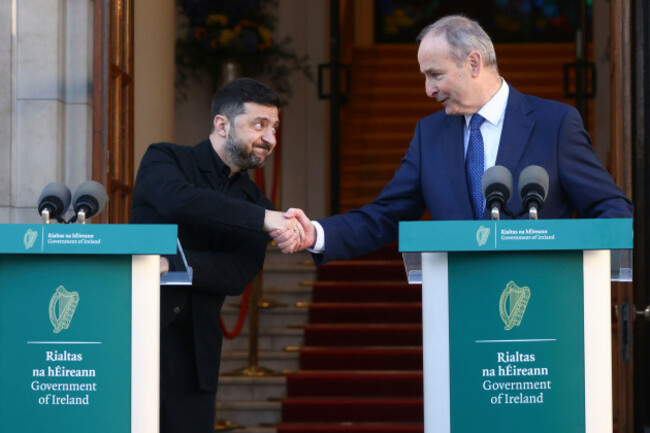
At present, Ireland – through no fault of the Defence Forces and an Garda Siochana themselves – is almost completely defenceless in the air, maritime, ground and cyber domains. This was uncomfortably apparent during the alleged drone incident during Ukrainian President Volodymyr Zelenskyy’s visit to Ireland on at the start of December.

Whilst it became clear that our security forces lacked the technology and equipment to detect, identify, track or intercept hostile drone activity, serious questions remain about command and control decisions and situational awareness at the highest levels during the incident. All credit goes to Naval Service personnel on the LÉ William Butler Yeats who spotted the drones, but what happened next raises serious concerns.

In particular, the failure of the relevant and competent office holders to inform the Irish aviation authorities – and pilots approaching and departing Dublin Airport on the night of the incident – of the presence of what were believed to be hostile industrial grade drones.

ukraine-president-volodymyr-zelenskyy-left-shakes-hands-with-the-irish-taoiseach-micheal-martin-during-a-joint-news-conference-in-dublin-ireland-tuesday-dec-2-2025-ap-photopeter-morrison Ukrainian President Volodymyr Zelenskyy and Taoiseach Micheál Martin outside Government Buildings on Tuesday 2 December. Alamy Stock Photo Alamy Stock Photo

Similar sightings across Europe during 2025 led to airport closures and the diverting of incoming aircraft away from the threat. In 2023, Dublin Airport was closed several times due to the proximity of tiny consumer drones. Aviation experts have confirmed that even small drones can inflict catastrophic damage on passenger aircraft in the landing and take-off phases.

As I write, we still have no answers from the relevant authorities as to why no warnings were issued to civil aviation on the night the drones were operating in close proximity to flight paths to Dublin Airport, at a point where passenger aircraft were descending to altitudes well within the operating ranges of industrial grade drones.

Whatever the explanation, or lack thereof, the incident and the response of key decision makers in our defence and national security community raise serious red flags about our ability to deal with the range of hybrid and conventional threats that will confront the state in 2026.

The government’s re-announced investment in our defence and national security capabilities in December is very welcome and sorely needed.

It has come at the end of a year in which there has been unprecedented discussion in Ireland’s public discourse around our national defence and militarily non-aligned neutrality.

Ireland’s neutrality debate

Our print and broadcast media have been flooded with – literally – hundreds of opinion pieces and on-air discussions of Ireland’s capacity to defend itself and to vindicate its sovereign neutral status, without having to rely on the Royal Air Force and Royal Navy – along with other Nato member states to de facto patrol and secure our air and maritime domains.

This state of affairs is deeply embarrassing for Ireland and seriously undermines our militarily non-aligned neutral status.

This will become even more apparent as Ireland assumes the presidency of the European Union in July of 2026.

Notwithstanding the dramatic re-announcement of increased defence spending by Minister for Defence Helen McEntee, it is not clear if we will have the necessary primary radar and counter drone capabilities to provide the minimum level of security necessary to ensure the safety of visiting heads of state during our presidency.

Hopefully, we will not see a repeat of the embarrassing – and possibly unconstitutional – presence of foreign police and military elements in the vicinity of Leinster House we saw during President Zelenskyy’s visit. Whilst the assistance of Portugal’s GNR – national guard police – was welcome, as a Nato military formation and part of Portugal’s defence establishment, it is unclear to me as to the constitutionality of having a foreign military force operating drone defences in our jurisdiction.

In the case of our public discourse, the narrative has been dominated by voices who are critical of Ireland’s militarily non-aligned neutral status. These voices range from a range of academics – some of whom have links to the international arms industry – and international voices from ‘Think Tanks’ or ‘Research Centres’ often funded directly by the arms industry and/or by the foreign offices of a number of key Nato member states. The narrative has also been exclusively framed by Putin’s criminal invasion of Ukraine and the threat that the Kremlin poses to the European Union and the Nato alliance.

It has been an interesting debate – if rather one-sided – that constantly repeats a number of myths about Ireland’s neutral status. One oft-repeated canard is that our international partners somehow ‘disapprove’ of our neutral status. This is absolute nonsense – often repeated by opinion ‘leaders’ in Ireland who have zero military experience and/or zero experience of or participation in international agencies or fora on defence and security.

The only concern our international partners have is in relation to our inability to meaningfully defend ourselves.

In fairness to government, they have begun to address this issue by way of much needed defence investment, which in turn will further strengthen our sovereign neutral status.

The Triple Lock

The other major defence and national security issue that will confront Ireland in 2026 will be the government’s intention to abolish Ireland’s ‘Triple Lock’ in the Defence Amendment Bill (2025) which is due to come before the Oireachtas on resumption of the Dail and Seanad in January.

The passage of this legislation will mark a major inflection point for Ireland. Thus far, it has been a debate that has been dominated by a great deal of misinformation – and at times disinformation – in relation to the impact the abolition of the Triple Lock will have on Ireland’s neutral status.

First of all, the Defence Amendment Bill 2025 does not ‘amend’ or ‘remedy’ the Triple Lock – it simply removes it entirely. Heretofore, in order to deploy Irish troops to an international peacekeeping or peace-enforcement mission, the government needed a UN Security Council mandate and approval of the government and the Dáil. Government spokespersons and ministers repeatedly assert that we have somehow ‘handed our sovereignty’ over to the permanent members of the UN Security Council – such as Russia, China or the US – in terms of our decision to deploy Irish troops to conflict zones. This is a false assertion.

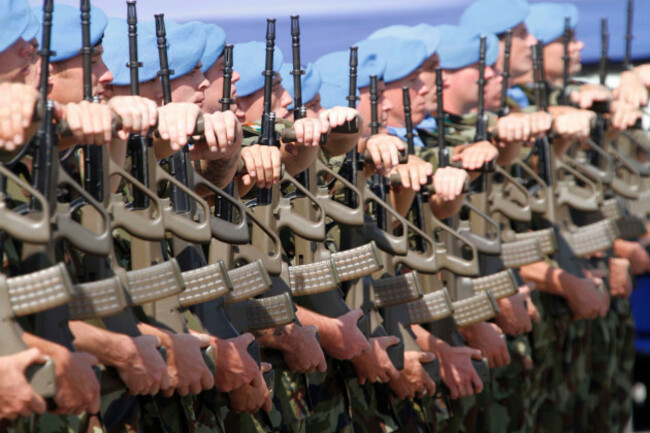
irish-un-peacekeeper-soldiers-salute-upon-the-arrival-of-the-irish-president-mary-mcaleese-not-seen-at-their-base-in-the-southern-village-of-tebnine-lebanon-on-saturday-oct-15-2011-mcalees-arr File photo of Irish peacekeepers in Lebanon in 2011. Alamy Stock Photo Alamy Stock Photo

The opposite is true. The Irish people – through decisions of the Oireachtas and by solemn declarations in International Treaties – has exercised its sovereignty in choosing only to participate in peacekeeping and peace-enforcement missions that have formal and legal UN sanction. The government’s argument that we allow ‘Putin’ or ‘Trump’ to make this decision for us is a disingenuous and perverse position.

If the Triple Lock is removed, and UN sanction is no longer required, it means that any future Irish government can send any number of Irish troops to any conflict internationally by simple – whipped – government majority.

So, we will go from a triple-lock to no lock at all, and the absence of any oversight or robust evaluation of any cabinet decision to deploy our troops to a hostile environment.

Government ministers and spokespersons repeatedly and erroneously refer to future hypothetical foreign missions as ‘peacekeeping’ missions. This is misinformation at best. The era of peacekeeping is effectively over – and any future military missions internationally will exclusively be peace-enforcement or ‘stabilisation forces’.

These missions, particularly without UN Security Council sanction – will be combat missions – and would involve Irish troops deployed to participate in Chapter 7, peace-enforcement to conflicts without the consent of all of the belligerent parties. Such missions, in the absence of multilateral UN approval and consent, will inevitably lead to war fighting as was the case with stabilisation forces in central Europe in the past and indeed with UN enforcement missions such as that to Korea in the 1950s which led to full-scale conventional warfare.

Ireland needs to be very cautious about the absence of oversight in cabinet decisions to deploy Irish troops to future conflicts in ‘peace enforcement’ ‘coalitions of the willing’.

Another myth repeatedly articulated by government ministers and spokespersons is the idea that the Triple Lock prevents Ireland from sending more than 12 troops to assist Irish citizens – or foreign citizens – caught up in manmade or natural disasters, such as the evacuation of Irish passport holders from Kabul, Afghanistan in 2021.

As confirmed to the Joint Oireachtas Committee on Defence and National Security by the Department of Defence in May 2025, the Triple Lock has no bearing whatsoever on such missions, with no limits placed on government in such scenarios. To suggest otherwise is an egregious misrepresentation of the facts and is has been a shameful component of government misinformation on this falsehood around the Triple Lock.

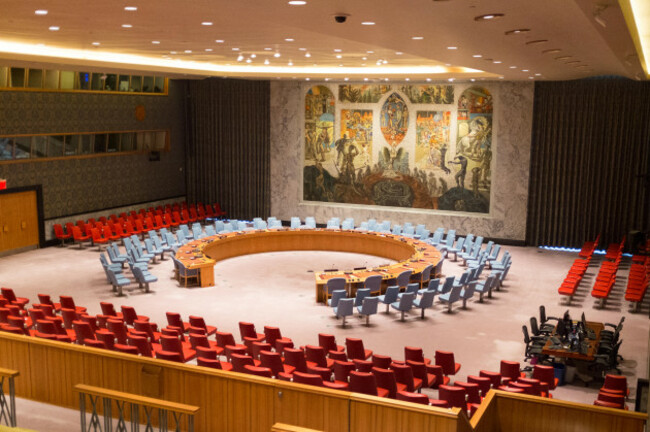
new-york-city-usa-united-nations-building-un-security-council-chamber The UN Security Council Chamber in the UN headquarters in New York. Alamy Stock Photo Alamy Stock Photo

Notwithstanding such misinformation, I trust government generally and the sovereignty of the Dail. However, I am also aware that governments make mistakes from time to time – as clearly evidenced during the intellectual and ethical failures of the Celtic Tiger for example. I am also conscious that the community of decision makers who will decide where Ireland deploys its troops to future conflicts as ‘peace enforcers’ – are the same community of decision makers that have allowed Ireland to become completely defenceless, Europe’s ‘weakest link’ in air, maritime, ground and cyber defence.

I do not trust them to make competent or informed decisions on where we deploy the men and women of Oglaigh na h’Eireann in an increasingly volatile geopolitical environment. This is another compelling reason why 2026 should see all of Ireland’s Defence and National Security stakeholders – without exception – amenable to accountability and parliamentary oversight from the Joint Oireachtas Committee on Defence and National Security.

I for one will submit amendments to the upcoming Defence Amendment Bill to suggest safeguards such as allowing for a ‘free’ or ‘non-whipped’ vote in the Dail on matters of deployment to future peace enforcement missions. For while government can make mistakes on economic or social matters from time to time, we cannot afford to make mistakes in the arena of international conflict.

In this regard, when looking at the objective evidence, the Triple Lock is intimately linked to Ireland’s militarily non-aligned neutrality. If government decide to abolish it in 2026 – by simple whipped majority – the Irish people need to be afforded a referendum to give an explicit constitutional guarantee of neutrality as is the case with Austria and Switzerland. It is the very least that the Irish people – including our children and grandchildren – deserve in these uncertain times.

Dr Tom Clonan is a retired army officer and former lecturer at TU Dublin. He is an Independent senator.

Readers like you are keeping these stories free for everyone...
A mix of advertising and supporting contributions helps keep paywalls away from valuable information like this article. Over 5,000 readers like you have already stepped up and support us with a monthly payment or a once-off donation.

View 65 comments
Close
65 Comments
This is YOUR comments community. Stay civil, stay constructive, stay on topic. Please familiarise yourself with our comments policy here before taking part.
Leave a Comment
    Submit a report
    Please help us understand how this comment violates our community guidelines.
    Thank you for the feedback
    Your feedback has been sent to our team for review.

    Leave a commentcancel

     
    JournalTv
    News in 60 seconds