Sign in. It’s quick, free and it’s up to you.
An account is an optional way to support the work we do. Find out more.
Sign in. It’s quick, free and it’s up to you.
An account is an optional way to support the work we do. Find out more.

WHERE IS THE EU as a single voice and actor in the Israel-Palestine humanitarian and political crisis?
This is a question I get asked regularly.
During the summer of 2001, I was really blessed to have secured an internship with the European Commission’s Middle East Peace Process Desk while training as a solicitor with A&L Goodbody. Commencing later in October, my boss was to be Christian Berger, an Austrian lawyer and then-Middle East peace process desk officer. We worked side-by-side with EU desk officers working on Syria, Israel, Lebanon, Jordan and Egypt.
It was an intense time, only weeks after 9/11 and the Second Intifada uprising, called by the Palestinians in 2000 against Israel, was well underway. There was little pathway to peace from both sides while the US under President Bush and the EU were making several attempts to organise a ceasefire.
On my first day, Christian invited me to join him at the Council Middle East Working Group, where we were representing the Commission meeting with fifteen national government officials, including Ireland. We were to present proposals on what was called the ‘Rule of Origin’ which set out to ensure that imported goods from Occupied Territory settlements in West Bank and East Jerusalem did not benefit from EU-Israel agreed preferential tariff treatments.
The newly signed 2000 EU-Israel Association Agreement, today a daily news point given calls for its suspension, included provision of a free trade area for industrial products and preferential treatment for Israeli agricultural exports to the EU and vice versa.
The Commission proposal set out to ensure that the EU was not indirectly recognising agricultural exports from Israeli settlements, created since June 1967 in the Occupied Territory settlements in West Bank and East Jerusalem, as ‘Made in Israel’. Logical legally, but not politically I was to learn.
“So, this is just an initial position Christian,” I said when we discussed what just happened in the working group after the meeting. “Germany and the Netherlands will change their position shortly, from this their starting position, right?”
Not so, I was to learn – and very quickly. The decision needed all fifteen governments to agree. It would take more than two years for the ‘Rule of Origin’ rule to be implemented.
I learned then that there are two key points explaining why the EU was unable to reach a unified position on the Middle East peace process.
Firstly, foreign policy matters remain the competence of national governments. Under the Lisbon Treaty, common foreign and security policy needs to be agreed by all 27 governments voting unanimously. Any country can veto a proposal, thus scuppering a united EU voice.
Secondly, there is general and historical reluctance among large member states, in particular Germany and Italy – alongside smaller member states Netherlands, Austria, Slovakia, Romania, Bulgaria and Croatia – to speak out against Israel. This is due to the complex combination of the weight of collective national guilt for their respective history as part of Hitler’s axis alliance and resulting Holocaust.
Additionally, only 10 EU governments have recognised Palestine as a State, some of them only very recently at the UN in September.
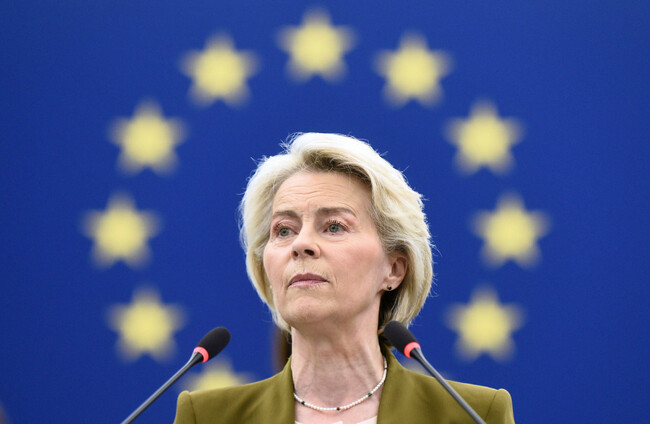
To add further confusion around an EU position, the European Commission President Ursula von der Leyen, without any mandate, rushed twice to categorically support Israel over the last two years. She is a former Germany cabinet member and an ally of Israel.
Consequentially, the EU – without unity, amid a man-made famine and a UN-declared genocide – has no voice. And yet the EU has leverage. We are Israel’s largest trading partner globally, amounting to a third of Israel’s trade.
Historically, however, sanctions would not fly, and so the EU-Israel Agreement remains intact. With pressure from EU citizens over the summer and cracks in former entrenched government positions, the Commission started to change tack.
The agreement explicitly provides a legal basis for its suspension, if serious violations occur relating to human rights and democratic principles.
In late July, a mild change in direction by the Commission was put forward to examine suspension on aspects of the agreement. High Representative for Foreign Affairs Kaja Kallas proposed to national governments to partially suspend Israel’s participation to EU research funds in response to Israel’s breach of international law. If passed, the proposal would have meant a suspension of €2.5 million funding for start-ups and SMES.
It failed. It was not about the numbers. History and political positions continued.
Hungary, Austria, Bulgaria and Czech Republic voted against. Germany and Italy postponed the vote. Ireland, The Netherlands, France, Luxembourg, Slovenia, Portugal, Malta and Spain voted in favour.
Netherlands changed its historical position.
Following accumulating pressure for the full suspension of the trade agreement from EU citizens, governments, lawyers, former EU ambassadors and officials, the Commission President last month made a personal U-turn and promised for the first time proposals on partial trade suspension and sanctions.
Within days, a new unprecedented proposal to partially suspend trade-related measures at a cost to Israeli exporters €227 million is now before national governments for a crucial vote. The proposal could have gone further, but with less chance of success given where these governments are coming from.
In order to succeed, unlike previous unanimity based legal proposals, this trade proposal will be voted through under Qualified Majority Voting rules – meaning it will require the support of 15 of the 27 EU governments and simultaneously represent two-thirds of the EU population.
To succeed, Germany or Italy – combined with a block of smaller countries such as Hungary, Austria, Bulgaria or Czech Republic – would need to change their historical position.
Due to powerful national protests and pressure, PM Giorgia Meloni of Italy’s national position is moving away from its entrenched alliance with Israel. This was clear in her recent speech at the UN, coupled with Italy’s dispatch of naval vessels to partially assist the Global Sumud Flotilla and murmurs of recognition of a Palestinian State with conditions. Italy may vote in favour.
Germany’s Chancellor Merz, while condemning Israel’s disproportionate response
and recently embargoing on new arms sales, does not share the Gaza genocide
assessment. His coalition government is split with his conservative alliance party
remaining strong Israeli allies.
Ireland, Belgium, Slovenia, Spain and Luxembourg requested that this vote would happen at the Heads of States meeting in Copenhagen on Wednesday. Merz, who was to declare Germany’s position on the sanction proposal, instead postponed and deflected to the Trump 20-point peace plan. We may now have to wait for a scheduled formal meeting at the end of October.
Will political lines alter? The position is evolving daily.
What is clear is that if the EU continues to remain divided and thus silent on this humanitarian crisis, it will continue to fail its own citizens when they ask: ‘Where is the EU on this and why is it not speaking out?’.
Externally, the EU will be exploited for its impotence on the world stage at a pivotal time of a world order transition.
Regina O’ Connor worked across three EU Institutions in Brussels, including the Commission Middle East Peace Process Desk. She is the author of ‘The Reasons Why, Ireland at the Heart of Europe’ and completed a Masters Thesis in EU and Democratisation of the Palestinian Authority (College of Europe).
Need more information on what is happening in Israel and Palestine? Check out our FactCheck Knowledge Bank for essential reads and guides to navigating the news online.
To embed this post, copy the code below on your site











have your say