Sign in. It’s quick, free and it’s up to you.
An account is an optional way to support the work we do. Find out more.
Sign in. It’s quick, free and it’s up to you.
An account is an optional way to support the work we do. Find out more.
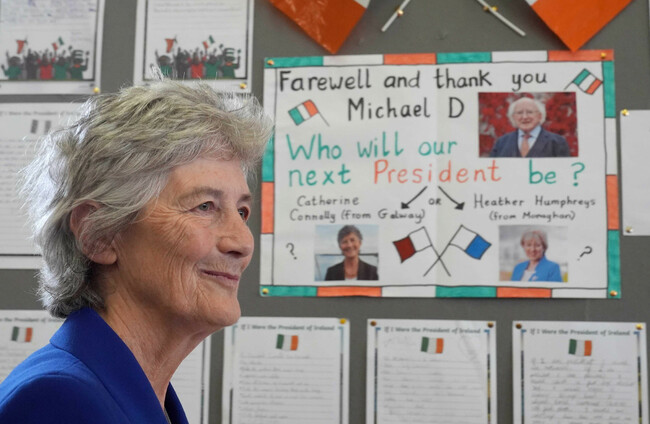

IT WILL BE a surprise of monumental proportions if Catherine Connolly isn’t chosen to become the tenth Uachtarán na hÉireann by what turned out to be a not so minuscule sliver of the Irish people yesterday.
The opinion surveys consistently showed the proud Galwegian considerably ahead. And the gap between her and Heather Humphreys of Fine Gael and Monaghan only grew, even as the latter’s camp contended that the margin may ultimately be smaller than forecast because Connolly voters were less likely to turn out.
That Catherine Connolly could be elected on the first count engenders one of several questions weighing on the minds of many keen observers of Irish politics: Who woulda thunk it? When she announced her candidacy in July, my take was that, in a best case scenario for her, a lot of the left, though not Sinn Féin, would rally around one of their own, but that the numbers did not add up.
For Connolly’s unambiguously left-wing stances on multiple topics – which she notably has declined to repudiate and instead has nimbly talked around when interrogated in interviews and debates – were so beyond the mainstream, as borne out by the results of general elections, that a clear majority of the citizenry would deem her unsuitable for the Áras at this complicated juncture for Ireland internationally. Such was the conventional wisdom.
In an effort to explain what has come to pass, pundits have repeatedly noted that Connolly has benefited enormously from Sinn Féin’s decision to back her – in fairness to Mary Lou McDonald, it really was a “game changer” – from the ugly implosion and early demise of Jim Gavin’s bid, as well as from Heather Humphreys’ failure to connect and her weak media performances.
Nonetheless, that she stands on the praecipes of an emphatic triumph is, first and foremost, a credit to Connolly and her inner circle, who have done a marvellous job in traversing a perhaps uniquely tricky path for their woman, who, if not anti-establishment, is certainly no part of it.
It is, of course, indisputable that the ball bounced perfectly for Connolly, and in a literal sense with the viral “keepie-uppies” video. Yet luck and timing are two crucially important intangibles in politics. Team Connolly did get lucky with her happening to play football and basketball with a crowd of enthused children. Moreover, even if its gravity has probably been exaggerated, she was fortunate that Ivan Yates uttered the infamous “smear the bejaysus” refrain when asked about Fine Gael’s strategy to catch the frontrunner on Newstalk’s Calling It podcast.
🔥 Catherine showing us how it’s done today in Courtney Place pic.twitter.com/FjEgBmNG1C
— Mary Lou McDonald (@MaryLouMcDonald) October 5, 2025
But her advisers took these political gifts and, demonstrating social media expertise, maximised their impact. They also spread the images of events, featuring a litany of celebrity artists and attended by large crowds, which created the impression online that Connolly’s support base had morphed into a movement akin to the Yes groupings on marriage equality and the repeal of the Eighth Amendment. By any objective measure, what they were able to assemble in a limited period is extraordinary.
And timing was ideal for Connolly in two key ways. First, she has – rather ironically – profited greatly from the presidency of her former Labour party colleague with whom she had a falling out, Michael D Higgins. He has redefined the office in the eyes of many as one suited to occasionally upbraiding the Government and one which is more activist than was originally intended. Despite the consequent concerns of some journalists and academics, people seem to relish this “rebellious streak” and anticipate that Connolly may be even bolder than her predecessor. They welcome it.
Second is the anger at the establishment, which the mainstream media is oft-accused of downplaying with some justification. It is undeniable, however, and is most evident in divergent constituencies.
There are young people who are simultaneously well-educated and hopeless because they see no future in a country where they cannot afford a home. Connolly has dared them to dream differently.
And there is a swathe on the centre-right and right, who think Fianna Fáil and Fine Gael have forsaken them by drifting leftward. They are accordingly so furious that they were happy to facilitate Catherine Connolly as president by staying home, spoiling their votes or even by giving their ideological foe a first preference.
An additional question, currently the source of worry at the top levels of Government and the Department of Foreign Affairs, is how will Connolly fulfil her duties? She has made numerous controversial and negative remarks about Ireland’s closest allies: France, Germany, the UK and the US among them.
She claims that she will execute all aspects of her constitutional role diligently and professionally. Connolly has equally said that, if the matter of the genocide in Gaza surfaces, she will not shrink from expressing her heartfelt convictions. This may be admirable, yet it could provoke a very serious diplomatic incident with unknowable repercussions for this island, which is hugely exposed to ominous geopolitical clouds.
A further question is what this presidential election campaign, a joint disaster for Fianna Fáil and Fine Gael, portends for each. Obviously, the leadership of both parties will desperately endeavour to put this second order contest in the rear view mirror and drive on. They can take a bit of comfort from the next tests of strength being a good distance off. Regardless, rumours of discontent, especially within Fianna Fáil, will intensify, as will speculation about the manoeuvres of those waiting in the wings.
A final question is what a Catherine Connolly victory will mean for Irish politics broadly. There is an understandable tendency to overegg what elections will translate into in their immediate aftermath. With that caveat, it is reasonable to proffer that this is a potentially pivotal moment, not wholly attributable to this individual race.
The achievement of the leftist alliance this time is significant. A diverse range of figures from Ruth Coppinger to Eileen Flynn to Roderic O’Gorman stayed on the exact same page from start to finish.
The depth and sustainability of this unity is no sure thing, if precedent is any guide, and the key variable will be Sinn Féin’s positioning inside or outside the ad hoc or more durable coalitions that are cobbled together.
Conversely, whether mobilised by the democratic deficit they find in the unsuccessful initiative to secure Maria Steen a line on the ballot or by what they deem to be a broken immigration system, there is renewed cause to believe that the hour may have arrived for an entity representing the political right in Ireland.
Two critical issues will be if a credible person, such as Ms Steen, will emerge to be its public face and if some of the more extreme elements, such as those unwilling to condemn unreservedly the out-of-control protesters in Saggart this week, can be persuaded to row in behind it as preferable to what they perceive to be the centre-left status quo or what is, from their vantage point, a far worse progressive alternative.
But in the shorter term, I suspect I speak for the political anorak class in lamenting that today’s count looks unlikely to be dramatic or exciting.
Larry Donnelly is a Boston lawyer, a law lecturer at the University of Galway and a political columnist with The Journal.
To embed this post, copy the code below on your site















have your say