We need your help now

Support from readers like you keeps The Journal open.

You are visiting us because we have something you value. Independent, unbiased news that tells the truth. Advertising revenue goes some way to support our mission, but this year it has not been enough.

If you've seen value in our reporting, please contribute what you can, so we can continue to produce accurate and meaningful journalism. For everyone who needs it.

Alamy Stock Photo

Breaking the grip Can we rethink education in Ireland, north and south?

From Belfast to Dublin, religious ethos still shapes classrooms — but models across Europe show a secular, all-island system is within reach, writes Emma DeSouza.

THE ISLAND OF Ireland is home to two highly disparate education systems between two different legal jurisdictions, and yet they bear one striking similarity; neither appears capable of shaking the long-held grip of religious indoctrination.

The UK Supreme Court ruled last year that Northern Ireland’s compulsory religious education provision is unlawful and does not comply with human rights standards, while in Ireland, 88 per cent of state-funded primary schools remain under the patronage of the Catholic Church, with students receiving at least two hours of formal religious instruction per week.

Unlike many other Western democracies, education on this island has remained steeped in religious formation despite increased secularism and diversity within the population.

In response to the Supreme Court judgement, NI education minister Paul Givan has announced an independent review, whilst reiterating that Christianity will remain the core focus of any reformed curriculum.

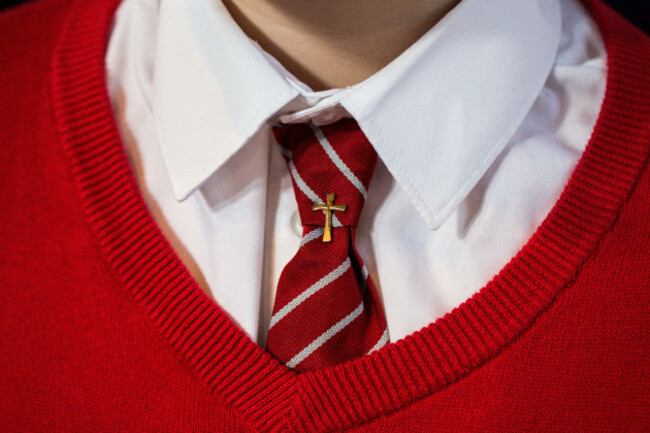
school-pupils-at-a-st-patricks-day-mass-st-patricks-church-thornaby-north-yorkshire-uk-1732022-photograph-stuart-boulton Alamy Stock Photo Alamy Stock Photo

In Ireland, parents have a constitutional right to withdraw their child from religious formation, but without an alternative, this right in practice leaves many children either left at the back of the classroom to absorb the content anyway or secluded to an empty room.

It doesn’t have to be this way. There are any number of modern education systems from which we can learn, and — especially with the prospect of constitutional change — examine as models for a new, all-island education system.

How it works in other jurisdictions

In Norway, where over 60 per cent of the population belongs to the Evangelical Lutheran Church, religious instruction can only entail the dissemination of information. Preaching or religious practice in education is forbidden; instead of religious education, students are taught a module on ‘Religion, Philosophies of Life and Ethics’.

In Finland, students have the right to select either an ethics or a religion class. Those who opt to study religion have the right to take part in classes examining their own faith, and as in Norway, there is no religious instruction.

In the Netherlands, freedom of education that respects all religions and beliefs is enshrined in the constitution. Parents may choose between religious or secular tracks with equal government funding. Public schools are strictly secular, while non-public schools can be religious.

Estonia treats religious studies as an elective, and schools only have to provide a course if at least 15 students or parents request it. When such a course is provided, it is to be strictly academic and non-confessional.

Slovenia has banned faith-based teachings from schools. Instead, primary school students take an information-based module on religions and ethics.

These five countries are some of the highest-ranked performers in the field of education. None enforces a religious ethos, opting instead for a focus on ethics, human rights and non-denominational studies of world religions.

What benefits does an education system steeped in religious formation afford children that cannot be provided through teachings grounded in ethics, or through the examination of world religions without instruction?

What do people want?

A 2025 survey of Irish National Teachers’ Association members demonstrates considerable support for reforming the manner in which religion is taught in Irish schools. 83 per cent of respondents stated that children should be taught about other religions, 63 per cent backed secular patrons for primary schools, 57 per cent believed that faith formation should not be taught in primary schools, while only four per cent supported primary schools bearing responsibility for preparing students for sacraments.

A 2024 Lucid Talk poll in Northern Ireland revealed that 67 per cent of respondents believe integrated education should be the primary model.

The demographic makeup of religious beliefs throughout this island is rapidly changing. The 2021 Northern Ireland census reported an 80 per cent increase in those describing themselves as having no religion since 2011, while in Ireland, there has been a 187 per cent surge in the same category since the 2011 census.

As Protestant religions decline in Northern Ireland, and Catholicism respectively in Ireland, other faiths are on the increase; Islam, Hinduism, Judaism – Northern Ireland is no longer a Protestant state for a Protestant people, nor is Ireland a Catholic country. The education system should be inclusive to all faiths and none.

Having a strictly non-religious ethos in any of the aforementioned countries has not stripped children of moral education, but rather seeks to instil morals based on the academic study of all religions through the lens of ethics and human rights. We do not need to enforce Christian teachings in schools to teach children the difference between right and wrong.

Modern approach

Of course, moving away from an overtly religious model of education need not be the only change in a united Ireland, should we reach that day. There are many improvements we could and should make, changes that will require political will and financial backing. The Netherlands, Norway, Finland, Slovenia and Estonia, European countries listed, have other commonalities; none enforce mandatory school uniforms, and all teach philosophy, to name only two.

In Finland, education is entirely free from pre-kindergarten to PHD levels. There is no formal education until age seven. Once parental leave ends, every child has a right to childcare, which is either heavily subsidised or entirely free — the maximum amount a parent can expect to pay is €311 a month, while approximately 50 per cent of families pay nothing because they fall below the income threshold. By contrast, families in Ireland are paying upwards of €800 to €1200 a month on childcare.

The Irish government committed to trialling a cap of €200 a week for childcare – the difference? Finland treats childcare as public infrastructure. Ireland: a market-driven income generator.

There are no formal exams for students in Finland until age 18, pre-school is focused on play and nature, and students at university receive monthly grants and housing support.

While parents lose countless hours in traffic to get their children to after-school clubs, paying mounting fees for sports, art and music activities outside of school hours, Estonia treats these activities as a cornerstone of the education system.

Huvikool, or hobby schools, focus on technology, sports, music, arts and nature. A standard school day ends at 2:00 pm, at which point about 90 per cent of students then attend one such hobby school. Access is heavily subsidised, costing between €20-€50 a month, and lower-income families can apply for a full waiver.

In the Netherlands, students receive little to no homework up to age 12. Most schools finish early on Wednesdays to give students and parents a mid-week break. Three educational tracks open to students at age 12: vocational, professional and research-intensive.

Constitutional change will be the great disruptor and a chance for all of us to have a role in dismantling the antiquated institutional structures that limit the progress and potential of the people of Ireland.

An all-island education system will be one of the most essential building blocks of a new Ireland. We should be ambitious; all too often, we limit our aspirations and accept the status quo. Let’s break that cycle and demand a better future, with a better education system, for our children, north and south.

Emma DeSouza is a writer and campaigner.

Readers like you are keeping these stories free for everyone...
A mix of advertising and supporting contributions helps keep paywalls away from valuable information like this article. Over 5,000 readers like you have already stepped up and support us with a monthly payment or a once-off donation.

View 19 comments
Close
19 Comments
This is YOUR comments community. Stay civil, stay constructive, stay on topic. Please familiarise yourself with our comments policy here before taking part.
Leave a Comment
    Submit a report
    Please help us understand how this comment violates our community guidelines.
    Thank you for the feedback
    Your feedback has been sent to our team for review.

    Leave a commentcancel

     
    JournalTv
    News in 60 seconds