We need your help now

Support from readers like you keeps The Journal open.

You are visiting us because we have something you value. Independent, unbiased news that tells the truth. Advertising revenue goes some way to support our mission, but this year it has not been enough.

If you've seen value in our reporting, please contribute what you can, so we can continue to produce accurate and meaningful journalism. For everyone who needs it.

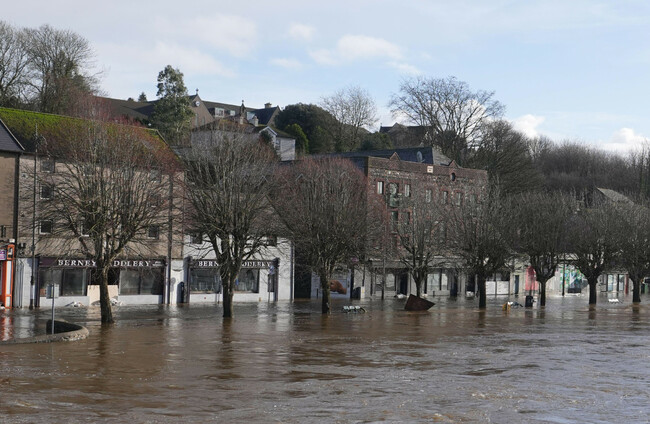
Flood waters in Enniscorthy Co Wexford after Storm Chandra hit on January 28. Alamy Stock Photo

Ireland in the storms Flood barriers won't save us if we keep draining the land

After flooding in the past, successive governments promised protections, but instead, doubled down on dredging and delayed land-use reform, leaving communities exposed, writes Pádraic Fogarty.

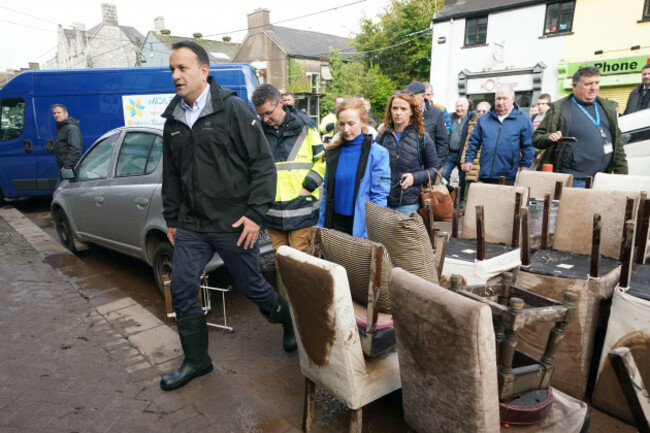
AFTER MIDLETON IN Cork was flooded in 2023, then-taoiseach Leo Varadkar told the Dáil that what he had seen in the town was “at a different scale” to anything he had seen before.

“The floodwaters were up to my arm. It was not just water. There was dirt, mud and sewage. A huge amount of damage was done,” he said.

He referred to the need for more flood defence schemes for towns but noted that “it is not just about flood barriers. We have to consider the impact inappropriate land use can have on flooding and drainage”, adding that “we need a land use plan for Ireland”.

taoiseach-leo-varadkar-visits-the-local-businesses-on-main-street-in-midleton-co-cork-after-storm-babet-the-second-named-storm-of-the-season-swept-in-picture-date-thursday-october-19-2023 Then=Taoiseach Leo Varadkar visiting flood-stricken Midleton in 2023. Alamy Stock Photo Alamy Stock Photo

Land use is relevant to flooding because water falling from the sky will pass through or over the ground before entering rivers. When water does enter a stream or river, the speed with which it flows downstream is influenced by the shape and depth of the river, as well as whether its historic floodplain is available to store water.

What happened the land use plan?

Land with trees, particularly native forests with their tangle of roots that penetrate deep into the soil, as well as intact bogs and wetlands, can act as sponges, attenuating the volumes of water entering rivers.

Lowland rivers that still have natural meanders, with lots of fallen trees and dead wood, or with access to adjacent floodplains, will move relatively slowly. Ecologists refer to these features as natural ecosystems, and they are home to rich biodiversity, as well as providing water and flood protection for people, businesses and infrastructure.

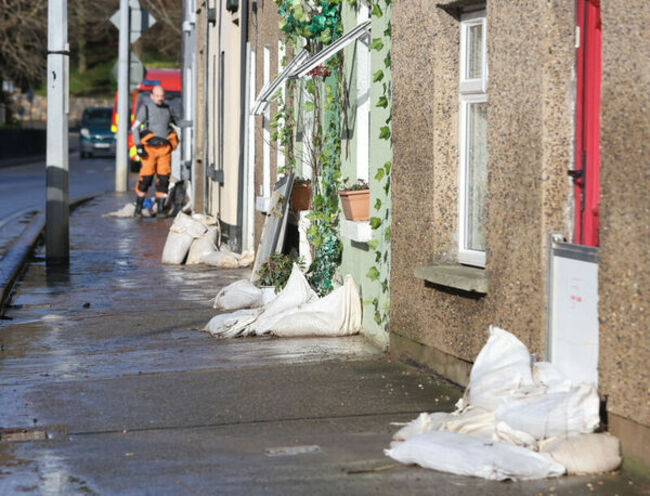
Enniscorthy clean up-20_90741990 Major clean-up in Enniscorthy, Co Wexford, after the River Slaney burst its banks during Storm Chandra. Rolling News Rolling News

The problem in Ireland is that we no longer have natural ecosystems. We have cleared away our natural forests, dug out peatlands, converted hills to conifer plantations, drained wetlands, compacted soil under the weight of millions of farm animals and straightened rivers to create yet more grazing land.

Historic floodplains have been ‘reclaimed’ for agriculture, or in many cases built on, so that rising rivers, instead of spreading out over land, become torrents of water barrelling to the next pinch point – usually a town or village.

Because land has multiple functions, and since land degradation is also related to water quality, habitat protection and emissions of greenhouse gases, managing it is complicated. Hence, the need for a land use plan, work on which started with the last government in 2020.

However, it has yet to see the light of day.

Now, as the predicted impacts of climate change come to pass, with greater levels of rainfall and more intense weather events, the Taoiseach, now Micheál Martin, is once again explaining to traumatised people why so little has been done to protect them.

Screenshot 2026-02-04 at 16.09.15

Martin last week told RTÉ that “we need other natural responses” as well as flood protection measures. However, not only has his government forestalled the publication of the land use plan but, last summer, it formally designated 466 rivers as ‘highly modified’. This sleight of hand removes the requirement under the Water Framework Directive to restore the natural shape to rivers that have been dredged and straightened under the Arterial Drainage Act of 1945 or other schemes.

The Arterial Drainage Act was introduced after World War II to create more serviceable farmland and requires the Office of Public Works to continually re-dredge and drain 11,500 km of rivers. Again, this is designed to protected grazing pastures for livestock, not people or their homes.

Dredging is recognised as a ‘significant pressure’ on rivers (in addition to pollution) and the requirement to reform the Arterial Drainage Act was, after a lengthy campaign by NGOs, accepted by the last government in the Water Action Plan of 2024. However, the new government has not progressed this and has generally retreated from environmental ambition.

Who pays the price?

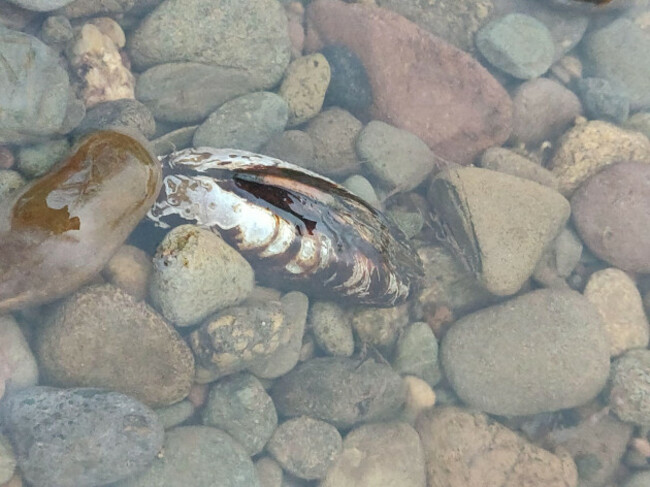
Some people in a flooded Enniscorthy have blamed the lack of flood protection for their town on freshwater pearl mussels, saying that the long-lived bivalves that are about the size of your hand are being given greater protection than people.

It’s entirely understandable that residents feel this frustration, given the circumstances, but the reality is that the mussels are well on their way to extinction, having been effectively wiped out by a combination of pollution and river dredging. They are nature’s freshwater filters, keeping our rivers clean, and are widely considered to be the ‘canary in the coal mine’ when it comes to river ecosystems. 

Mussels, of course, are not more important than people, but we should by now have learned that we cannot continually push nature aside to make way for development. Nature is pushing back.

freshwater-pearl-mussel-margaritifera-margaritifera-mollusca-eden-lawn-tennis-club-carlisle-ca3-9an-uk The endangered Freshwater Pearl Mussel is considered the 'canary in the coal mine' for river ecosystems. Alamy Stock Photo Alamy Stock Photo

Saving the pearl mussel from extinction is, rightly, a legal requirement. This would mean restoring rivers to a more natural state and cleaning up the pollution that is daily flowing into them. It would mean repairing the peatlands in the uplands and bringing back more natural forests, particularly along riverbanks where trees have mostly been stripped out.

These are precisely the things that would help to slow water and reduce downstream flooding, but the task of protecting nature has not been taken seriously by the State.

It’s not just the pearl mussels; a report published by the National Parks and Wildlife Service before Christmas showed that natural ecosystems continue to deteriorate, and now 90% of ‘protected’ habitats in this country are in ‘poor’ or ‘inadequate’ condition.

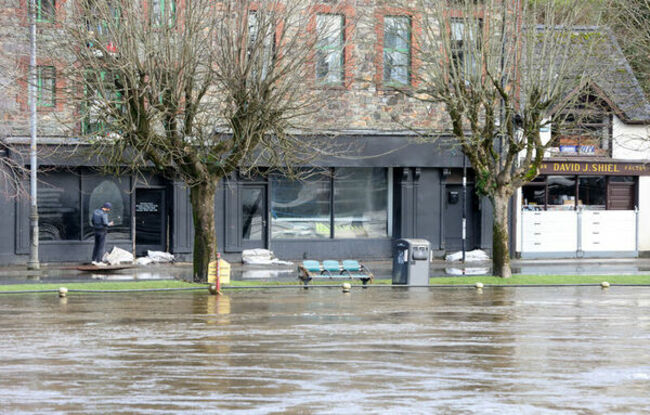
Enniscorthy clean up-32_90741981 Damaged shops can be seen on the Quays in Enniscorthy, which is being repaired due to flooding.

Addressing our land use is not necessarily a substitute for flood defences in larger towns, but it can reduce the need for concrete and high walls while providing a solution for the countless smaller towns and villages that will never get a flood defence scheme.

This is a huge challenge, but the fact that the government can’t even bring itself to publish its land use plan shows how little appetite there is to deal with the environmental crisis.

What should government do immediately?

As we grapple as a country with the effects of the most recent storm, Chandra, and look at the cleanup for many communities in Wicklow, Wexford, Waterford, Dublin, and Kilkenny. We should be approaching this level of climate impact as the emergency that it is. We have been warned for many years that these storms were coming, and that they were coming fast. We have no room left for complacency.

The government can no longer feign surprise when communities are left with a messy and distressing flood clean-up. If I were to sit at Cabinet this week, I would implore the Taoiseach and other ministers to do the following, without delay:

  • Stop the dredging, repeal the Arterial Drainage Act and mandate the Office of Public Works to restore rivers to a more natural state.
  • Immediately reform the Forest Strategy to end clear-felling of plantations and introduce payments to landowners to establish natural forests in the uplands. No more conifer monocultures.
  • Introduce mandatory buffer zones along main river channels, between 30-50m wide depending on the size of the river, to create bands of river forests.
  • Stop removing fallen trees from rivers and prohibit the infilling of wetlands.
  • Stop building on floodplains.
  • Pay farmers to block drains and restore wetlands.
  • Stop digging out bogs and mandate Bord na Móna to rewet and restore all of the land under its control.
  • Introduce beavers to do the work of river restoration at minimal cost and maximum benefit.

What we are seeing is not a ‘new normal’. In fact, it is just the beginning of a deterioration of our climate that will continue to worsen until we stop burning fossil fuels.

In parallel, restoring ecosystems is the cheapest, quickest and most effective way that we can protect ourselves from the coming onslaught.

The communities of Enniscorthy and other affected areas deserve nothing less. Many more communities are set to feel the impacts if we don’t act now.

Pádraic Fogarty is an environmental campaigner.   

Readers like you are keeping these stories free for everyone...
A mix of advertising and supporting contributions helps keep paywalls away from valuable information like this article. Over 5,000 readers like you have already stepped up and support us with a monthly payment or a once-off donation.

Close
15 Comments
This is YOUR comments community. Stay civil, stay constructive, stay on topic. Please familiarise yourself with our comments policy here before taking part.
Leave a Comment
    Submit a report
    Please help us understand how this comment violates our community guidelines.
    Thank you for the feedback
    Your feedback has been sent to our team for review.

    Leave a commentcancel

     
    JournalTv
    News in 60 seconds