Sign in. It’s quick, free and it’s up to you.
An account is an optional way to support the work we do. Find out more.
Sign in. It’s quick, free and it’s up to you.
An account is an optional way to support the work we do. Find out more.

IT’S BEEN HOT this week. That’s fair to say. The temperatures have been high. Higher than usual, like. Not quite record-breaking in the way that we might have expected, but sure look. Next year we’ll be prepared. We’ll do a proper sacrifice to Ra the Sun God before the Leaving Cert even starts, and we’ll finally break that warm glass ceiling.
The thing is, though, I haven’t been hot. Whatever it is about the location of my apartment, the entire thing seems to be in the shade from all directions, and had I not ventured outside in the evenings, then at no point would I have noticed there was anything different about the days’ temperature. But just because this week wasn’t really all that hot for me, that doesn’t mean it wasn’t hot.
Met Éireann, for example, had to issue warnings about how hot it was. One imagines that construction workers or bus drivers or anybody by an office window must have felt like ants trying to hit their KPIs while under a magnifying glass. It’s important to retain the perspective that just because you aren’t personally experiencing something doesn’t mean that thing isn’t real or that it isn’t affecting others. I am going somewhere with this.
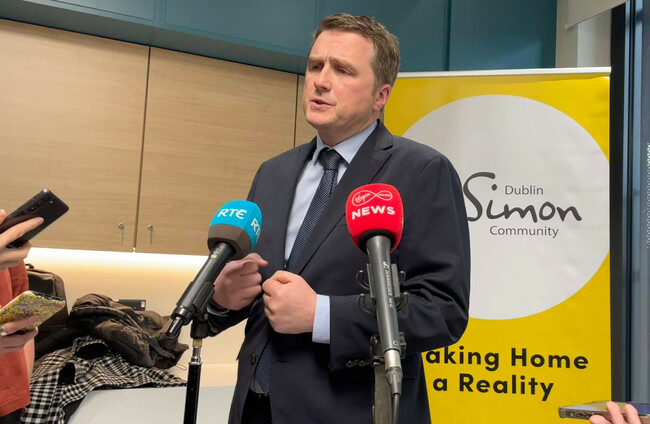
This week, Minister for Housing James Browne told interviewer Gavan Reilly he would no longer be giving estimates for when homelessness figures are expected to, you know, stop rising. Browne explained that this was because it was “very difficult to model” when homelessness figures would drop. Difficult to model? No. High heels made out of jelly are “difficult to model”. The drop in homelessness figures isn’t difficult to model; it’s just that homelessness figures aren’t meaningfully dropping despite minor fluctuations (this month, for example, the number of people accessing homelessness services dropped by 0.5%, but is up 66% against June four years ago).
A cornerstone of Browne’s approach as housing minister has been to “move away from targets”, which is a fun choice of words, since it’s not like we were ever anywhere near the targets to begin with. What he means to say is that he wants to move away from talking about targets. Being reminded that his department keeps missing the targets. That kind of thing.
Targets, after all, are an inherently helpful tool. It’s quite difficult to accomplish anything if you don’t have a target in mind. Trying to give yourself a better chance at solving the housing crisis by getting rid of targets is sort of like if you were shooting at a bullseye, missed 10 times in a row, and concluded that the problem is that you’d been doing it with your eyes open.
Browne is now taking that same approach to homelessness, which reached a new high of 17,548 in May, including 5,604 children accessing emergency accommodation during that time. As always, this figure undoubtedly understates the real level of homelessness and housing need in the country, as it does not count people sleeping rough, anyone couch-surfing, those trapped in domestic violence situations, adults who cannot move out of their parents’ homes, and all manner of people whose needs are not served by the Irish housing supply.
Browne’s approach is a tacit admission that we are not trying to solve the housing crisis; we are merely trying to keep pace with it, and we are doing so with all the athleticism one might expect of a Sunday shopper who’s ended up walking out into the middle of the Dublin marathon by accident.
“Unfortunately, it’s when the number of homes being delivered exceeds the number of people who need homes in terms of our population increase, and we’ve seen a significant increase in our population,” Browne told Reilly, by way of blaming the housing crisis on people coming into the country.
Even if we were to take it as a given for a moment that the housing crisis is entirely attributable to a sudden and rapid increase in population, which it is not, it would still be Browne’s job to sort it out, by the way. Simon Coveney promised to end homelessness during his tenure as housing minister back at the outset of 2017 — long before the war in Ukraine, long before this supposedly insurmountable influx of people made it impossible to fix a housing crisis that had already been well underway for at least six years.
Rather than trying to make the case that individuals coming into Ireland are making it impossible for Irish people to afford homes, perhaps we should be looking at those who are actually buying the properties and actually setting the rents — corporate landlords, such as Ires Reit.
While Ires Reit sounds like an East German photographer-cum-performance artist you pretend to be familiar with at parties so people don’t think you’re uncultured, it is actually Ireland’s largest private residential landlord, owning no fewer than 3,627 residential properties across the country. Ires was in the news this week when it was reported that the landlord is lobbying to be included in Tánaiste Simon Harris’ shiny investment scheme, designed to encourage young Irish people to make some money off the market.
The argument in favour of Simon Harris’ investment scheme is that it’s a way for young people to build up a bit of wealth in the face of an economy that is otherwise highly extractive in terms of basic cost of living (Irish people pay the highest costs in Europe for both energy and housing, with other necessities such as groceries and childcare also relatively very costly).
It would, therefore, be fitting if the means by which young Irish investors can make money on the market is by pumping their own savings into a company that is the perfect emblem of why all our savings feel so measly in the first place. Whether you’re buying a gaff or simply comforting yourself with some investments, it seems auld Ires is getting your money. If only she’d stuck to the performance art.
While we’re on that subject, and if you’ll forgive me for sounding a note of caution with my two whole years of university-level economics, choosing 2026 of all years to become an investor might not be the smartest move in the world, since the market is currently an enormous bubble-risk due to the massive amount of investment eggs being kept in the AI basket. I’m not David McWilliams or anything, but if the bubble bursts in the next few years, there will be plenty of very unhappy, very exposed investors, so that’s something to bear in mind.
One potential solution to all of our worries is that when the AI bubble does inevitably burst, we can all live in the gutted husks of the data centres that are forecasted to use about a third of the country’s total energy over the coming years. A third! That’s a nice thought, isn’t it? Energy consumption by robots, for robots. Though of course, where would an online-only columnist be without data centres? Without data centres, there’d be nowhere to hold all the data that these columns are made up of! Without the data centres, you’d never hear from me again! Am I inspiring you to action yet?
And of course, on the subject of energy usage, we come back to… the heat. This month, the European Data Centre Association, who lobby the European Union on behalf of data centres, argued that the EU must choose between its climate goals and the proliferation of data centres. And just for the avoidance of any doubt, these people are saying that data centres should win that particular battle.
So the next time you’re standing in that 30-degree Irish summer sun, feeling the very world end on your skin in real-time, disappointed that we’ve failed to break records in temperature as easily as we do with homelessness, just remember that there’s always next year, and if we build just a few more data centres, we’ll get there eventually.
To embed this post, copy the code below on your site












have your say