We need your help now

Support from readers like you keeps The Journal open.

You are visiting us because we have something you value. Independent, unbiased news that tells the truth. Advertising revenue goes some way to support our mission, but this year it has not been enough.

If you've seen value in our reporting, please contribute what you can, so we can continue to produce accurate and meaningful journalism. For everyone who needs it.

Alamy Stock Photo

Getting inked Just how toxic are tattoos?

Dr Catherine Conlon examines the research around tattoos and how they might affect the body in the long run.

YOU’VE BEEN DREAMING about it for months. You’ve picked out your design, saved your money and booked your appointment. Lurking in the back of your brain is the age-old question: ‘What will my mum/dad/granny/boss say?’

Does that still happen? Or have tattoos gone mainstream, and anything, any place goes? Can you walk into a job as a corporate lawyer with a tattoo on the back of your hand? Can you work as a GP with a snake on the side of your neck? Can you show your tattoo to your grandmother?’

The answer to these examples is maybe, maybe not. For some more traditional environments, tattoos are still associated with gangs, sailors and undesirables. Some employers still hesitate to employ workers with highly visible tattoos.

In recent decades, the stigma of wearing a tattoo has definitely plummeted, with many workplaces encouraging people to ‘express themselves’. Tattoos have gone mainstream for young people in the last decade, with over a third (35%) of Irish people reported to have a tattoo in 2019, and the average number of tattoos per person is two.

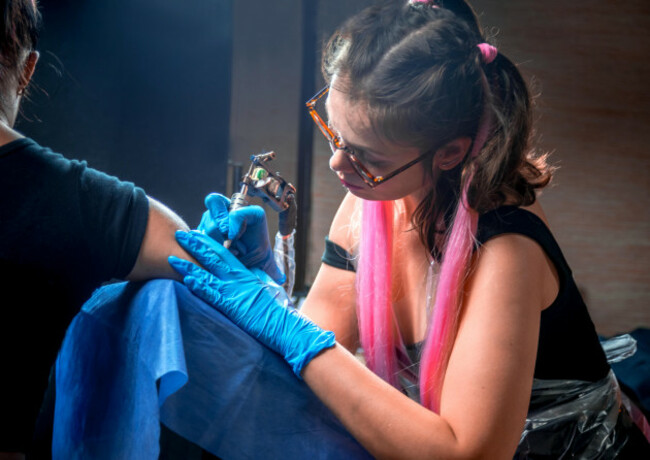
master-of-the-art-of-tattooing-does-tattoo-on-the-skin-of-his-client-in-tattoo-parlour Alamy Stock Photo Alamy Stock Photo

A US Pew Research survey (2023) found similar numbers with nearly one-third (32%) of adults having a tattoo, including more than half of women aged 18 to 49, and over a fifth of adults (22%) having more than one tattoo — numbers that have skyrocketed in recent years.

Social media has accelerated the trend, and new trends, including fine lines on the hands and the back of the arms, have exploded among Generation Z.

The earliest tattoo is reported to have been found on the body of Ötzi the Iceman, the natural mummy of a man who lived between 3,350 and 3,105 BC, whose remains were discovered in the Ötza Alps on the Austrian-Italy border in 1991. He was found to have a cross-shaped tattoo near his knee and lines on his body, postulated to relate to pain or ritual use.

Are tattoos bad for your health?

If you are one of the third of Irish people sporting one or more tattoos, some recent research may have you worried.

A Swedish study published in eClinical Medicine (2024) conducted a large case control study to investigate the link between tattoos and malignant lymphoma. The researchers examined data from national registers, focusing on people diagnosed with lymphoma between 2007 and 2017 and compared them to a control group without lymphoma.

The study found that people with tattoos had a slightly higher risk (21%) of developing lymphoma compared to those without tattoos. This increased risk was highest for individuals who received their first tattoo within the past two years.

‘We already know that when the tattoo ink is injected into the skin, the body interprets this as something foreign that should not be there, and the immune system is activated,’ researcher Christel Nielson said in a statement. ‘A large part of the ink is transported away from the skin to the lymph nodes, where it is deposited.’

While the study suggests a possible link between tattoos and lymphoma, the risk appears to be small, and the results were not statistically significant. That means that the reported links between tattoos and lymphoma were questionable and could have been observed by chance.

The researchers from Lund University suggested that more research was needed, specifically to investigate the components of tattoo inks that might be risky and explore safer alternatives.

A more recent study, published in Behaviour Genetics in March by researchers from the Department of Public Health and the Department of Clinical Research at the University of Helsinki, investigated the health consequences of tattoos.

black-white-studio-portrait-of-man-and-woman-with-tattoos Alamy Stock Photo Alamy Stock Photo

Using data from Danish twin pairs, they found that tattooed individuals are more frequently diagnosed with skin and lymphoma cancers compared to those without tattoos.

The research highlighted how the lymph nodes are a crucial part of the immune system, helping to fight infections and filter harmful substances from the body. When tattoo ink enters the skin, some of it travels to the lymph nodes. The researchers were concerned that tattoo ink may trigger chronic inflammation in the lymph nodes, which predisposes to an increased risk of cancer over time.

‘We can see that ink particles accumulate in the lymph nodes, and we suspect that the body perceives them as foreign substances,’ said co-author Henrik Frederiksen, consultant in haematology at Odense University Hospital and clinic professor at Syddansk University (SDU).

portrait-of-a-young-woman-with-tattoos-in-the-garden Alamy Stock Photo Alamy Stock Photo

‘This may mean that the immune system is constantly trying to respond to the ink, and we do not yet know whether this persistent strain could weaken the function of the lymph nodes or have other health consequences,’ Frederiksen added.

This means that exposure in youth may not lead to illness until decades later, making it difficult to measure the direct effect.

This most recent study is based on data from the Danish Twin Tattoo Cohort, where researchers have information on almost 6,000 Danish twins.

By analysing tattoo patterns alongside cancer diagnoses, they found a higher occurrence of both skin and lymphoma cancers in tattooed individuals.

The results in twin pairs showed that the link between tattoos and cancer was most evident in those with large tattoos, defined as bigger than the palm of your hand.

For lymphoma, the rate was nearly three times higher for the group of individuals with large tattoos compared to those without tattoos.

monk-with-buddhist-tattoos-lolei-temple-roluos-group-siem-reap-cambodia Alamy Stock Photo Alamy Stock Photo

The authors concluded that the bigger the tattoo and the longer it has been there, the more ink accumulates in the lymph nodes.

Lead author, Signe Bedsted Clemmensen, assistant professor of biostatistics at SDU suggested that the extent of the impact on the immune system should be further investigated so that the mechanisms at play could be better understood.

The study did not find a clear link between cancer occurrence and specific ink colours, but the researchers reported that this does not mean that colour is irrelevant.

Previous research has shown that ink can contain potentially harmful substances and red ink, in particular is more often associated with allergic reactions.

handsome-man-with-beard-and-long-hair-standing-shirtless-showing-tattoos-pointing-displeased-and-frustrated-to-the-camera-angry-and-furious-with-you Alamy Stock Photo Alamy Stock Photo

More research is planned, particularly to investigate the biological mechanisms — what happens in the lymph nodes when they are exposed to ink particles over decades.

‘This can help us assess whether there is a real health risk and what we might do to reduce it,’ concludes Signe Bedsted Clemmensen.

In the meantime, while we are waiting for the research to provide more clear-cut answers about the magnitude of cancer risk from tattoos over several decades, think carefully.

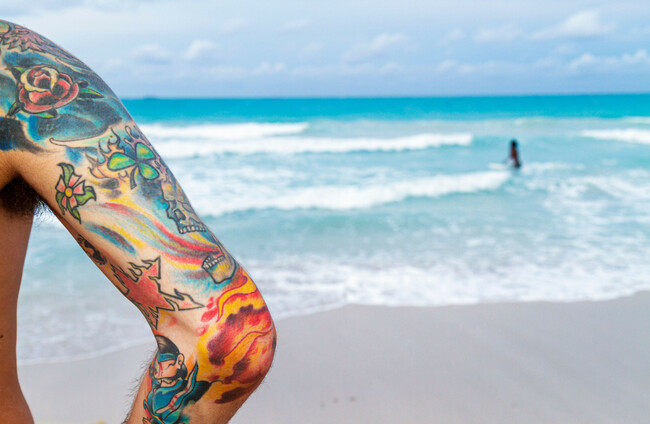
It might look cool on the beach this summer, but do you want to have it with you, a constant reminder of summer 2025, for the rest of your life?

Dr Catherine Conlon is a public health doctor in Cork.

Readers like you are keeping these stories free for everyone...
A mix of advertising and supporting contributions helps keep paywalls away from valuable information like this article. Over 5,000 readers like you have already stepped up and support us with a monthly payment or a once-off donation.

Close
74 Comments
This is YOUR comments community. Stay civil, stay constructive, stay on topic. Please familiarise yourself with our comments policy here before taking part.
Leave a Comment
    Submit a report
    Please help us understand how this comment violates our community guidelines.
    Thank you for the feedback
    Your feedback has been sent to our team for review.

    Leave a commentcancel

     
    JournalTv
    News in 60 seconds