We need your help now

Support from readers like you keeps The Journal open.

You are visiting us because we have something you value. Independent, unbiased news that tells the truth. Advertising revenue goes some way to support our mission, but this year it has not been enough.

If you've seen value in our reporting, please contribute what you can, so we can continue to produce accurate and meaningful journalism. For everyone who needs it.

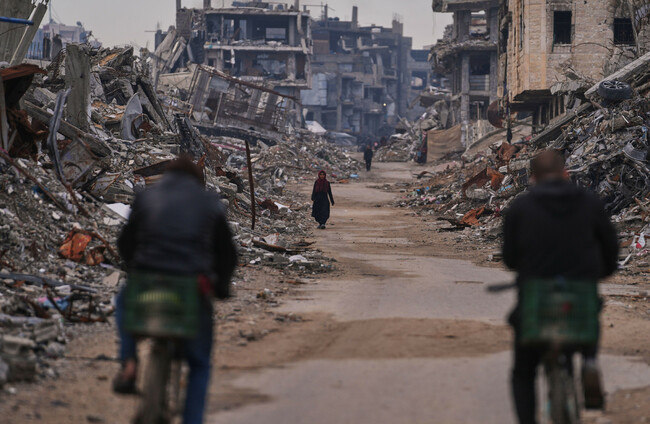
Buildings destroyed by Israeli air and ground attacks on the Sheikh Radwan neighborhood in Gaza City. Alamy Stock Photo

The future of Gaza Should Ireland contribute troops to the proposed Gaza Stabilisation Force?

Professor Ray Murphy writes that Palestinians have been excluded from the planning of a peacebuilding structure for Gaza.

THE US, ALONG with European and Arab states, is pushing for the implementation of the next phase of the Trump peace plan. However, without a proper peacebuilding plan, international forces will fail to achieve long term stability. This lesson should be evident from past US experience in Afghanistan and Iraq.

The current Trump plan proposes a system reminiscent of the mandates established in the region following the First World War. This is not the kind of international force that Ireland should participate in. It is neo-colonial in nature and effectively gives the US a leading role in the occupation of Gaza.

Palestinians have, for the most part, been excluded from the planning and there is no mention of international law or accountability for violations committed by all parties.

A new political geography is emerging that threatens the whole peace process. Gaza is now divided into two zones: the eastern areas under Israeli control, and the western areas under a weakened but still potent Hamas. A so-called Yellow Line divides these two zones and has become a flashpoint for most recent incidents.

Trump’s peace plan is intended to be executed by a coalition. There are parallels with how the US built coalitions in Afghanistan and Iraq in order to share the significant military and economic burden involved. We are still living with the disastrous consequences of those ill-conceived interventions.

Protection of civilians and securing humanitarian aid are critical roles for any intervention force. According to the US, an international stabilisation force will deploy under a unified command to secure Gaza, oversee demilitarisation, protect civilians and escort aid through safe corridors.

All this should take place while Israel phases out its presence and a recently trained Palestinian police force takes on a new role.

Already the consequences of flawed planning are evident with a stabilisation or peace enforcement mission not yet established and no financial plan in place to ensure its operation. Other fundamental questions remain unresolved which could doom the plan to failure.

An unclear plan

The mandate is unclear. What does it demand from the parties? How many troops will be needed and from which states. Who will disarm Hamas and under what conditions?

What authority would an international force have if it ultimately entered Gaza? The area of operations is undecided. There are also the challenges relating to the heavy machinery needed to clear the rubble, how to deal with unexploded ordnance and the recovery of the thousands of bodies buried there.

This is not a UN multilateral peacekeeping force. While the UN resolution approving the peace plan confirms that the Security Council will remain ‘seized of the matter’, all aspects of Gaza’s governance rest in the hands of the proposed Board of Peace, which will be led by Trump.

In a clear effort to erase the historical context and minimise the role of the UN, there is no mention of previous UN resolutions. It is noteworthy that the proposed force is authorised to use all necessary measures to carry out its mandate, a euphemism for the use of force.

Palestinian statehood

In 2024, the UN International Court of Justice advisory opinion ruled that the entire occupation of Palestinian territories is illegal and must end. That should mean requiring Israel to withdraw from sovereign Palestinian territory. The deployment of an international force as part of the transition to Palestinian governance is an ideal opportunity to do so.

A study by the US Army War College provides important lessons for Gaza. It found the failures of the multinational force in Afghanistan were primarily due to unclear strategic aims combined with random implementation that depended on those in command at any given time.

As things stand, neither Hamas nor Israel seems willing to compromise. Hamas will not disarm without a clear Israeli withdrawal and a plan for handling weapons laid down. Pressure needs to be put on Israel to withdraw and Hamas to disarm, in that order. Trump alone has the leverage to push this through.

Trump’s plan for Gaza is notable for offering a vague pathway to Palestinian statehood. Nevertheless, many Palestinians fear that the proposed International Stabilisation Force will freeze the status quo and legitimise the ongoing occupation.

The preferred alternative is a UN resolution that reinforces the ceasefire and deploys an international peacekeeping force, rather than giving external actors direct authority over Palestinian governance.

A move towards accepting the framework of two states with international protection would provide a compelling incentive for Hamas to disarm. This would imply a mandate over Gaza and the West Bank also, where Palestinians need protection from the latest wave of settler violence.

In order to support the transition to Palestinian self-determination, the peacekeeping force’s mandate should cover the entire Palestinian Occupied Territory, not just Gaza. Thus allowing the troops to maintain security and act as a buffer between Israelis and Palestinians.

Its mandate should enforce the peace and it should replace all Israeli forces within the Occupied Territory. In such a situation, Ireland could participate along with other currently uncommitted countries such as Italy.

The Gaza peace plan needs a peacekeeping force for all of Palestine, not a stabilisation force for Gaza. The current plan risks international forces being sucked into the conflict doing Israel’s and Trump’s bidding. An extensive and focused peacebuilding plan involving the UN would increase the prospects of success.

Unless bold and courageous decisions are made by all parties and external actors, the ongoing conflict will continue, punctuated by regular outbreaks of extreme violence.

Professor Ray Murphy works at the Irish Centre for Human Rights, School of Law, University of Galway. He previously served with the Defence Forces on peacekeeping missions in Lebanon and worked with the independent Palestinian Human Rights Organization Al-Haq and the EU in the Occupied Palestinian Territory.

Readers like you are keeping these stories free for everyone...
A mix of advertising and supporting contributions helps keep paywalls away from valuable information like this article. Over 5,000 readers like you have already stepped up and support us with a monthly payment or a once-off donation.

Close
JournalTv
News in 60 seconds