Take part in our latest brand partnership survey

We need your help now

Support from readers like you keeps The Journal open.

You are visiting us because we have something you value. Independent, unbiased news that tells the truth. Advertising revenue goes some way to support our mission, but this year it has not been enough.

If you've seen value in our reporting, please contribute what you can, so we can continue to produce accurate and meaningful journalism. For everyone who needs it.

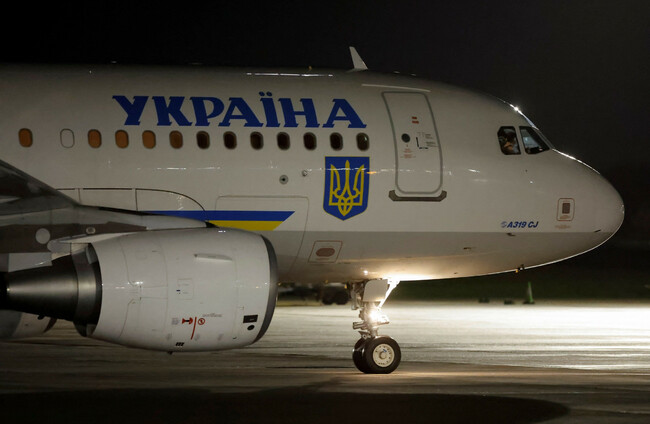
Ukrainian President Volodymyr Zelenskyy's plane after it arrived in Dublin Airport on Monday night. Alamy Stock Photo

Tom Clonan If media didn't report on drones breaching no-fly zone, the state may never have told us

The drones incident during Zelenskyy’s visit informs us of a number of things regarding Ireland’s security capacity, writes Tom Clonan.

MONDAY NIGHT’S REPORTED drone incident raises grave concerns about Ireland’s capacity to defend itself.

Ireland’s principal security stakeholders are silent on the matter. An Garda Síochána, Ireland’s primary intelligence agency, is said to be investigating the incident. The Department of Defence have thus far declined to comment on what happened during Ukrainian President Volodymyr Zelenskyy’s visit to Ireland last week.

In this scenario, the Irish public have had to rely on the work of security correspondents to try to piece together what may have happened in our airspace approximately 20km east of Dublin Airport. As part of the security arrangements surrounding President Zelenskyy’s visit, two Irish Naval Vessels – the LÉ Aoibhinn and LÉ William Butler Yeats – were on-station, patrolling the waters of Dublin Bay.

It is reported that shortly after 11pm – just a short while after President Zelenskyy’s plane landed at Dublin Airport – four or five military-style unmanned aerial vehicles (UAVs), also known as ‘drones’, were spotted by the crew of the William Butler Yeats. These drones were described as ‘quadcopters’ with their navigation lights ‘switched on’.

If these matters were not reported by The Journal – and then subsequently by other Irish news outlets – it is not at all clear that the Irish public would have been informed of this grave threat to civil aviation.

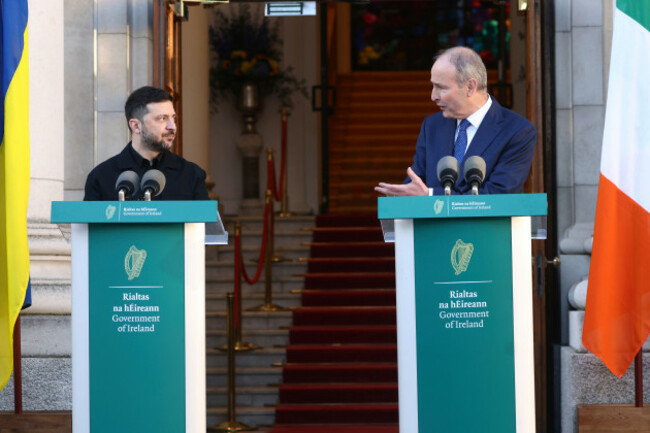
ukraine-president-volodymyr-zelenskyy-left-listens-to-the-irish-taoiseach-micheal-martin-as-they-hold-a-joint-news-conference-in-dublin-ireland-tuesday-dec-2-2025-ap-photopeter-morrison Ukrainian President Volodymyr Zelenskyy and Taoiseach Micheál Martin outside Government Buildings on Tuesday 2 December. Alamy Stock Photo Alamy Stock Photo

According to reported Naval Service eyewitness accounts, the drones loitered and manoeuvred close to the busiest flight paths approaching Dublin Airport for up to two hours.

Whilst President Zelenskyy’s plane had landed safely at this point – the continued presence of these drones represented a clear and immediate danger to dozens of passenger flights arriving in Dublin Airport during the two hours of their observed activity.

As large and powerful drones, each one represented a grave threat to passenger jets descending into Dublin Airport.

For context, when tiny ‘consumer’ drones were spotted in the vicinity of Dublin Airport in early 2023, the airport was closed to incoming flights on several occasions. When suspicious drone activity was observed recently at airports across Europe – in places like Brussels and Denmark – airports were closed and incoming flights diverted elsewhere in order to protect civil aviation and passengers from the risk of collision.

This did not happen in Dublin last Monday evening. Although senior government figures were briefed on the matter, it appears to be the case that no alert was issued to pilots approaching Dublin airport at the time of the presence of potentially hostile ‘military grade’ drones.

In other words, after Zelenskyy’s plane landed safely, hundreds and hundreds of air passengers were recklessly exposed to the catastrophic risk of collision with military drones operating along the flight paths of their incoming aircraft. It is recognised internationally that the take-off and landing phases for passenger aircraft are when these planes are at their most vulnerable. Approaching Dublin Airport – at 20km out from the runway – these aircraft are descending to relatively low altitudes, well within the operating range and ceiling of industrial drones.

It is incredibly fortunate for Ireland that nobody was hurt in this bizarre scenario. If, whilst descending, a passenger jet struck one of these drones – on the cockpit, wings or engines – the result could have been catastrophic. And yet, nobody in the Departments of Defence, Justice, Transport or an Taoiseach thought to inform pilots of the risk of collision on Monday evening.

The reported incident informs us of a number of things regarding Ireland’s security capacity.

It confirms that the Naval Service (through no fault of their own) lack the ability to detect, track, monitor or intercept military grade or industrial drones. They were almost completely powerless to intervene. There would appear to be no legal guidance or ‘rules of engagement’ for firing the ship’s armaments, at night, at such drones in order to destroy them – even when they present a threat to civil aviation.

Even if there was, the weapons currently available to the Naval Service have ammunition safety ranges and tracer burn-out profiles that – potentially – would have posed a risk to passenger aircraft making their final approach to Dublin Airport.

However, by sheer professionalism and sheer bloody luck, Naval Personnel did detect and identify the aerial threat. They also managed to track the drones to a certain extent as it is reported they ‘loitered’ in the vicinity of the ship. It is also reported that video footage of the drones was obtained.

Aside from conventional military capabilities however, what happened next speaks to the competence and situational awareness of the community of decision makers in the Departments of Defence, Justice and the Taoiseach that – literally and metaphorically – ‘call the shots’ when this incident was underway.

Dublin Airport was not closed to incoming traffic on Monday night, nor were pilots informed of the ongoing risk to them, their aircraft and their passengers. No alert was issued and at the time of the observed drone activity, operations continued as normal into and out of Dublin Airport. Pilots were not given the information to make a decision whether or not to continue to descend or to divert elsewhere. This is an indefensible and inexplicable scenario.

The community of senior decision makers who allowed this situation to develop = without informing or warning the travelling public – are the same community of decision makers who have allowed Ireland’s defence and national security to deteriorate to the point where we are completely defenceless in the air, maritime, ground and cyber domains.

These are also the same community of decision makers who are refusing to attend the Joint Oireachtas Committee on Defence and National Security to answer basic questions about Ireland’s defence and security environment. This makes Ireland the only country in the EU where there is no parliamentary oversight or accountability when it comes to these crucial matters. Despite the fact that the Committee’s remit includes ‘related hybrid threats’ – in my view, the full spectrum of threats that confront us in a time of hybrid warfare from state and non-state actors – the key stakeholders in Ireland are refusing to be accountable to the people. This is a major red flag. We know from bitter experience in Ireland that where there is a lack of accountability and oversight – disaster normally follows.

The Irish people need answers from government about what happened in Irish airspace in the approaches to Dublin Airport last Monday evening – at one of the busiest time of year for air passengers. We need to know who made the decision not to inform pilots about the risk to aviation and passengers at that time. Perhaps the government could start by instructing those decision makers and key stakeholders to attend the emergency meeting convened by the Committee on Defence and Security on Wednesday afternoon for this very purpose.

Dr Tom Clonan is a retired army officer and former lecturer at TU Dublin. He is an Independent senator.

Readers like you are keeping these stories free for everyone...
A mix of advertising and supporting contributions helps keep paywalls away from valuable information like this article. Over 5,000 readers like you have already stepped up and support us with a monthly payment or a once-off donation.

Close
JournalTv
News in 60 seconds