We need your help now

Support from readers like you keeps The Journal open.

You are visiting us because we have something you value. Independent, unbiased news that tells the truth. Advertising revenue goes some way to support our mission, but this year it has not been enough.

If you've seen value in our reporting, please contribute what you can, so we can continue to produce accurate and meaningful journalism. For everyone who needs it.

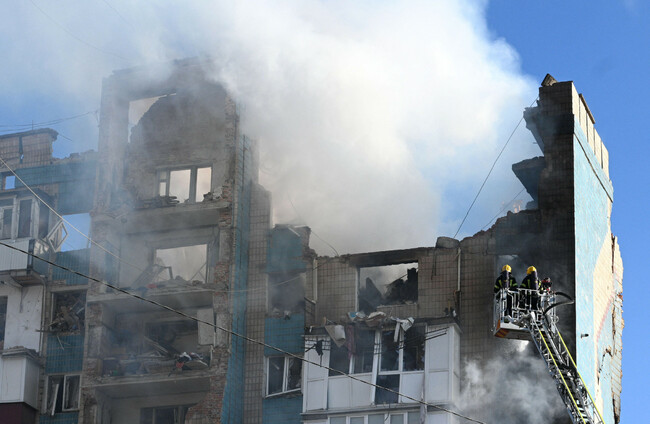
Rescue personnel battle a blaze in a heavily damaged apartment building following Russian air missile strike in Ternopil, Ukraine - November 19, 2025 Alamy Stock Photo

Tom Clonan My New Year's wish is for peace in Ukraine and Europe as a whole

Tom Clonan analyses the state of Russia’s war on Ukraine and gives his view of what will, or should, happen in 2026.

RUSSIAN PRESIDENT VLADIMIR Putin’s ‘three-day special military operation’ in Ukraine is approaching its four year anniversary in February.

There have been more than 1,400 days of grinding attritional combat. 2025 has seen a major shift in Putin’s propaganda efforts to portray Ukraine’s defence as ‘crumbling’ with Russian victory in Luhansk and Donetsk as ‘inevitable’.

It is certainly the case that Russian forces have made a number of minor advances along the 1,000km front. The centre of gravity of the Kremlin’s winter campaign has been in Donetsk, with Russian forces moving west of Bakhmut towards Pokrovsk, Kostyantynivka, Siversk and Kupyansk.

Russian Chief of the General Staff, Valery Gerasimov has claimed victory in these areas, with Putin awarding the Hero of Russia Medal to the military commander of Russia Forces West, Colonel General Sergey Kuzovlev, for the capture of Kupyansk on 9 December.

However, on 12 December, Ukrainian President Volodymyr Zelenskyy was filmed in Kupyansk with Ukrainian Chief of Staff General Oleksandr Syrsky claiming that Kupyansk remained under Kyiv’s control. In unverified reports, Colonel General Sergey Kuzovlev is reported missing as of 14 December.

In the midst of claim and counter-claim, Russian Defence Minister Andrei Belousov in an end of year assessment has stated that Putin’s forces have captured approximately 6,000 square kilometres of territory in the Donbas in 2025.

If true, this represents a tiny advance, with no strategic towns or military targets seized.

Despite secondary assaults to the north in the Kharkiv direction and south in the direction west towards Mykolaiv and Zaporizhzhia, Putin’s winter offensive has failed to gain momentum.

Critically, Ukraine’s strategically vital military hubs from Lyman in the north, south through Slovyansk, Kramatorsk and Druzhkivka remain functioning – effectively re-supplying and reinforcing Ukrainian positions and counterattacks along the Donetsk front.

Gains and losses

Despite claims that Ukraine’s defence is ‘collapsing’ during 2025, Kyiv has managed to continue to rotate up to 20,000 troops per month to the eastern front.

However, Ukraine’s casualties have been significant. Although Kyiv does not publish these figures, it is estimated that up to 500,000 Ukrainian troops have been killed and seriously injured to date.

As we approach the fourth anniversary of the invasion, these figures represent a serious and tragic strain on Kyiv’s war effort as many of their combat formations have been in continuous combat for the entirety of the conflict.

If and when the conflict comes to an end, it will be very difficult for Ukraine to re-integrate this huge cohort of traumatised men and women into any post-conflict society or economy.

For Putin, Russia’s losses in Ukraine – when various sources are collated – would appear to be in excess of one million men killed, maimed or missing.

Up until now, the Kremlin has avoided a general military mobilisation of Russia – on a full war footing – and have managed to replace and reinforce their forces in Ukraine through limited conscription, recruitment drives and ‘contracted’ soldiers.

However, it is believed that such are Putin’s losses, in relentless ‘meat grinder’ mass-wave assaults, that continued reinforcement may be unsustainable without universal conscription including in the metropolitan areas of St Petersburg and Moscow.

In economic terms, Putin is also under pressure. Russia’s war economy is unsustainable in the long term. With a GDP similar to that of Spain, Russia will find it difficult to continue the war in Ukraine indefinitely, whilst sustaining the current appalling loss of men and material. To put Ukraine in context, the Soviet Union lost 15,000 troops killed and 35,000 injured in their nine year war in Afghanistan. To lose over a million troops in Ukraine – with very little to show for it in territorial terms – places Vladimir Putin under considerable pressure.

Foreign support

The decision by the EU to provide Ukraine with €90 billion in aid over the next two years will allow President Zelenskyy to continue Kyiv’s defence of the country for at least another year and beyond. Whilst the fullest implications of the EU’s decision are yet to play out in geopolitical terms, it signals Europe’s – and Nato’s – resolve to support Kyiv in seeking a just resolution to Putin’s war crimes in Ukraine.

In the immediate term, this decision will increase the pressure on Putin and his Foreign Minister Sergei Lavrov as US-brokered negotiations continue toward a cease fire and some sort of resolution to the conflict. In this context, in the absence of a deal, or in the continued negotiation for a resolution, Putin and his henchmen will ratchet up their bellicose rhetoric and will threaten a grave escalation in the conflict – no doubt threatening EU member states and likely invoking the threat of the possible use of tactical nuclear weapons.

This type of language is normally invoked by the Kremlin when under pressure – as evidenced during the opening phase of their current invasion of Ukraine when their assault spectacularly failed to oust Zelensky and collapse the Ukrainian government. In February and March of 2022, Putin threatened the use of tactical nuclear weapons on three separate occasions.

So, whilst 2026 may begin with a very depressing and bleak picture in Ukraine, with increasingly grave threats of escalation from Moscow, the passage of time is not in Putin’s favour.

With the benefit of renewed and guaranteed funding from the EU, Kyiv will continue to carry out long range strikes on Putin’s energy, gas and oil infrastructure and will continue to carry out attacks on military infrastructure such as December’s attack on Russian S-400 air defence systems at Rayevka, north of Belgorod.

The year to come

As 2025 comes to a close, the early weeks of 2026 will be a crucial period for the future of Ukraine.

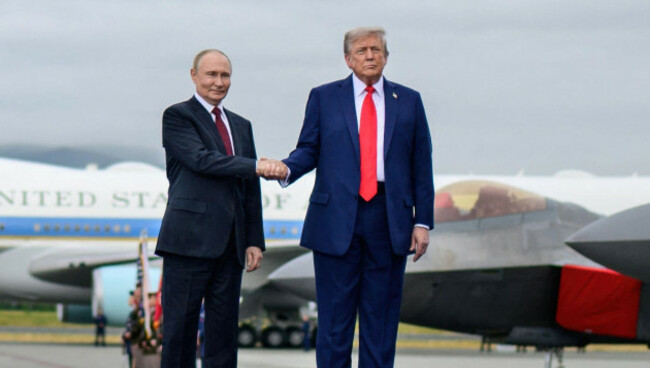
With Zelenskyy’s hand – however temporarily – strengthened by the EU’s monetary assistance, there will be a concerted diplomatic effort to persuade President Trump and his negotiation team to forge terms between Putin and Zelenskyy that provide Ukraine with an equitable and just end to this savage and brutal war.

3CE5TY3 Trump and Putin meeting in Alaska for talks in August 2025. Alamy Stock Photo Alamy Stock Photo

The challenge for all concerned will be in persuading and maintaining President Trump’s interest in negotiating equitable terms with Moscow – as Putin has indicated he will not deal with the EU or any European leaders whom he is currently referring to as ‘young pigs’.

For the EU, the opening months of 2026 will be tense and will fully test the transatlantic relationship – already damaged by the publication of Trump’s US National Security Strategy – which unequivocally identifies the EU and Europe as ‘adversaries’ of Washington.

The fear in Berlin, Paris, London and across all European capitals, is that the Trump administration will ignore the plight of the Ukrainian people in favour of restoring or ‘normalising’ economic relations with Russia for purely self-interested economic reasons and in prospect of Arctic exploitation in cooperation and collaboration with Moscow.

If Putin were to be given an unambiguous ‘victory’ in Ukraine, it will embolden him to continue to probe and provoke Europe in order to dismantle what Moscow refers to as the ‘security architecture’ of the European project. Putin’s ultimate aim is to undermine and end the transatlantic Nato alliance and to suborn Europe to Moscow’s imperial ambitions. The Kremlin will seek to maximize the opportunity to do this while Trump’s administration is in power.

Whatever the outcome in Ukraine in the coming months – whether 2026 sees an end to the war, or a continuing grinding and barbaric slaughter – Putin will continue to escalate hybrid operations throughout the EU. Ultimately, at some point, Putin will test Nato and Europe’s resolve and cohesion by testing Nato’s Article 5 mutual assistance clause – most likely with some intervention involving a Russian speaking population centre in the Baltic States.

The war in Ukraine is a test of European and Nato resolve, and of EU and European norms and values in the face of the rise of global authoritarian power and the wielding of power through the projection of military force and coercion.

As we enter 2026, we enter a crucial moment in negotiating the future of Ukraine, and by extension the future of Europe.

I hope we see an end to the senseless slaughter in Ukraine and continued solidarity, unity and cohesion in Europe – in the cause of peace.

This being the ultimate aim of the European project, my New Year’s wish is that at some point this year, the EU can re-orient toward peace. Certainly that peace can only come through strength and deterrence – but I hope that we can avoid a catastrophic slide into war.

Ireland, as a militarily non-aligned neutral state, and with our recent history of peacemaking and reconciliation has a role to play in offering leadership in the cause of peace.

Dr Tom Clonan is a retired army officer and former lecturer at TU Dublin. He is an Independent senator.

Readers like you are keeping these stories free for everyone...
A mix of advertising and supporting contributions helps keep paywalls away from valuable information like this article. Over 5,000 readers like you have already stepped up and support us with a monthly payment or a once-off donation.

Close
JournalTv
News in 60 seconds