Sign in. It’s quick, free and it’s up to you.
An account is an optional way to support the work we do. Find out more.
Sign in. It’s quick, free and it’s up to you.
An account is an optional way to support the work we do. Find out more.


THERE IS A common misconception that the USC is hated.
Not so.
And the reason why is because people know it’s one of the fairest and most progressive taxes in Ireland and could go a long way to solving our housing, education and healthcare crisis.
Ahead of last year’s Budget, an Irish Times MRBI Poll asked the question: How should the Government spend the promised €1.5bn in the budget?
Despite this, the government cut USC and didn’t sufficiently invest in public services – leading to an exacerbated housing and public healthcare crisis this year.
Last week, ahead of Budget 2017 – where the USC was cut by 0.5% across the three lowest bands – another MRBI poll revealed that only 10% wanted a cut in the USC, whereas 72% prioritise higher spending on public services, particularly health care.
So why all the talk of cutting USC?
The USC raises €4 billion in revenue every year and is the most progressive income tax – meaning the higher your income, the more you pay.
It is so progressive that 75% of the USC raised (€3bn) comes from the top 20% of earners and 43% comes from those earning more than €100,000.
The simple fact of the matter is, if you scrap the USC then that revenue must be found elsewhere or we will all face deteriorated public services.
Documents recently drawn up by the Department of Finance for the Irish Government explained options available for the replacement of the USC:
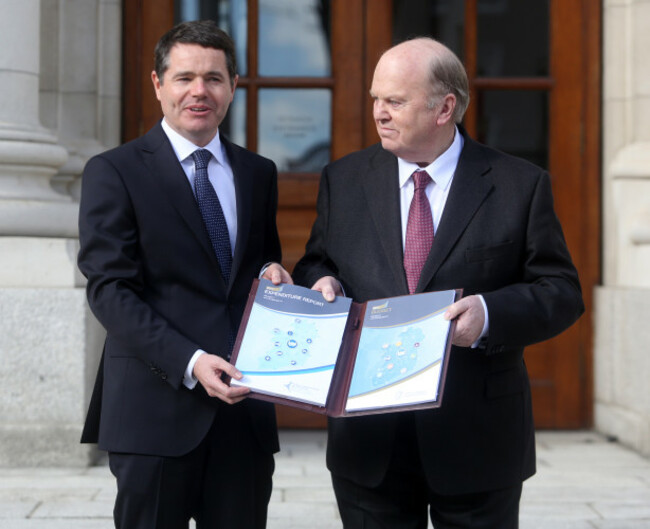
In the Department’s briefing document, they state:
The USC is a progressive tax, therefore abolition of, or substantial reductions in the USC would be regressive. For example if the USC were abolished a person on minimum wage would benefit by €316, whereas an employee earning €150,000 would benefit by over €9,500.
The reason for such a high contribution from high earners is because the USC has very few tax avoidance loopholes for the wealthy to exploit, unlike income tax. Low paid workers cannot avail of income tax loopholes because many of them do not earn enough to pay tax in the first place.
Furthermore, the list of representative bodies opposed to tax cuts is growing. The Irish Congress of Trade Unions (ICTU) has opposed a cut in the USC, as has employers’ group IBEC.
Also, in recent weeks the government-funded Economic Social Research Institute (ESRI) has publicly warned of the dangers of tax cuts at a time of economic growth, where there are rising levels of personal consumption and retail sales combined with an acceleration in employment growth:
“This suggests that economic activity does not need to be further stimulated by reducing personal taxation levels.”
Squeezed middle
So why is it the narrative that we should cut the USC? Well, abolishing the USC would benefit the highest earners most who tend to have louder voices than low income households or the actual ‘squeezed middle’.
For instance, abolishing the USC would mean a substantial increase in take home pay for many people who do not depend on public services:
The cuts to the USC in Budget 2017 will mean a net benefit to a worker on €70,000 of €353, whereas a retail worker on €25,000 per year will only benefit by one third of that figure – €128.
Combined with the cuts to USC last year, a worker on €70,000 is now €1,255 better off, whereas someone earning €25,000 is only €355 better off.
However, it is the retail worker who cannot afford private healthcare, private pensions and private housing options. To illustrate this point further, the USC allows the State to hire two nurses based on Richie Boucher’s contribution alone. Without those nurses, low-paid workers would no doubt receive reduced care levels while relying on public health services.
What should be done with the USC?

In terms of achieving a fairer, more equitable society, it makes sense to continue the USC but the income from it should be ring-fenced to provide better vital public services in health, education, housing, transport and also social security.
Rather than scrap the USC, as has been proposed by Fine Gael, over the next five years, the USC’s €4 billion in revenue could be invested to do all of these:
The remaining revenue could be spent on social security, mental health, and public transport, among other areas in dire need of investment.
So the question for us all is, what type of society do we want to live in?
One where we cut taxes that will disproportionately benefit the wealthiest in our society at the expense of those who rely on public services and social protection? Or one where we ask the richest to contribute that little bit more so that we can protect the most vulnerable and have decent public services?
David Gibney is communications officer with Mandate Trade Union and a Right2Water coordinator.
To embed this post, copy the code below on your site












have your say