We need your help now

Support from readers like you keeps The Journal open.

You are visiting us because we have something you value. Independent, unbiased news that tells the truth. Advertising revenue goes some way to support our mission, but this year it has not been enough.

If you've seen value in our reporting, please contribute what you can, so we can continue to produce accurate and meaningful journalism. For everyone who needs it.

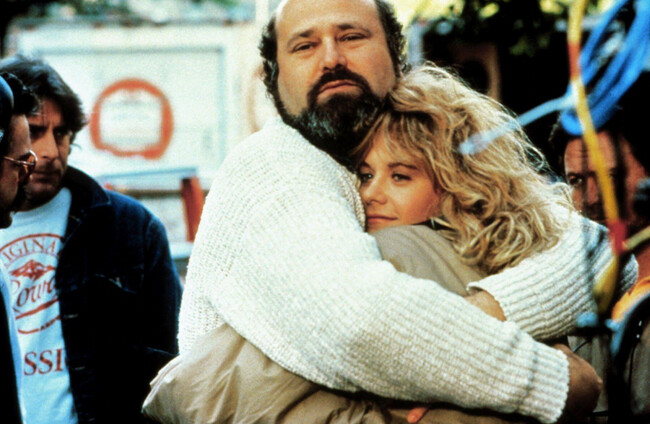
Rob Reiner on the set of When Harry Met Sally with Meg Ryan. Cinematic

Rob Reiner had an inconceivable run in his heyday - and his hit movies still resonate in 2025

The tragic deaths of the director and his wife Michele are being mourned by fans of his films like Stand By Me.

IT’S ONE THING to make a movie so iconic that for generations it becomes a cultural touchstone. It’s another thing to make a series of movies that span several genres and are each as genuinely impactful as the last.

The sort of films that evoke a specific, warm sense of nostalgia whenever you think of them. The type that they just don’t make anymore. 

But that was what Rob Reiner achieved throughout the 1980s and 1990s, when he directed a string of films that became Hollywood classics. Think of the catchphrases “These go to 11″; “I’ll have what she’s having”; “You can’t handle the truth!”; “Inconceivable” – all came from Reiner’s films made across a 10-year stretch.

So when news of the tragic death of Reiner and his wife, photographer/producer Michele Singer Reiner, broke this morning, it was felt in a particularly acute and devastating way by his fans. 

Given today’s world of franchises and endlessly-recycled IP, many people yearn for the real depth Reiner brought to the screen, and how he did it in such an entertaining, thrilling way.

That a generational talent would meet such a terrible end to his life feels particularly cruel. The police continue to investigate after the bodies of Rob and Michele were discovered in their Los Angeles home. Their son Nick has been arrested in the wake of their deaths.

Tributes to Rob Reiner from stars like John Cusack and Eric Idle continue to flow, but they are intertwined with memories from fans who have long treasured his work.

For movie lovers, many of Reiner’s films – like his breakout, the mockumentary Spinal Tap (1984), coming-of age film Stand By Me (1986), comedy/fantasy The Princess Bride (1987), romcom When Harry Met Sally (1989), thriller Misery (1990), and legal drama A Few Good Men (1992) – still have huge resonance.

They remain examples of how great films should be made. They entertain, but connect with people too. 

‘Working from someplace honest’

There was something about Reiner’s movie streak during his early days that lodged itself into people’s hearts, no matter their age. Perhaps it was because, regardless of their genre or plot, Reiner often found a way to put some of himself into them.

Though he didn’t write these early films’ screenplays – he created the outline for Spinal Tap, which was improvised – he nonetheless spoke about decisions he made as director which reflected his own experiences.

Take the ending of When Harry Met Sally, a film written by his friend Nora Ephron. It originally ended with Harry and Sally deciding that men and women can be platonic friends. But after Reiner met Michele Singer on set, marrying her seven months later, he changed the ending. 

Stand By Me was based on a Stephen King novel, but the struggles between character Gordie (Wil Wheaton) and his father also reflected, to a degree, feelings that Reiner had as a youngster.

He too felt at times misunderstood and disconnected from his dad. “If you’re working from someplace honest, you’re always going to tap into your own experience,” he told 60 Minutes in 1994.

His own feelings were in part due to his father’s talent. “How will I ever live up to this?” he asked himself.

Reiner was born into Hollywood privilege, the son of actor/writer/director Carl Reiner, the creator of the Dick Van Dyke Show. Hollywood royalty like Mel Brooks could pop over for dinner. Yet it wasn’t Rob’s father who noticed his own comedic skills – it was producer/screenwriter Norman Lear.

Life in Hollywood

WhatsApp Image 2025-12-15 at 15.22.17 Rob Reiner on set.

Lear not only gave the young Reiner a role in the 1970s sitcom All in the Family, which made him a TV star, but he financed several of Reiner’s films when others were not interested in them.

For example, Lear’s paternal-like support meant that The Princess Bride, an adaptation of the William Goldman novel, didn’t remain in ‘development hell’.

Reiner was determined to get it made, despite the lack of support. “It was the recognition that it was impossible but that he wanted to make the reach, and that was a reason to do it,” Lear later told the LA Times of agreeing to finance it.

It had been deemed unfilmable, given that it was a romantic comedy-meets-satire-meets-fantasy. But with Reiner’s astute sense of comedy and emotional intelligence, it ended up being a hit.

Lear also revealed to the LA Times that the coming-of-age classic Stand By Me nearly went unfinished as the original production company “wanted to close [it] down”. 

“We had everything, a whole crew, a cast, everything was there,” Reiner told the publication. “What happened is, Norman stepped in and said, ‘I’ll foot the bill for this, I’ll just go on the line and do this,’ and it was like, Oh my God, this . . . this . . . this . . . godsend!”

Despite his obvious privilege, Reiner still had these early struggles to get his films made. His subsequent success underlined the phrase William Goldman is famous for: that “nobody knows anything” in Hollywood. 

Power for good

When asked about his ‘nepo baby’ status last year, a self-aware Reiner told The Guardian:

“If you’re a nepo baby, doors will open. But you have to deliver. If you don’t deliver, the door will close just as fast as it opened.”

That Reiner used his power and money to fund liberal causes also made him stand out from a privileged pack. He co-founded the American Foundation for Equal Rights, an organisation which played a pivotal role in overturning California’s same-sex marriage ban.

He also campaigned for higher taxes to be placed on cigarettes in California, with the money used for childhood health programmes. This use of his power for good seemed to speak to the emotional depths that his filmmaking touched. 

Looking back at Reiner’s career now, not all of his films had the same impact as his early work. But what a legacy he leaves, though the circumstances of his death are a tragedy. Many of his films became classics because of the places they transported the viewer, not just in terms of location (The Princess Bride features the Cliffs of Moher) but emotionally.

Though every film requires a team to put it together, from writers to actors to below the line staff, the director has a huge say in its ultimate direction. Reiner seemed to always want to demonstrate in his work that it is possible to entertain and thrill, but still keep things real.

For example, Stand By Me captures the fracturing of innocence that happens when, as children, we realise the world can be a frightening place. The Princess Bride allows viewers to take a leap of fantasy and understand that true love will always win out against any evil.

The much-loved When Harry Met Sally makes us believe that even if we’re imperfect, we deserve to be loved. A Few Good Men confirms that sometimes, people will do anything to stand in the way of justice. And in Misery, a heightened storyline about an obsessed fan still has plenty of humanity to it.

Reiner’s last few films show that he continued to have range as a filmmaker. In 2024 he released the documentary God and Country, about the rise of Christian Nationalism. Earlier this year he released a Spinal Tap sequel, Spinal Tap II: The End Continues.

Once more he played the hapless director Marty DiBergi, and joked to 60 Minutes that directing a film while acting in it as a director (while in his late 70s) made him feel “nuts”. But in footage of him on set, he was in his element. 

Reiner took filmmaking seriously, which was obvious from his work. But he knew that to an extent it was all a game too, which likely accounts for the lightness of touch in his films.

His approach to filmmaking is summed up in his answer to a question from The Guardian about dealing with big egos on film sets.

“You know, people only act up out of insecurity,” he said, “and when they make it difficult I just say: ‘We’re playing make-believe here – enjoy yourself!’” 

Readers like you are keeping these stories free for everyone...
A mix of advertising and supporting contributions helps keep paywalls away from valuable information like this article. Over 5,000 readers like you have already stepped up and support us with a monthly payment or a once-off donation.

Close
JournalTv
News in 60 seconds