Sign in. It’s quick, free and it’s up to you.
An account is an optional way to support the work we do. Find out more.
Sign in. It’s quick, free and it’s up to you.
An account is an optional way to support the work we do. Find out more.
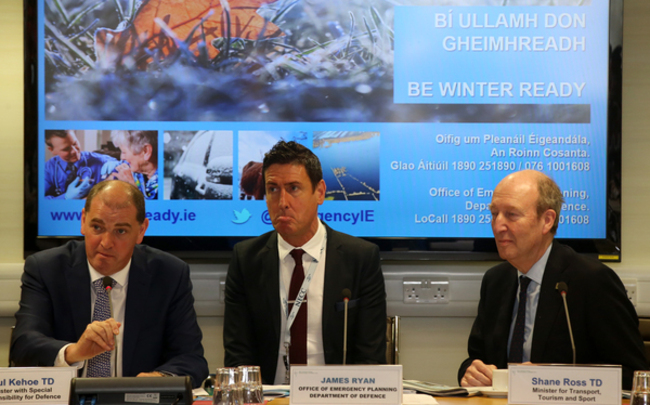
VARIOUS MINISTERS, DEPARTMENT officials and heads of agencies like the OPW and Met Éireann held their traditional pre-winter meeting at the government’s emergency planning centre in Dublin this morning.
The meeting takes place every year – typically followed by a sedate media briefing, during which ministers list the various initiatives they’re overseeing in the coming months and thank emergency services and council staff for their responses to recent crises.
It’s important information to get out – there’s a ‘Winter Ready’ website to promote along with an information booklet, with information and advice for householders.
For the most part though, it’s the sort of stuff we expect governments to be on top of anyway – and reporters’ questions tend to focus on current crises, like, for instance, the rail strike.
In recent years, the stockpile of rock salt for the roads has also been a priority issue for the media.
Back in 2010, you may recall, there was a shortage of the stuff. The National Roads Authority (as it was then known) admitted – during a particularly prolonged cold spell – that it had spread an entire winter’s supply of the stuff by early January.
Local authorities, during that cold spell, were spreading around 20,000 tonnes of rock salt every week. A further 130,000 tonnes was used during the extremely cold winter of 2011.
Last winter, by comparison, 85,000 tonnes of salt were used last winter.
In his update today, Transport Minister Shane Ross confirmed we currently have 212,000 tonnes of rock salt.
The flu
There was a particular focus on the flu vaccine this year, with Health Minister Simon Harris reiterating his call for at-risk groups to get the vaccine.
“I would like to take this opportunity to again encourage all those in at-risk groups to get the flu vaccine now, as it can take up to 2 weeks to take effect,” Harris said.
The vaccine reduces the risk of influenza as well as reducing hospitalisation and mortality in older people.
The at-risk groups are:
The strike
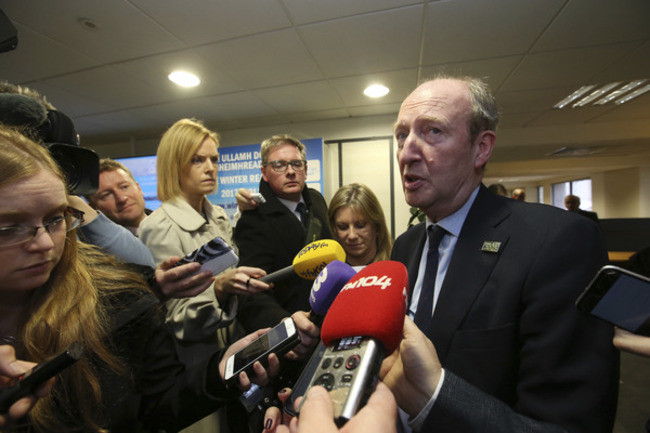
Asked what measures he might take to beef up other transport options in the event of a rail strike during particularly bad winter weather, Minister Ross said he wouldn’t do anything that would be regarded as intervening the dispute.
“I’m not going to do anything during the strike that would be interpreted as an intervention in the process which is going on – which hopefully will come to a conclusion very, very shortly.
If you’re asking me as minister would I do something which would be provocative in the strike or would materially affect the negotiations – which I hope will be in train shortly - the answer is I am not going to intervene.
Answering follow-up questions, Ross said he was hopeful the company and unions would take up the option of going to the Labour Court. Further rail stoppages are being planned for next Tuesday, Thursday 23 November and on Friday 8 December.
You can find more information about the flu vaccine here, and the general Winter Ready website can be found here. On Twitter, the Office of Emergency Planning tweets information from this account.

To embed this post, copy the code below on your site












have your say