We need your help now

Support from readers like you keeps The Journal open.

You are visiting us because we have something you value. Independent, unbiased news that tells the truth. Advertising revenue goes some way to support our mission, but this year it has not been enough.

If you've seen value in our reporting, please contribute what you can, so we can continue to produce accurate and meaningful journalism. For everyone who needs it.

Prices rose rapidly following the war in Ukraine, and some believe we will be seeing similar over the coming months. Alamy Stock Photo

Fertiliser prices are soaring due to the war - that could lead to higher shopping bills

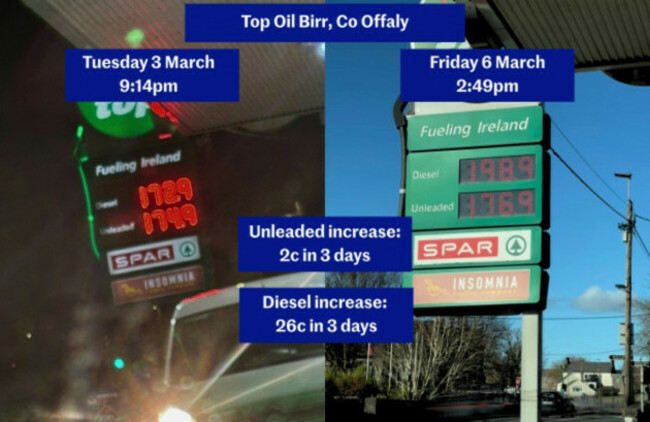
We’ve already seen inflation at the petrol pump, but can we expect this to go further and start hitting our food?

PRICES FOR KEY supplies needed to run Eddie Doyle’s 900-acre potato farm outside Mooncoin, Co Kilkenny have already “gone way up” since the start of the war in the Gulf region two weeks ago.

Fertiliser for his vegetables has shot up from around €590 to €850, while he recently found prices for nitrogen per tonne, a key element used in fertilisers to drive crop yields, had risen almost 20%.

“Prior to Christmas we paid €360 and last week it was €430, but that’s only if you’re a regular customer – otherwise you’re paying €460-470.”

The price rises have been driven by the war and it’s expected these increases will eventually make their way through the supply chain and hit the products on supermarket shelves. 

It’s due to the critical importance of the Strait of Hormuz, the vital shipping route that has now been blockaded by Iran in response to attacks by US and Israel. Between 20 and 30% of global fertiliser exports cross the strait normally.

“It’s a bit ominous for the coming season,” Doyle told The Journal this week.

We’ve already seen inflation at the petrol pump, but can we expect this to go further and start hitting our food?

download (57) Fuel price increases seen last week. The Journal The Journal

When The Journal checked in with the big supermarket chains this week, most were keeping schtum, except for Lidl. The German chain’s Irish press office told us that it does “not anticipate any major impacts on our supply chain or retail prices” at the moment.

“We continue to work closely with our long-term local producers to ensure consistent supply across all our stores,” a spokesperson said.

Industry group Retail Ireland pointed to how the sector had become battle hardened thanks to supply disruptions wrought by the Covid-19 pandemic and, later, the war in Ukraine.

But it’s a “rapidly evolving situation”, according to Retail Ireland director Arnold Dillon, and the shock to global energy prices is expected to make itself felt sooner rather than later.

“Irish retailers and suppliers have become experienced in dealing with supply‑chain disruption in recent years,” Dillon said.

“The current energy pressures are adding real costs right across the supply chain, from transport to day‑to‑day store operations. Retailers are working actively with suppliers and logistics partners to manage these increases and to minimise any impact on consumers.”

Inflation – when could it hit food?

As highlighted by the case of Doyle on his potato farm in Kilkenny, it’s what happens with fertiliser that “needs to be watched the most”, according to Deloitte’s chief economist Kate English.

“With that higher fertiliser cost, there’s no way food prices cannot be impacted if this continues,” English told The Journal.

Looking back at Ukraine, English noted that food prices started to increase from May onwards after Russia’s invasion in late February – so it was several months before the real impacts began to be felt.

In May 2022, transport and energy costs both spiked by about 20% year on year, while food such as meat, bread and cereals increased by the significantly smaller but notable 3.5%.

However, looking longer term – as more produce is harvested throughout this year – there is a danger of further spikes.

In May 2023, 12 months on from the sharp rises in response to the war in Ukraine, food and non-alcoholic drinks had risen by 12.7%.

As noted by some economists earlier this week, the rise in prices following the start of the Ukraine war was added to by a combination of factors, including supply chains struggling to operate smoothly again post-pandemic.

But if something similar to those increases comes to pass then it will pose very real problems for people in Ireland over the coming months, English said. 

While Donald Trump has indicated repeatedly that the strikes on Iran are nearing an end, security analysts have noted that once you start a military action of this type you’re no longer necessarily in control of all of the consequences – and, so far, the Iran regime has been clear they’re not backing down.

The question then for English is how much pain households and businesses can tolerate, given “we’re already coming into this where costs are at a much higher than what they were three, four or five years ago”.

“Inflation is the biggest risk here, and it does feed into every single part of our economy. It’s how long this lasts really will dictate how high that inflation figure goes.”

Readers like you are keeping these stories free for everyone...
A mix of advertising and supporting contributions helps keep paywalls away from valuable information like this article. Over 5,000 readers like you have already stepped up and support us with a monthly payment or a once-off donation.

Close
36 Comments
This is YOUR comments community. Stay civil, stay constructive, stay on topic. Please familiarise yourself with our comments policy here before taking part.
Leave a Comment
    Submit a report
    Please help us understand how this comment violates our community guidelines.
    Thank you for the feedback
    Your feedback has been sent to our team for review.

    Leave a commentcancel

     
    JournalTv
    News in 60 seconds