We need your help now

Support from readers like you keeps The Journal open.

You are visiting us because we have something you value. Independent, unbiased news that tells the truth. Advertising revenue goes some way to support our mission, but this year it has not been enough.

If you've seen value in our reporting, please contribute what you can, so we can continue to produce accurate and meaningful journalism. For everyone who needs it.

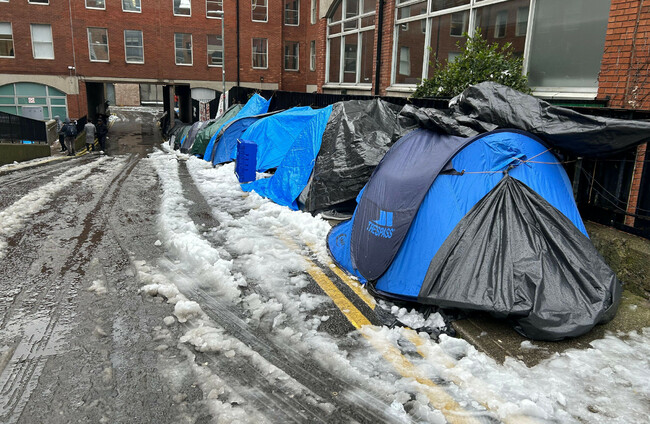
Tents pitched by asylum seekers outside the International Protection Office in Dublin in 2024 Alamy Stock Photo

Asylum seekers had to 'defecate on the street' as they had no access to toilet facilities

However, a barrister representing the State argued that the situation is not something asylum seekers can sue over.

THE SUPREME COURT has heard that the concept of dignity is not a right that can be breached, and therefore cannot form the basis of litigation in Irish courts.

Counsel for the State, David Conlan-Smith, agreed with Judge Iseult O’Malley that the dignity of homeless asylum seekers was breached when they had to “defecate in the street” because they had nowhere to stay, but said they couldn’t sue the State over this. 

The arguments were heard on the second day of a case taken by the Irish Human Rights and Equality Commission (IHREC) on behalf of 2,807 people who have arrived in Ireland since the case was first lodged with the court in December 2023.

The commission has argued that the State is breaching the EU’s Charter of Fundamental Rights, the European Convention on Human Rights and the Irish Constitution. 

The case was brought after the government ran out of public accommodation for asylum seekers in 2023, and increased payments and provided temporary shelter, such as tents, to those who arrived by themselves and were without housing.

The IHREC has argued that the dignity of asylum seekers, which they are entitled to under Article 1 of the EU’s Charter of Fundamental Rights, but Conlan-Smith told the court this morning that no law or other judgment has found that dignity is a right.

Conlan-Smith said that there is ultimately a difficulty in how one would define the right to dignity, as it’s a principle that is context-specific.

He also argued that the principle of dignity was first articulated at an EU level when the charter was adopted in 2001, but that in the 25 years since, the Court of Justice of the European Union has never articulated it as a specific right.

“There is no proper legal basis articulated in the law that Article 1 stands by itself, that it can be relied upon or is justiciable,” counsel said.

Conlan-Smith also referenced 13 affidavits sworn by asylum seekers as part of IHREC’s case, saying that they had access to food, clothing, and in some cases, showers in day centres.

He told the court that there wasn’t enough of a case to claim their dignity had been breached.

Judge Iseult O’Malley put it to him that there were reports of people seeking asylum who lived in unsanitary conditions and were “defecating in the streets”, asking him whether he considered that a breach of dignity.

Conlan-Smith said he would not dispute that the dignity of those individuals was not breached, but that the State had always taken a multi-faceted approach to meet the basic needs of asylum seekers, including the provision of food vouchers and access to social welfare.

“Taken as a package together, the whole package met with their basic needs and it is not the case that the State has interfered in any way with their dignity,” he said.

The hearing continues this afternoon.

The commission first brought proceedings in 2024 to obtain a declaration that the State failed to adequately provide asylum seekers with shelter, food and access to basic hygiene facilities on top of a weekly allowance.

In August that year, the High Court ruled that the State had breached the human rights of 2,807 male international protection applicants by failing to provide them with accommodation.

However, the Court of Appeal overturned that ruling last year, saying that the IHREC had not proved that the physical or mental health of IP applicants was undermined “in a state of degradation incompatible with human dignity”.

In the overturning of the decision, the court accepted that people seeking international protection in Ireland could be classified as being in extreme material poverty, because of testimony from 13 asylum seekers who claimed the lack of services had an impact on their health.

But the court disagreed that the group’s health issues were representative of all international protection applicants who had similarly not been offered services.

Readers like you are keeping these stories free for everyone...
A mix of advertising and supporting contributions helps keep paywalls away from valuable information like this article. Over 5,000 readers like you have already stepped up and support us with a monthly payment or a once-off donation.

Close
JournalTv
News in 60 seconds