Sign in. It’s quick, free and it’s up to you.
An account is an optional way to support the work we do. Find out more.
Sign in. It’s quick, free and it’s up to you.
An account is an optional way to support the work we do. Find out more.
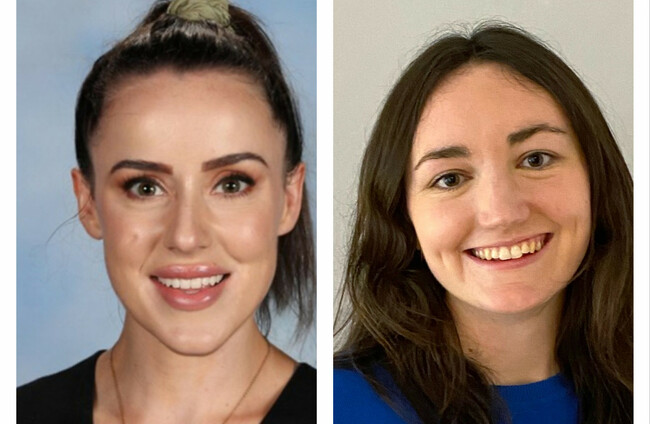
EIMEAR NIC GIOLLA PHÁDRAIG grew up in an English-speaking home in Dublin and found her grá for gaeilge in school; Jane Ní Luasa grew up in a bilingual house in the Cork Gaeltacht.
Today, they are behind two of the most popular accounts for learning Irish on TikTok.
Nic Giolla Phádraig, who is a secondary school teacher, has 45.6k followers on her Gaeilge Bheo TikTok account. Growing up, she saw gaeilge as “a dead language” – until she was 14. “I started learning about the Famine, the negative impact that had on the language, the Penal Laws, how Gaeilge essentially was targeted,” she says.
“It wasn’t ‘I want to learn Irish’… It was a need. It was a must,” she says. “This is something that people have passed on to me, and it is my responsibility to not only love and appreciate Gaeilge, but to spread it as far as possible.”
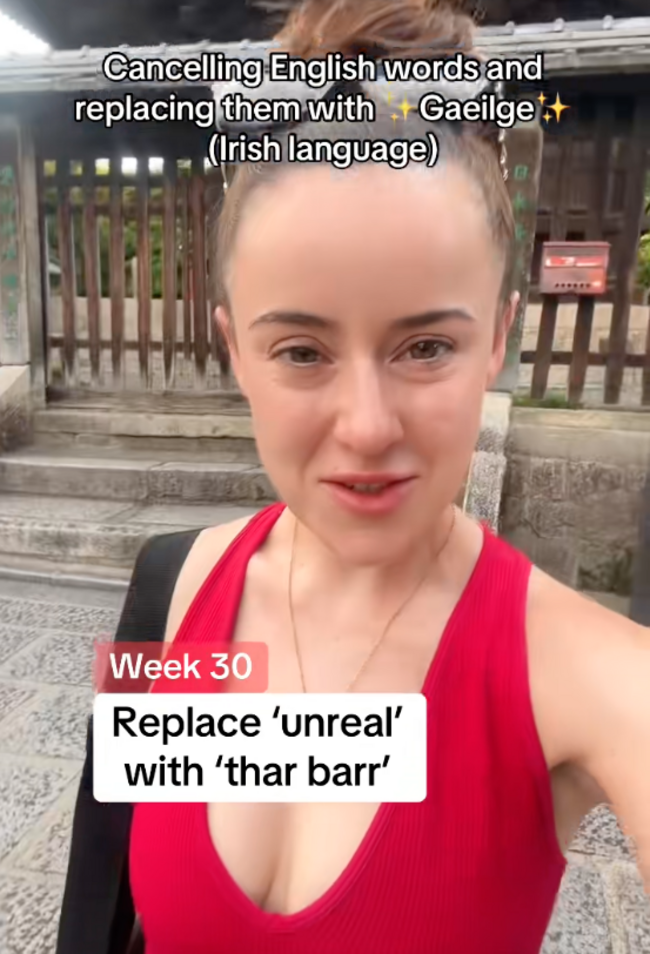
Nic Giolla Phádraig, 28, later trained as an Irish and History teacher. She is currently in Melbourne, but preparing for a return to Ireland after two years away.
Ní Luasa, meanwhile, has 53.9k followers on her Gaeilge le Jane TikTok account. She grew up in Gaeltacht Mhúscraí, the Cork Gaeltacht, to parents working in hospitality in Gougane Barra. She trained as a primary school teacher and taught in gaelscoileanna until September 2020, when she went to the University of Montana on a Fulbright scholarship to teach Irish.
“It was there that I got to see Irish in a completely different way,” she says, explaining that there is a serious grá for Irish culture in Montana due to emigration to the state post-Famine. “Because I grew up with it, just taking it for granted that we could all speak it – it was just around us, at school, at home, at the shop.”
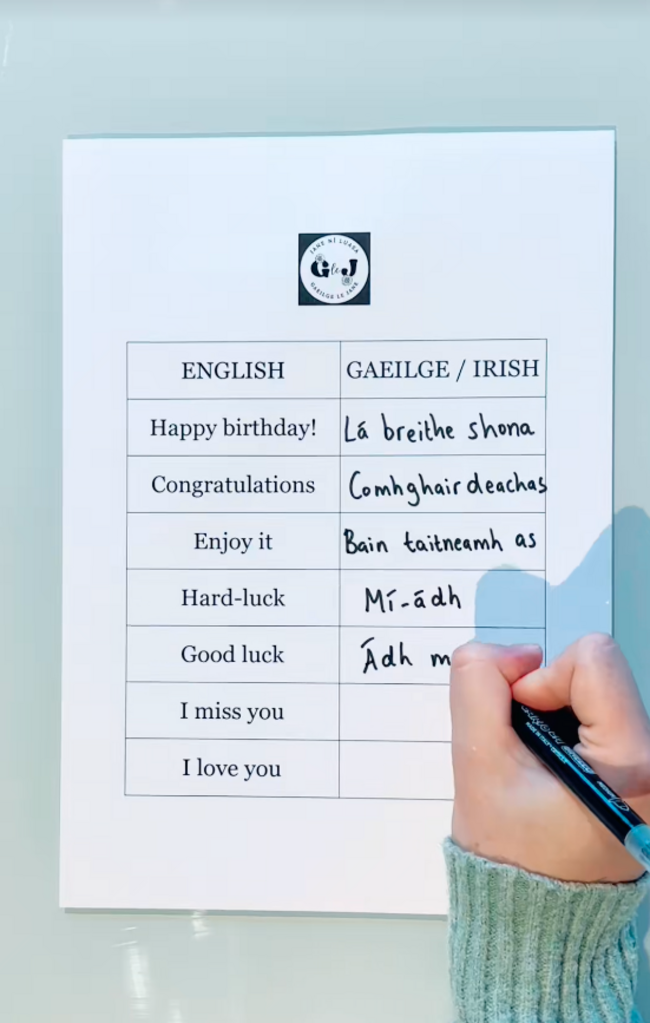
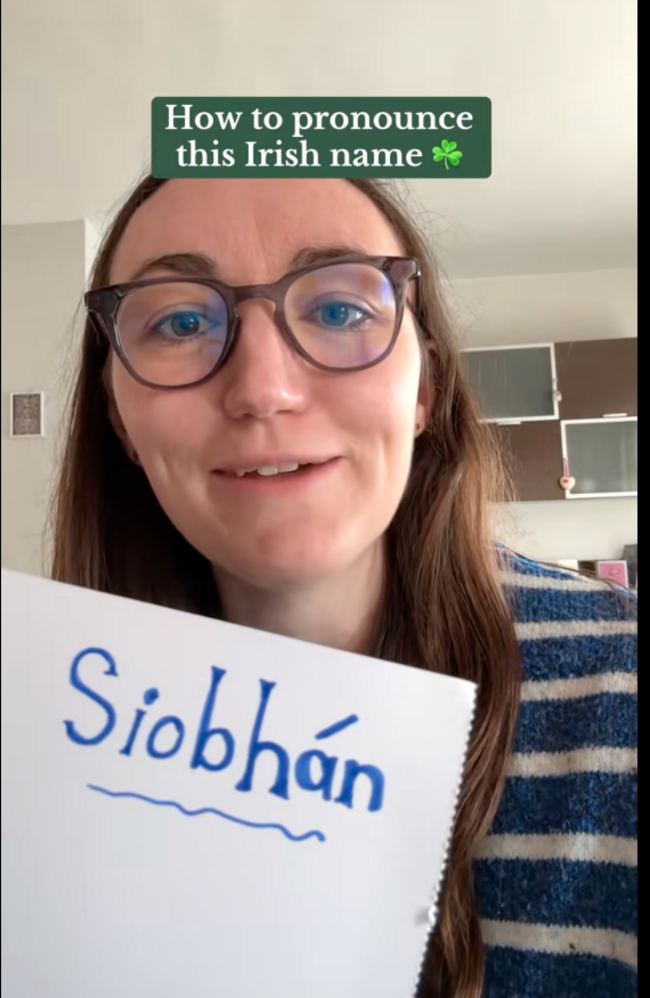
While in Montana, she set up her TikTok account. “It’s so important to bring [Irish] out of the textbook – it’s not just there to do ‘fill in the gap’ exercises, it’s so important to speak it,” says Ní Luasa. Her TikTok videos include ones about Irish pronunciation, simple translations of English words and phrases (like ‘I’m sorry’ or ‘I don’t know’) and proverbs of the week.
Learning a language is like climbing a mountain, says Nic Giolla Phádraig, and she wants to help people figure out where to start. “I’m trying to make it as palatable as possible, as easy as possible – any focal is better than nothing… the more people that say ‘go raibh maith agat’ in the shop, the more normal that becomes.”
She set up her Gaeilge Bheo account in 2022 after a student expressed shock that there is a word for sex (gnéas) in Irish. It showed her that people might not realise that Irish isn’t just a subject – it’s a teanga (a language).
Shyness – Cúthail
Ní Luasa was shy about her account at first, but quickly built up followers. A message asking her if she’d teach an Irish language class on Zoom kickstarted a whole new career.
She now teaches individual and group adult classes on Zoom, and has completed a Masters in Irish language and culture in UCC. She also runs immersion weeks, where students meet in Gougane Barra for nature walks, classes, history walks, céilí and seisiúin ceoil.
I’ve students in Greece, Italy, France, Sweden, Hong Kong, Canada, Argentina, England. It’s this global community.
Like Nic Giolla Phádraig, Ní Luasa wants to break through the fear that can sometimes be present when learning Irish.
“I have students in their 70s, 80s, 90s, who are reconnecting to the language. At the start they’re so shocked with how much they can remember. But also they’re so shocked with how they’re suddenly using it to communicate,” she says.
The first few classes, they have this huge shyness, or fear of getting anything wrong. And I’m always saying to them: speaking a language, even if we’re speaking in English, sometimes we make mistakes. It’s ok to make a mistake as long as you’re getting the message across.
Social media offers a worldwide audience, says Nic Giolla Phádraig.
“TikTok is a fantastic platform to spread Gaeilge, because you can post a video and it can reach literally millions of people, which is scary.
“But at the same time, if the mission is to spread Gaeilge, that’s a really practical way to do so, and it’s fun…
“It gives people a direct line of communication to ask questions, and to practice and to connect with each other as well from all parts of the globe.”
Nic Giolla Phádraig is part of the Irish-speaking community in Melbourne, teaching free Irish classes in St Kilda (“we call it County Kilda”) and taking part in ‘pop-up Gaeltachts’.
“There was actually a child that wanted to come [to a class]… because he was really into Kneecap, he was Australian and he wanted to learn some cupla focal,” she says.
Popularity – Tóir
Nic Giolla Phádraig says she’s seen a direct impact of the Belfast rap band Kneecap’s popularity on interest in Gaeilge.
“The interest has gone through the roof.
“It’s not just the interest, but it’s also [Kneecap's] dearca, the perspective as well, it’s a really positive perspective. And I think what they are doing is similar to what my goal would be, in the sense of showing it as a language that’s alive.”
In some of her posts she takes a tongue-in-cheek approach to ‘cancelling’ English words and replacing them with Gaeilge. “The reason I started that was, if you know a word in Gaeilge you have a choice. And my message is, choose Gaeilge.”
While at first Ní Luasa found some people on TikTok were surprised to discover Irish was a ‘real’ language (she’s been asked if it is Simlish, a language used in the Sims video game), she says social media has given it a welcome visibility.
“You can see the Claddagh rings, the t-shirts with Irish on them, the tote bags. There’s definitely a huge revival happening in Ireland, but also people around the world with connection to Ireland. A lot of my students, their ancestors were from Ireland. I have some students who are just learning it because they think it sounds so cool.”
Gaeilge’s popularity is also a chance to appreciate those who have kept the language alive, adds Ní Luasa.
There’s hundreds of years of people who have kept the language alive, and we should use that as inspiration to keep it alive and keep pushing – and make sure it’s a language that’s alive for our descendants.
Nic Giolla Phádraig raises the issue of how people’s access to the language can depend on their socioeconomic background.
“[Trips to the Gaeltacht are] not accessible to everyone, especially if you’re from a lower socioeconomic background,” she points out. “There are now deis gaelscoileanna, which is fantastic. So we are seeing some form of change in accessibility, which is great.”
She also wants to open the conversation around dialects. There are three dialects, but as a Dubliner she notes that she takes from all of them. In addition, while there is no longer a distinct Leinster dialect, she is eager to discuss the “controversial” topic of whether there is a Dublin dialect emerging.
“Being from Dublin, I had many different Irish teachers… so you could argue now I have Gaeilge Conamara (Connemara Gaeilge) predominantly, but there are definitely some words that I would have in Gaeilge na Mumhan (Munster Irish) or Gaeilge Uladh (Ulster Irish) as well.”
“I would be of the view that any Gaeilge is good Gaeilge. It’s great that there are people there who do want to keep some kind of baseline and a standard, and they want to make sure that the integrity of the language is protected to an extent. I 100% respect that. But I would be more on the inclusive side of: just get people in first, and then we can iron out other things later.”
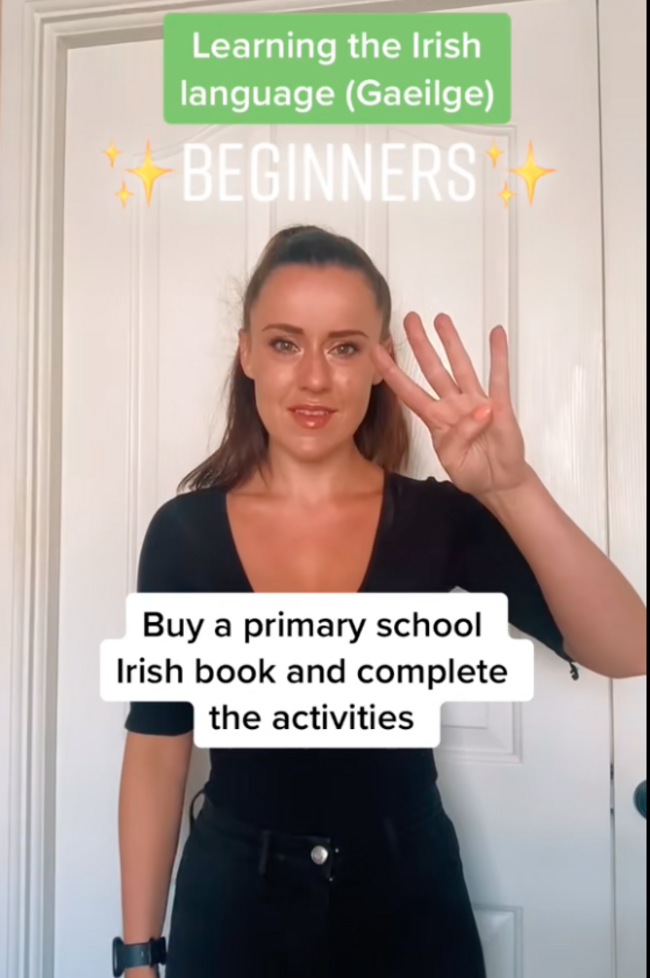
While social media can provide Irish teachers with instant access to communities, challenges can come along with that.
“I protect my space quite closely, especially being a muinteoir (teacher),” says Nic Giolla Phádraig. “I’m acutely aware of the dangers of social media and that dark side as well. So I do try to protect my space, and I put in as many measures as possible – for example on TikTok you can filter certain words.”
Meanwhile, Ní Luasa believes that it’s important to bring a social media community together in real life. She runs a monthly Irish conversation circle on Zoom, and an Irish-language WhatsApp group.
The key message from both women is that Gaeilge is for everybody.
“It is inclusive. It doesn’t matter – even if you’ve never been to Ireland, if you have heritage, if you don’t have heritage, it doesn’t matter if you’re rural, if you’re urban,” says Nic Giolla Phádraig.
“Gaeilge is a beautiful gift from the past that was preserved by our ancestors, and it’s something for everybody to enjoy and to love and to engage with.”
Find Gaeilge Bheo and Gaeilge le Jane on TikTok.
To embed this post, copy the code below on your site




have your say