Support from readers like you keeps The Journal open.
You are visiting us because we have something you value. Independent, unbiased news that tells the truth. Advertising revenue goes some way to support our mission, but this year it has not been enough.
If you've seen value in our reporting, please contribute what you can, so we can continue to produce accurate and meaningful journalism. For everyone who needs it.

It’s a framework of five levels. At each level, there are different restrictions in place based on the current status of Covid-19 in the country.
If we’re at Level One, we’re coping quite well with Covid and the loosest guidelines are in place. Level Five is not where we want to be, and will be akin to the full lockdown we had in April and May.
Currently, the country is at Level Two. Well, most counties are. There will be extra restrictions in effect in Dublin from midnight tonight. But Dublin isn’t at Level Three. More a Level Two plus (more on that later).
Last week, the Minister for Higher Education Simon Harris said that today’s announcement would be a chance for the government to “press reset” and improve its communication with the people.
“We need to up our game on this,” he said. “And next week is an opportunity to do so.”
Let’s dive into each of these so-called levels and what each one will mean.
The Levels
The government wants this system to mean we can go about our daily lives as much as possible while managing the “behaviour of the virus”.
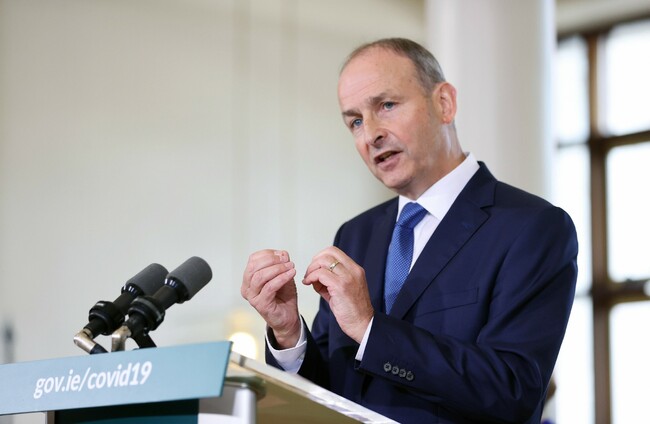
Taoiseach Micheál Martin said that it’ll be some time before a vaccine is widely available so we need to be able to live with the virus while also living our lives at the same time.
According to the government’s plan, the “lower levels will be activated when there is a low incidence of the disease, with isolated outbreaks, low community transmission”.
On the other hand, “the higher levels will be used to deal with higher incidences of the disease”.
Moving from one to another will be based on a number of factors, including the 14-day and 7-day figures on new cases, the 5-day rolling average of cases by county and nationally.
Other indicators will be the reproduction number, positivity rate, the capacity and performance of contact tracing and testing, and the capacity and admissions hospitals and ICU.
If all of these are increasing, the decision could be made to up an area’s – or the whole country’s – level.
It’ll be possible for different regions and counties to be at a different level to the national level, depending on the incidence of the virus in those areas. For example, while it’s not yet at Level Three, Dublin has a far greater figure for cases per 100,000 population over the past two weeks.
The restrictions at Level Three are far more stringent than at Level Two, so it’ll be hoped that the spread of the virus can be stemmed in the capital in the next few days and weeks.
To move up a level, the situation would have to worsen considerably in an area.
This could include the capacity to test and trace being constrained due to demand, the admissions to hospital and critical care increasing, a significant increase in the incidence rate and multiple clusters with secondary spread.
Serious implications
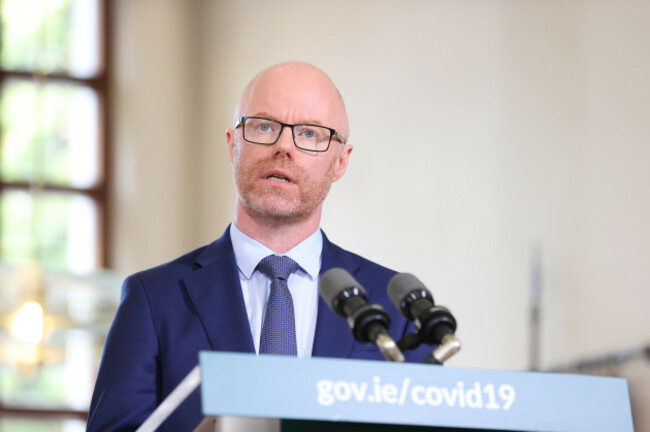
Health Minister Stephen Donnelly Julien Behal Photography
Julien Behal Photography
Minister for Health Stephen Donnelly was clear that updating an area’s level from two to three, for example, would have serious implications.
He told today’s press conference: “It’s a serious thing to do for any county. It has a serious impact on jobs, and a serious impact on how we live our lives.”
When asked why the advice within Level Two was different for Dublin compared to the rest of the country, Donnelly said that “within any level”, NPHET could provide advice.
The government document added: “At all times the priority guiding the plan will be to keep our schools open while keeping people safe and protecting the resilience of our economy and communities.”
Level One
This is where we want to be.
It’d mean that we’re at a level where there is a very low incidence of Covid-19 in an area. Community transmission is suppressed, hospitalisations are stable or decreasing, few or no clusters and all other indicators low.
But it also doesn’t mean we can do whatever we want.
Looking ahead to Christmas, for example, if we were to reach a stage where we were at Level One we could still only have 10 visitors from up to three households under this plan.
Members of different households can continue to meet socially in other settings – like pubs or restaurants – with strict adherence to guidelines.
Gatherings
Weddings of up to 100 people can take place.
When it comes to organised indoor gatherings, such as conferences, events in theatres and cinemas, most venues can have a maximum of 100 people in attendance.
Up to 200 patrons are allowed for “larger [indoor] venues” where strict two-metre seated social distancing can be observed.
Advertisement
When it comes to outdoor gatherings, such as sports events, most venues can have a maximum of 200 patrons. Outdoor stadia can have up to 500 patrons – with strict distancing – when there’s a maximum capacity of 5,000.
When it comes to sports, normal training sessions and games can take place indoors and outdoors with protective measures.
Religious services can take place for up to 50 worshippers, or more in larger venues.
Furthermore, those aged over 70 and the medically vulnerable should “exercise judgement regarding the extent to which they engage with others and in activities outside home”. Nursing homes and care homes can also open with protective measures in place.
Hospitality, retail and work
Bars, cafes and restaurants will be open under the guidelines already issued to the hospitality sector. Hotels and accommodation will be permitted to do likewise.
The wet pubs can be open but nightclubs, discos and casinos will remain closed.
There are no restrictions on domestic travel so staycations can still be enjoyed.
Face coverings must be worn in retail settings and on public transport.
Museums, galleries and other cultural attractions can open in line with public health guidance.
Even at Level One, people are advised to work from home if possible. You are allowed attend work for specific business requirements and on a staggered attendance basis.
Level Two
This is where we are right now.
At this level, the majority of areas of economy and society such as schools, restaurants, pubs and gyms are open.
Sporting activities can continue but with a higher level of restrictions than in Level One.
Gatherings
People can have visitors from a maximum of three households up to six people. In Dublin, no more than six people from two households can gather.
Members of different households can meet socially with up to 15 people outdoors, including Dublin. However, the guidance says that socialising can continue at indoor or outdoor public venues in Dublin “but only with people from your own household or one other household, and in groups of maximum six people”.
People in Dublin are encouraged to limit travel outside that region, and only meet one other household when outside the county.
Weddings with up to 50 people can take place.
Indoor gatherings can take place with at most 50 people, divided into pods or groups of six with no intermingling, and larger venues can have 100.
Up to 100 people are permitted at outdoor venues or 200 where the venue has a capacity of 5,000.
Sport training can take place in pods of 15 outdoors or 6 indoors. Up to 50 spectators/patrons indoors can attend sports events, 100 outdoors, and 200 in venues with a capacity of 5,000.
50 people can attend religious services or more in larger venues. Funerals can have a maximum of 50 people in attendance.
Those in at-risk groups should exercise judgement in how much they take part in activities.
Nursing homes and care homes are open with enhanced protective measures.
Hospitality, retail and work
Bars, cafes and restaurants will be open under the guidelines already issued to the hospitality sector. Hotels and accommodation will be permitted to do likewise.
Wet pubs will also be permitted to open at Level Two. However, in Dublin, they will not be permitted to do so. The set date for re-opening pubs in the rest of the country is 21 September.
There are no restrictions on domestic travel.
Face coverings must be worn in retail settings and on public transport.
Museums, galleries and other cultural attractions can open in line with public health guidance.
People are advised to work from home if possible but attend for essential on-site meetings, inductions, and training.
Level Three
The restrictions get much stricter at Level Three, and it’s believed Dublin may be perilously close to getting upgraded to this level. NPHET is due to meet to discuss the situation in Dublin again on Thursday.
The government said the priority at this level is to keep schools and childcare facilities open and minimise disruption in the workforce.
It means that the likes of museums and other indoor cultural venues would be closed.
Related Reads
Taoiseach says he has 'deep concerns' about 'aggression' of weekend anti-mask protest
Taoiseach announces entire country is now on 'Level 2' of new Covid plan - here's what that means
Dublin pubs to stay closed as residents asked to limit household visits
Gatherings
Visitors from only one other household are permitted.
No gatherings at all are permitted in social settings.
Up to 25 people can attend a wedding.
No organised indoor gathering (theatre event, cinema, training event, conference etc.) should take place.
Outdoor gatherings of up to 15 can take place.
For Sports, non-contact training only in pods of up to 15 (with an exemption for professional, elite, inter-county sports, senior club championship).
No matches or events can take place, except in those cases listed above. Horse racing is also permitted.
Gyms, leisure centres and swimming pools can still open for individual training only.
Religious services will move online, although venues will remain open for private prayer and a maximum of 25 people can attend funerals.
Access to long-term residential care facilities (nursing and care homes) will be suspended aside from critical and compassionate circumstances.
Hospitality, retail and work
All museums, galleries and other cultural attractions will close.
Restaurants can remain open but with additional restrictions for indoor dining. Although the plan says “additional restrictions” would apply to wet pubs, an earlier version of the plan it says that pubs would close under Level Three.
Hotels will be permitted to open but with services limited to residents.
You’ll also be advised to stay in your county apart from work, education and other essential purposes. You are advised to work from home unless absolutely necessary to attend in person.
While schools will remain open, higher education facilities will be urged to escalate all protective measures and limit congregation as far as possible.
Public transport will be down to 50% capacity and limited to essential journeys only.
Level Four
This is more serious again.
The government said the priority here is still to keep schools and childcare services open, even though the virus has significantly worsened in an area. It features measures similar to what we experienced earlier in the year.
It said: “Businesses and services which are essential will be open. No visitors to private homes or social gatherings will be allowed. All businesses and services will be closed, other than those deemed to be essential.”
In some ways, it’s more straightforward as most things will be closed. Here’s a breakdown:
No home visits
Up to six people at weddings
No indoor gatherings
Up to 15 people at outdoor gatherings
Non-contact sports training outdoors at take place in pods of 15
Gyms, leisure centres, and swimming pools closed
Up to 25 at funerals
Takeaway service only at bars, cafes, and restaurants, and outdoor dining of up to 15 people
Up to 15 people outdoors at wet pubs
Hotels open only for existing guests and those on essential non-social and non-tourist visits
Essential retail and businesses that are primarily outdoors only can remain open. All other retail and personal services closed.
Public transport down to 25% capacity
Higher education moves primarily online.
Level Five
This is absolutely not where we want to be.
Under the plan, it says that we’ve reached a stage where hospital or critical care capacity is “likely” to be exceeded.
It means that the number of deaths, the number of new cases, the number of hospital admissions, the number of outbreaks – all are rapidly increasing.
And we already know what it’s like to live through Level Five. We did so, more or less, throughout April and May.
Here’s a breakdown of the measures:
Full lockdown – stay at home and exercise with 5km of your home
No visitors to your home
Takeaway service only at bars, restaurants, cafes, and wet pubs
Up to 10 people at funerals
No outdoor sport training
All non-essential retail must close
Schools remain open.
Going forward
Reading through these levels, it’s clear that whichever way we go we’re going to be living with this virus for a long time.
Even if we reach Level One – and let’s really hope we do – it still won’t be life as we know it.
And, if it goes the other way, the government’s plan emphasises the importance of communicating effectively to the public the reasons why an action is being taken and what must be done to help stem the spread of the virus.
It says: “As the plan is executed, government will work to ensure that the rationale for the measures, the public health triggers that raised the risk level and the implications for specific groups, sectors, individuals are clearly articulated.
The more challenging the message, the more important it is that we provide opportunities for engagement and debate, but ultimately ensure that public gets clear and unambiguous messages.
With a long way to go before we see the back of Covid-19, communicating to the public effectively will be vital as we go forward with the potential for very strict restrictions to take effect again.
However, we are currently at Level Two. The overall aim of the plan is understood to be about setting out a more steady approach and avoid the kind of overnight shock announcements of severe restrictions that we saw earlier in the year.
With this plan now in place, the government will have to succeed in its aim of communicating more effectively as we go through this.
And let’s hope we’re all at Level One in time for Christmas.
Readers like you are keeping these stories free for everyone...
Our Explainer articles bring context and explanations in plain language to help make sense of complex issues.
We're asking readers like you to support us so we can continue to provide helpful context to everyone, regardless of their ability to pay.
TheJournal.ie's Coronavirus Newsletter
TheJournal.ie's coronavirus newsletter cuts through the misinformation and noise with the clear facts you need to make informed choices. Sign up here
To embed this post, copy the code below on your site
Close
46 Comments
This is YOUR comments community. Stay civil, stay constructive, stay on topic.
Please familiarise yourself with our comments policy
here
before taking part.
Level 4 & 5 shouldn’t even exist, it’s like looking at a leaked document from north Korea, people have to act responsibly and protect others, but the economy, Jobs and quality of life must also always be a top priority, where else will the HSE etc get funding from? And who wants to live a life being told to stay home every time the inevitable happens?
@David Lee: ok, but what do you recommend they do if it gets to a stage where the hospitals can’t function due to the level of seriously ill covid patients?
@David Lee: well can we blame those who object to and fail to abide by level 1 and level 2 measures for the necessity of and the introduction of level 3, level 4 or level 5 measures. Level 5 downwards are designed to protect life itself and not just quality of life. There us little point in some having a “high” quality of life if it means that others have no life at all.
@Lurfic: thats not the ordinary citizens fault, that is down to the government and how bad our healtchare system is, some countries haven’t locked down at all, yes they’ve had many cases and more deaths, but their hospitals functioned throughout.
@Deirdre Meredith: seems that common sense is missing… Essential journeys are normally permitted. Many kids do not need parents to bring them to school. Some walk, some cycle, some go by public transport, some by private bus but some will need lifts, particularly those in primary school and I am sure some parents may want to keep their kids at home or maybe even their school or class will have a case and be closed. Keeping the schools open has to be a top priority after essential services so I hope common sense will prevail and people will not be too literal.
@Stephen East: We get a bonus round in which we have to guess movie quotes for extra home visitors. The goid kind of visitors which is helping with the dishes
@William O’ Connor: there are an infinite number of levels between level 2 and level 3. That is a mathematical fact although some mathematical numbers may be irrational
@Eric Vdc: this is a pandemic, not an epidemic, maybe you should understand the definition of the words you’re using before worrying about the statistics.
@Eric Vdc: which epidemic is that. The Covid-19 case count currently has a 7 day average of nearly 275,000 new cases a day. This is the highest 7 day average recorded so far. So the global statistics show that the case rate is increasing as well as the case count.
The 7 day average death rate is 5100 deaths a day which is a slight fall in death rate which can be attributed better medical intervention, and, maybe, a different case age profile such as we have in Ireland.
@Niall Ó Cofaigh: The daily count of people tested Covid positively is absolutely irrelevant. This can be easily explained by the # of tests performed worldwide. — What matters really is the # of death and people admitted in ICU. — All stats indicate that the virus is not as virulent as it was before June- as experts acknowledge there is not 1 but multiple (7?) virus strain and a large number of us are aready healthy carriers.
@Eric Vdc: True hardly any deaths in Spain even thought more cases than at height of crisis, it’s burning itself out. Wear masks and wash hands. Simple.
@Niall Ó Cofaigh: Do you work for the Journal or do you just have plenty of time to have an opinion on absolutely everything? You’ve alot to say on every topic.
?? Hahahahhaha funny buddy nobody can not tell me how many people can be in my house this is my property not government take this level 1,2,3,4,5,6,7,8 and put in your …
@A d d y o u r n a m e: I think six people from two different households is twelve people in total. Is six people from Cork and six people from Donegal six people from two different counties or twelve people from two different counties. I think we are counting “people from different households” rather than “people” so six “people from two different households” means a maxinum of 12 people with no more than 6 from any one household. But I could be wrong – oh how I love the different interpretations of the same simple words.
@Paul Lanigan: who told you the pandemic has passed? We don’t have a vaccine and we still don’t know all there is to know about this virus yet. It doesn’t just affect the lungs, it also affects the brain. And possibly much more. It hasn’t even been on the planet for a year, strange you’d be so dismissive about it.
Why is martin not in isolation until the results come back for the minister of health? He knows that minister has been sent forward for testing, he was in contact with him today martin should be in isolation. Better still permanent isolation for not putting the country first over his own needs and greed
Losing the will to live listening to this mumbo jumbo for the last six months, I’ve been working in a hospital all through this. I live in Dublin and do the mask and social distancing bit but…give over on the ridiculous mixed messages your losing credibility fast.
All I want is for my kids to be able to stay in school. So, please can we all do our part to not give it to someone who has children who will possibly pass it on to another child who will then shut down their pod, their class, or even their school? Online learning did not work on so many levels. I certainly do not want to be the reason why my son’s school is shut down.
If we all do our part it can actually make a difference rather than the government having to put us in lockdown.
Ireland's long-promised plan to regulate commercial drones to be published today
Christina Finn
1 hr ago
556
Syria
Syrian and Israeli diplomats reportedly hold rare meeting in Paris to discuss 'de-escalation'
2 hrs ago
1.2k
Dublin
Luas bridge left in ruins after major fire brought under control in Dublin
Updated
2 hrs ago
79.3k
Your Cookies. Your Choice.
Cookies help provide our news service while also enabling the advertising needed to fund this work.
We categorise cookies as Necessary, Performance (used to analyse the site performance) and Targeting (used to target advertising which helps us keep this service free).
We and our 222 partners store and access personal data, like browsing data or unique identifiers, on your device. Selecting Accept All enables tracking technologies to support the purposes shown under we and our partners process data to provide. If trackers are disabled, some content and ads you see may not be as relevant to you. You can resurface this menu to change your choices or withdraw consent at any time by clicking the Cookie Preferences link on the bottom of the webpage . Your choices will have effect within our Website. For more details, refer to our Privacy Policy.
We and our vendors process data for the following purposes:
Use precise geolocation data. Actively scan device characteristics for identification. Store and/or access information on a device. Personalised advertising and content, advertising and content measurement, audience research and services development.
Cookies Preference Centre
We process your data to deliver content or advertisements and measure the delivery of such content or advertisements to extract insights about our website. We share this information with our partners on the basis of consent. You may exercise your right to consent, based on a specific purpose below or at a partner level in the link under each purpose. Some vendors may process your data based on their legitimate interests, which does not require your consent. You cannot object to tracking technologies placed to ensure security, prevent fraud, fix errors, or deliver and present advertising and content, and precise geolocation data and active scanning of device characteristics for identification may be used to support this purpose. This exception does not apply to targeted advertising. These choices will be signaled to our vendors participating in the Transparency and Consent Framework. The choices you make regarding the purposes and vendors listed in this notice are saved and stored locally on your device for a maximum duration of 1 year.
Manage Consent Preferences
Necessary Cookies
Always Active
These cookies are necessary for the website to function and cannot be switched off in our systems. They are usually only set in response to actions made by you which amount to a request for services, such as setting your privacy preferences, logging in or filling in forms. You can set your browser to block or alert you about these cookies, but some parts of the site will not then work.
Social Media Cookies
These cookies are set by a range of social media services that we have added to the site to enable you to share our content with your friends and networks. They are capable of tracking your browser across other sites and building up a profile of your interests. This may impact the content and messages you see on other websites you visit. If you do not allow these cookies you may not be able to use or see these sharing tools.
Targeting Cookies
These cookies may be set through our site by our advertising partners. They may be used by those companies to build a profile of your interests and show you relevant adverts on other sites. They do not store directly personal information, but are based on uniquely identifying your browser and internet device. If you do not allow these cookies, you will experience less targeted advertising.
Functional Cookies
These cookies enable the website to provide enhanced functionality and personalisation. They may be set by us or by third party providers whose services we have added to our pages. If you do not allow these cookies then these services may not function properly.
Performance Cookies
These cookies allow us to count visits and traffic sources so we can measure and improve the performance of our site. They help us to know which pages are the most and least popular and see how visitors move around the site. All information these cookies collect is aggregated and therefore anonymous. If you do not allow these cookies we will not be able to monitor our performance.
Store and/or access information on a device 155 partners can use this purpose
Cookies, device or similar online identifiers (e.g. login-based identifiers, randomly assigned identifiers, network based identifiers) together with other information (e.g. browser type and information, language, screen size, supported technologies etc.) can be stored or read on your device to recognise it each time it connects to an app or to a website, for one or several of the purposes presented here.
Personalised advertising and content, advertising and content measurement, audience research and services development 202 partners can use this purpose
Use limited data to select advertising 162 partners can use this purpose
Advertising presented to you on this service can be based on limited data, such as the website or app you are using, your non-precise location, your device type or which content you are (or have been) interacting with (for example, to limit the number of times an ad is presented to you).
Create profiles for personalised advertising 125 partners can use this purpose
Information about your activity on this service (such as forms you submit, content you look at) can be stored and combined with other information about you (for example, information from your previous activity on this service and other websites or apps) or similar users. This is then used to build or improve a profile about you (that might include possible interests and personal aspects). Your profile can be used (also later) to present advertising that appears more relevant based on your possible interests by this and other entities.
Use profiles to select personalised advertising 126 partners can use this purpose
Advertising presented to you on this service can be based on your advertising profiles, which can reflect your activity on this service or other websites or apps (like the forms you submit, content you look at), possible interests and personal aspects.
Create profiles to personalise content 54 partners can use this purpose
Information about your activity on this service (for instance, forms you submit, non-advertising content you look at) can be stored and combined with other information about you (such as your previous activity on this service or other websites or apps) or similar users. This is then used to build or improve a profile about you (which might for example include possible interests and personal aspects). Your profile can be used (also later) to present content that appears more relevant based on your possible interests, such as by adapting the order in which content is shown to you, so that it is even easier for you to find content that matches your interests.
Use profiles to select personalised content 51 partners can use this purpose
Content presented to you on this service can be based on your content personalisation profiles, which can reflect your activity on this or other services (for instance, the forms you submit, content you look at), possible interests and personal aspects. This can for example be used to adapt the order in which content is shown to you, so that it is even easier for you to find (non-advertising) content that matches your interests.
Measure advertising performance 181 partners can use this purpose
Information regarding which advertising is presented to you and how you interact with it can be used to determine how well an advert has worked for you or other users and whether the goals of the advertising were reached. For instance, whether you saw an ad, whether you clicked on it, whether it led you to buy a product or visit a website, etc. This is very helpful to understand the relevance of advertising campaigns.
Measure content performance 80 partners can use this purpose
Information regarding which content is presented to you and how you interact with it can be used to determine whether the (non-advertising) content e.g. reached its intended audience and matched your interests. For instance, whether you read an article, watch a video, listen to a podcast or look at a product description, how long you spent on this service and the web pages you visit etc. This is very helpful to understand the relevance of (non-advertising) content that is shown to you.
Understand audiences through statistics or combinations of data from different sources 114 partners can use this purpose
Reports can be generated based on the combination of data sets (like user profiles, statistics, market research, analytics data) regarding your interactions and those of other users with advertising or (non-advertising) content to identify common characteristics (for instance, to determine which target audiences are more receptive to an ad campaign or to certain contents).
Develop and improve services 120 partners can use this purpose
Information about your activity on this service, such as your interaction with ads or content, can be very helpful to improve products and services and to build new products and services based on user interactions, the type of audience, etc. This specific purpose does not include the development or improvement of user profiles and identifiers.
Use limited data to select content 53 partners can use this purpose
Content presented to you on this service can be based on limited data, such as the website or app you are using, your non-precise location, your device type, or which content you are (or have been) interacting with (for example, to limit the number of times a video or an article is presented to you).
Use precise geolocation data 67 partners can use this special feature
With your acceptance, your precise location (within a radius of less than 500 metres) may be used in support of the purposes explained in this notice.
Actively scan device characteristics for identification 38 partners can use this special feature
With your acceptance, certain characteristics specific to your device might be requested and used to distinguish it from other devices (such as the installed fonts or plugins, the resolution of your screen) in support of the purposes explained in this notice.
Ensure security, prevent and detect fraud, and fix errors 126 partners can use this special purpose
Always Active
Your data can be used to monitor for and prevent unusual and possibly fraudulent activity (for example, regarding advertising, ad clicks by bots), and ensure systems and processes work properly and securely. It can also be used to correct any problems you, the publisher or the advertiser may encounter in the delivery of content and ads and in your interaction with them.
Deliver and present advertising and content 129 partners can use this special purpose
Always Active
Certain information (like an IP address or device capabilities) is used to ensure the technical compatibility of the content or advertising, and to facilitate the transmission of the content or ad to your device.
Match and combine data from other data sources 98 partners can use this feature
Always Active
Information about your activity on this service may be matched and combined with other information relating to you and originating from various sources (for instance your activity on a separate online service, your use of a loyalty card in-store, or your answers to a survey), in support of the purposes explained in this notice.
Link different devices 70 partners can use this feature
Always Active
In support of the purposes explained in this notice, your device might be considered as likely linked to other devices that belong to you or your household (for instance because you are logged in to the same service on both your phone and your computer, or because you may use the same Internet connection on both devices).
Identify devices based on information transmitted automatically 122 partners can use this feature
Always Active
Your device might be distinguished from other devices based on information it automatically sends when accessing the Internet (for instance, the IP address of your Internet connection or the type of browser you are using) in support of the purposes exposed in this notice.
Save and communicate privacy choices 109 partners can use this special purpose
Always Active
The choices you make regarding the purposes and entities listed in this notice are saved and made available to those entities in the form of digital signals (such as a string of characters). This is necessary in order to enable both this service and those entities to respect such choices.
have your say