We need your help now

Support from readers like you keeps The Journal open.

You are visiting us because we have something you value. Independent, unbiased news that tells the truth. Advertising revenue goes some way to support our mission, but this year it has not been enough.

If you've seen value in our reporting, please contribute what you can, so we can continue to produce accurate and meaningful journalism. For everyone who needs it.

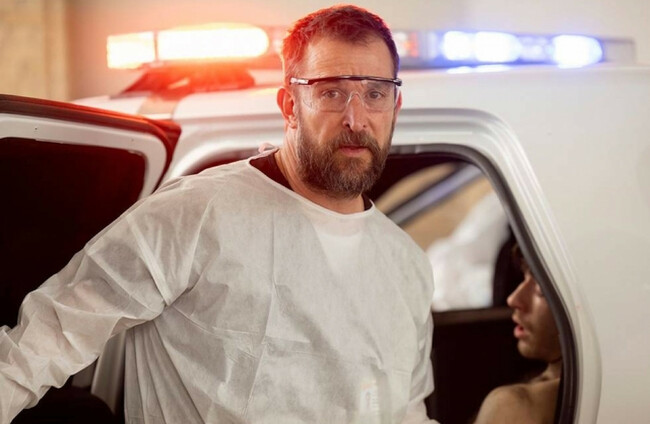
Noah Wyle as Dr Robby in The Pitt.

Review: Is The Pitt worth watching?

We take a closer look at the new series, which was a smash hit in the US.

IF YOU WERE to find yourself in need of hospital care, you could do worse than ending up in the hands of the staff at the emergency department of the Pittsburgh Trauma Medical Center.

The fictional ED is at the centre of new medical drama The Pitt, available to watch now on the streamer HBO Max. This is an American series that’s concerned less with gory injuries than with what it’s like to be on the frontline of providing medical care when the entire health system is under pressure. As such, it’s a scenario that won’t be unfamiliar to Irish viewers, who have been waiting for this hit series to arrive on our screens for over a year. 

The Pitt glides along in the furrow ploughed by 1990s series ER – notably, three of its creators worked on ER, including lead Noah Wyle – and the long-running Grey’s Anatomy.

If you’ve seen any medical drama you’ll know the bare bones of what to expect, but there has to be more than a well-worn formula to make a show draw in over 18 million viewers every week – as The Pitt does in the US – and win multiple Emmys. So what’s The Pitt’s appeal?

Real-time format

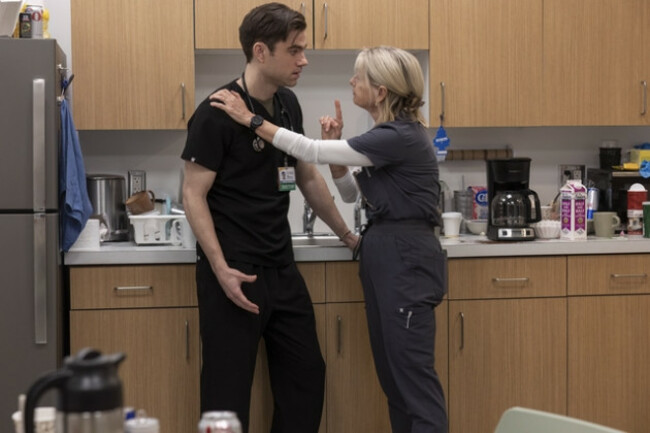
ep-115-sc-14 Dr Frank Langdon (Patrick Ball) and Dana Evans (Katherine LaNasa) in The Pitt. Warrick Page Warrick Page

What makes The Pitt stand out for starters is its format. It’s set across a 15-hour shift at the emergency department, with every episode taking in an hour of the shift. (It takes its cues here from other real-time shows, like 24.)

This is a handy container in which to explore the lives of the ER workers and patients, and gives us viewers the sense that we’re in the room observing as it’s all happening.

At the beginning of episode one, we meet a key character on The Pitt: Dr Michael ‘Robby’ Robinavitch, played by Noah Wyle (who’ll you remember played Dr John Carter in ER back in the 1990s). He’s a middle-aged senior attending physician, what would be known as a consultant in the Irish medical system.

Dr Robby is pensive, the type of guy we might call ‘grizzled’, but also someone who emanates an air of gentle control. As the series progresses, that sense of control is severely tested. Nods to Covid and its impact on medical staff give Dr Robby a backstory that brings a pang to your heart.

In the first episode we’re also introduced to new trainees who are on their first day at The Pitt. This is a clever narrative decision. Because the hospital is a training hospital, procedures are frequently explained by or to these trainees, which means us viewers are never left out of the loop either.

The show is also filmed on a hospital built on a soundstage, with real equipment. There are doctors and nurses on the writing staff too, so you finish each episode with a little more medical knowledge than you did when you started watching. Which might come in handy if you ever get a dog collar glued to your neck, as one patient does. 

Standouts among the cast include Dana Evans (Katherine LaNasa), the fast-talking, all-seeing charge nurse without whom The Pitt could not go on. Unsurprisingly, LaNasa won an Emmy for Supporting Actress in a Drama Series for her role last year.

The four new trainees are also excellent. Isa Briones fizzes as the spiky Dr Trinity Santos, a resident intern whose acerbic wit threatens to annoy all around her. Her opposite is the sensitive, softly-spoken farm boy Dennis Whitaker, played by Welsh actor Gerran Howell, who’s a first year resident doctor. Shabana Azeez imbues her character, medical student Victoria Javadi, with a shaky confidence befitting someone who’s basically a young genius.

Taylor Dearden is wonderful as Dr Mel King, whose intelligence is matched by an endearing awkwardness. She’s one of two neurodivergent characters, the other being her twin sister Becca (played by Tal Anderson). An ally to Dr Mel is Dr Frank Langdon (Patrick Ball), another key character whose story arc has a surprising trajectory.

Shock value?

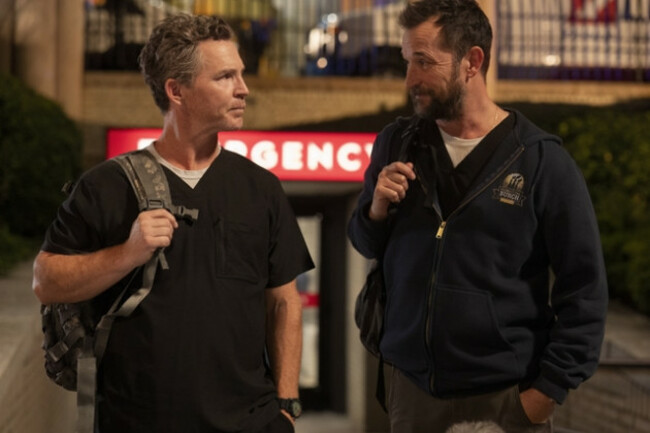
ep-115-sc Shawn Hatosy as Dr Jack Abbott and Noah Wyle as Dr Robby in The Pitt. Warrick Page Warrick Page

The series is crammed with interesting staff and patients, which is where The Pitt runs into some challenges. How can it give us a sense of who each staff member is and what they’re dealing with outside of work, quickly and memorably? And how does it ensure that each patient’s story has a purpose beyond shock value?

The solution is in part some obvious exposition via dialogue, which can chafe against how people talk in reality. In most hospitals, doctors wouldn’t be quite as into discussing the social taboos around illnesses like sickle cell anemia while they’re treating you. If there’s an agenda in The Pitt, it’s to show people that what they’re going through matters. It’s a wink to the viewer to say ‘I see you’. A laudable agenda for sure. 

This means that the exposition, obvious as it might be, feels forgivable. In addition, the viewer is aware of the clever constraints The Pitt has set for itself. Plus, it displays one of The Pitt’s strengths, which is that it is a show crammed full of empathy. The staff are certainly not always kind to each other or even to patients; there is stress around every corner. Some people learn to be more empathetic, others have their cockiness shaken out of them.

But in the world of The Pitt, the patient is king and the medical staff genuinely care about what happens to them. They – and us viewers – know that just like in real life, they’re doing all of this in a system that is never not under pressure. Yet they turn up every day to do their essential job.

The show teases out issues like homelessness and the manosphere in a sensitive way which feels welcome. It’s a show that has lessons to gently impart. There is plenty of blood, and some gory injuries, but it never feels like spectacle. There’s even flashes of humour to be found too. It’s all of these factors combined – entertainment plus empathy – which makes The Pitt such a great, bingeable series. 

The Pitt’s appeal grows the more episodes you consume, and the more the staff members’ personalities are revealed to us. The handheld camera makes us feel like a fly on the wall. We see how the staff remain sympathetic even as some behave awkwardly or awfully. We witness the toll their work takes on them, but how they must just get on with it too.  

It’s this humanity that makes The Pitt shine, and which is surely drawing viewers to it in such a strong way. It’s a show that makes you feel like people care; a show that’s the opposite to what we’re seeing across the news cycle. No matter what horrors await the staff, they don’t shirk from the job they have to do, a job that reverberates across families and communities.

The Pitt, for all of its gross injuries and nauseating rib-cracking, cares about its viewers too. It feels like something special, because it doesn’t talk down to people in any sense. A series set in an emergency department really shouldn’t be this enjoyable to watch, and yet The Pitt deserves every one of the accolades it gets.

Season one of The Pitt is available to watch on HBO Max now. Season two will drop weekly over the coming months.

Close